


Billions of physical objects could benefit from IoT connectivity, but connecting them all remains challenging due to battery limitations, maintenance costs, and infrastructure requirements.
Ambient IoT is an emerging approach that uses energy harvested from surrounding sources, such as radio frequency (RF) signals, light, heat, and motion, to power connected devices. By reducing or eliminating reliance on conventional batteries, it aims to make wireless tracking more scalable, affordable, and easier to maintain.
But how does Ambient IoT work? Does it always mean battery-free technology, and how does it compare with RFID, NB-IoT, and traditional wireless sensors? This guide explores its working principles, communication methods, device types, practical applications, and key deployment considerations.
What Is Ambient IoT?
Ambient IoT is a class of connected devices that primarily use harvested energy from their surrounding environment to power electronic functions and wireless communication.This definition is consistent with ITU-T’s technical analysis which examines its requirements, energy sources, and potential use cases.
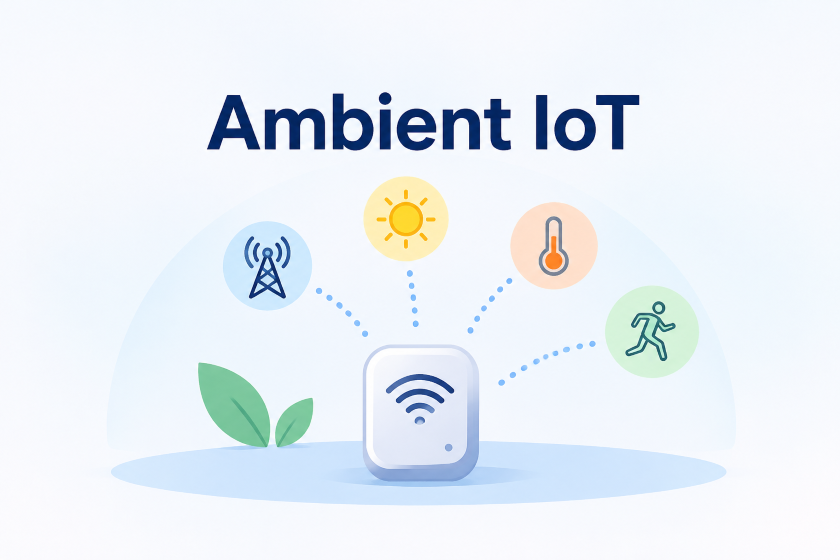
Instead of relying entirely on conventional batteries or wired power, these devices can collect small amounts of energy from available sources, including:
● Radio frequency (RF) energy: Energy captured from surrounding radio waves or dedicated RF transmitters.
● Light energy: Indoor or outdoor light converted into electrical energy through photovoltaic cells.
● Thermal energy: Electricity generated from temperature differences using thermoelectric energy-harvesting components.
● Motion and vibration: Mechanical energy converted into electrical power through electromagnetic or piezoelectric mechanisms.
The harvested energy powers the device’s electronic components, allowing it to perform simple tasks such as identifying an object, measuring an environmental parameter, or transmitting a short wireless message.
Ambient IoT is not necessarily synonymous with battery-free IoT. Some devices operate entirely on harvested energy, while others combine energy harvesting with capacitors or small energy-storage components.
The main objective is to make connectivity practical for objects that would otherwise be too expensive or difficult to maintain using conventional battery-powered IoT architectures.
How Is Ambient IoT Different from Traditional IoT?
Traditional IoT systems commonly use battery-powered or externally powered sensors, wireless modules, and gateways to collect and transmit information.
Ambient IoT introduces a different design philosophy: devices must operate within the energy available from their surroundings. The standardization work is also reflected in 3GPP’s study on Ambient power-enabled IoT (TR 22.840) and its RAN study on Ambient IoT (TR 38.848), which explore the technology from service and radio-access perspectives.
This changes several aspects of device design:
● Power consumption becomes a primary design constraint.
● Communication is often optimized for short messages and intermittent transmission.
● Device functionality may be limited according to available energy.
● Energy-harvesting circuits and power-management systems become essential components.
● Reader or access-point infrastructure may provide communication coverage and, in some architectures, RF energy.
Ambient IoT should therefore be understood as an extension of the broader IoT ecosystem rather than a direct replacement for all conventional IoT devices.
Why Battery-Powered IoT Is Difficult to Scale to Every Object?
Four challenges explain why alternative power architectures are attracting attention:
1.Battery Replacement Requires Ongoing Maintenance
Battery-powered IoT devices need periodic battery replacement to remain operational. When thousands or millions of devices are deployed across warehouses, factories, or supply chains, maintenance becomes increasingly difficult. Technicians must locate devices, replace batteries, and verify their operation, creating additional labor and management requirements.
2. Batteries Limit Device Size and Design
Batteries require physical space and add weight to IoT devices. They also influence product design, manufacturing costs, and installation flexibility. For small objects such as packages, labels, and individual inventory items, integrating a battery may be impractical or unnecessarily expensive, limiting the range of possible IoT applications.
3. Battery Disposal Creates Environmental Pressure
As IoT deployments expand, the number of batteries requiring disposal also increases. Replacing batteries across large device networks creates electronic waste and raises concerns about material consumption, recycling, and environmental impact. Reducing battery dependence can therefore become an important consideration for organizations pursuing more sustainable IoT deployments.
4. Operating Costs Increase with Deployment Scale
The cost of battery-powered IoT extends beyond the initial hardware purchase. Battery procurement, replacement labor, transportation, device downtime, and maintenance management all contribute to long-term operating expenses. As the number of connected objects grows, these recurring costs can make large-scale deployments harder to justify economically.
How Does Ambient IoT Work?
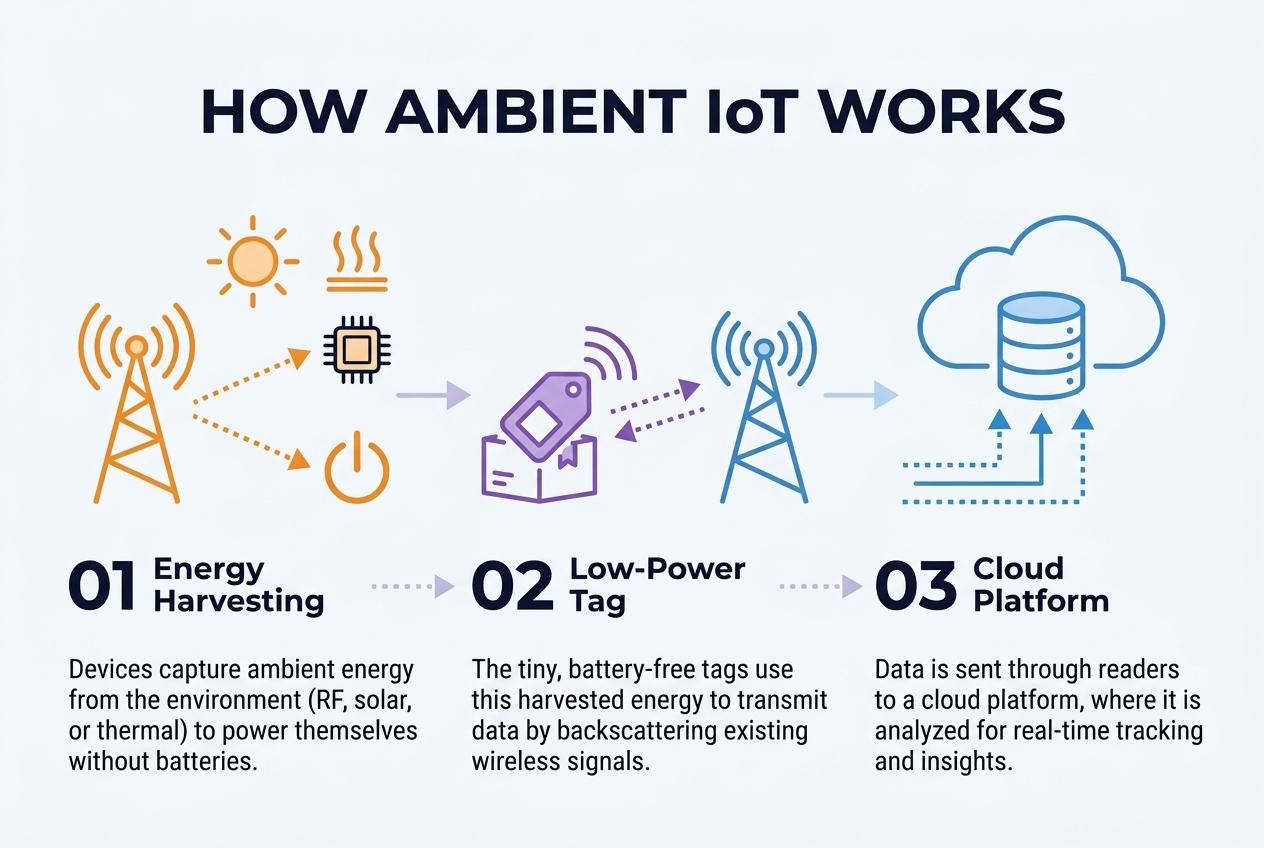
Ambient IoT combines energy harvesting, power management, low-power electronics, wireless communication, and network infrastructure.Although implementations vary, a typical system can be understood through six stages.
1. Energy Harvesting from Ambient Sources
The first step is collecting energy from the surrounding environment.An Ambient IoT device may use different energy-harvesting technologies depending on its deployment conditions.
| Energy Source | How It Works | Potential Applications |
| RF energy | Captures energy from radio frequency signals | Battery-free tags and identification |
| Light | Converts light into electrical energy | Indoor sensors and smart labels |
| Thermal energy | Uses temperature differences to generate electricity | Industrial equipment monitoring |
| Motion | Converts mechanical movement into electricity | Wearables and moving assets |
| Vibration | Converts repeated mechanical vibration into electrical energy | Machinery and industrial monitoring |
Not every energy source is suitable for every environment.For example, indoor solar harvesting depends on light intensity and exposure time, while vibration harvesting requires a sufficiently consistent mechanical energy source.RF energy harvesting also depends on transmitter power, distance, antenna characteristics, and surrounding radio conditions. Practical design considerations for matching harvested energy with device power needs are also discussed in Silicon Labs’ guide to Ambient IoT energy harvesting.
The key consideration is not simply whether energy is available, but whether enough usable energy can be collected to support the device’s intended functions.
2. Power Management and Energy Storage
Harvested energy is often small and unstable. It cannot always be used directly by the device’s electronic components. A power-management circuit helps convert and regulate the collected energy. A typical power-management system may include:
● Rectification: Converts harvested AC or RF-derived energy into a usable electrical form when required.
● Voltage regulation: Adjusts the voltage to match the requirements of electronic components.
● Energy storage: Uses capacitors or other storage elements to accumulate energy.
● Power management: Controls how available energy is distributed among sensing, processing, and communication functions.
The device may remain in an ultra-low-power state while energy accumulates. Once the stored energy reaches a predefined operating threshold, the system can activate selected components. This energy-aware operation is important because Ambient IoT devices cannot assume that power will always be available.
3. Low-Power Sensing and Processing
After sufficient energy becomes available, the device can activate its sensor, processor, or other electronic components.Depending on the application, it may:
●Read a device identifier.
●Measure temperature or humidity.
●Detect movement or a change in status.
●Process a small amount of sensor data.
●Prepare a short wireless message.
The amount of processing depends on the available energy budget.A simple identification tag may require very little computation, while a device that performs multiple sensor measurements and local data processing needs a more capable power architecture.
For this reason, Ambient IoT devices are generally better suited to lightweight sensing and intermittent data reporting than continuous, high-performance processing.
4. Wireless Data Transmission
Once the data is ready, the device communicates with a nearby receiver. Two important communication approaches are active transmission and backscatter communication. An active-transmission device uses harvested energy to generate and transmit its own wireless signal.
A backscatter device, by contrast, relies on an external carrier signal. It communicates by changing how the carrier is reflected or modulated, allowing a reader to detect the encoded information. The choice depends on device complexity, available energy, communication requirements, and reader infrastructure. These two approaches are explained in greater detail below.
5. Data Collection by Readers and Network Infrastructure
A nearby smartphone, access point, reader, base station, or dedicated gateway may receive the transmitted information, depending on the communication technology. The receiver is responsible for collecting the data and forwarding it to the next stage of the IoT system.
Some systems may use existing communication infrastructure, while others require dedicated readers or additional RF energy transmitters. This is an important deployment consideration: reducing the power requirements of individual tags does not necessarily eliminate the need for network infrastructure.
6. Data Transmission to the Cloud
After data collection, a gateway or other network-connected receiver can forward the information to a cloud platform through Wi-Fi, Ethernet, cellular connectivity, or another supported network connection. The cloud platform can then process the information and make it available to business applications.
For example, a warehouse management system may use Ambient IoT tag data to update inventory records, identify asset movements, or support stock reconciliation. The complete data path can be summarized as:
Ambient Energy → Power Management → Sensing and Processing → Wireless Communication → Reader or Gateway → Cloud Platform → Business Application
The exact architecture varies according to the communication standard and deployment requirements. Not every Ambient IoT system uses the same reader or gateway configuration.
The Real Value of Ambient IoT
Ambient IoT is valuable because it addresses a fundamental limitation of large-scale connectivity: the cost and complexity of powering and maintaining individual devices. Its potential advantages extend beyond battery reduction.
1. Zero-Battery and Reduced Maintenance
The most visible advantage is the possibility of operating devices without conventional batteries. When a device can collect enough energy from its environment, it may operate without periodic battery replacement.
This is particularly useful for devices attached to packages, products, or components that are difficult to access after deployment.However, zero-battery operation is not guaranteed in every environment. Some devices still require energy storage or alternative power sources to maintain reliable operation.
2. Lower Total Cost at Scale
Ambient IoT can reduce recurring maintenance expenses by minimizing battery replacement and simplifying device design. For large deployments, even small reductions in maintenance requirements may have a meaningful effect on total operating costs.
For example, a logistics company managing thousands of tagged assets may benefit from reducing the labor required to inspect and replace batteries. The economic benefit should be evaluated through a full TCO model rather than device price alone. Reader infrastructure, installation, system integration, and maintenance of network equipment must also be included.
3. Leveraging Existing Infrastructure
Some Ambient IoT architectures can make use of existing wireless infrastructure or communication networks. For example, compatible Bluetooth beacons, smartphones, or dedicated readers may serve as data collection points, depending on device capabilities and network design.
Other architectures may use dedicated RF transmitters or specialized readers.Leveraging existing infrastructure can help reduce deployment complexity, but compatibility must be verified. A conventional Bluetooth gateway, for example, should not automatically be assumed to support every Ambient IoT device or communication mechanism.
4. Continuous End-to-End Visibility
Ambient IoT can make it more practical to attach identifiers and lightweight sensing capabilities to a much larger number of physical objects. This can improve visibility across supply chains, warehouses, and industrial environments.
For example, connected labels on packages could provide identification and periodic status information at different points in a logistics network.However, continuous end-to-end visibility does not necessarily mean continuous real-time tracking. Energy availability, reader coverage, transmission intervals, and network connectivity determine how frequently data can be collected.
5. Dynamic Sensing Capability
Ambient IoT devices can adapt their behavior according to available energy.
For example, a device may reduce its transmission frequency when harvested energy is low, prioritize essential sensor readings, or remain in a low-power state until sufficient energy becomes available. This energy-aware approach allows devices to balance performance and power consumption.
It also introduces an important design consideration: applications must be able to tolerate variable reporting intervals and intermittent connectivity when using energy-constrained devices.
Active Transmission vs. Backscatter Communication
Active transmission and backscatter communication are two different approaches to wireless data transfer. Understanding the difference is essential when evaluating Ambient IoT devices because communication architecture directly affects device complexity, energy consumption, coverage, and receiver design.
Active Transmission
An active-transmission device uses its available energy to generate and transmit a wireless signal. The energy may come from harvested environmental sources, stored energy, or a combination of both.
The device typically includes a radio transmitter capable of generating the signal required to send its data.
How it works:
1.The device collects and stores energy.
2.Its processor prepares the data.
3.The radio circuit generates a wireless signal.
4.The receiver detects and decodes the transmitted information.
Active transmission can support more flexible communication architectures, but generating a wireless signal generally requires more energy than simply modulating an existing carrier.
Backscatter Communication
Backscatter communication uses an external radio frequency carrier rather than generating an entirely new RF signal.
The device changes its antenna impedance or reflection characteristics to modulate the incoming carrier. A reader detects these changes and decodes the transmitted data.
Two common configurations are:
● Monostatic backscatter: The same reader provides the carrier signal and receives the backscattered response.
● Bistatic backscatter: Separate nodes provide the carrier signal and receive the backscattered data.
The distinction affects reader placement, system architecture, link budget, and deployment requirements.
Active Transmission vs. Backscatter: Key Differences
| Workplace Dimension | Active Transmission | Backscatter Communication |
| Signal generation | Device generates its own RF signal | Device modulates an external carrier |
| Energy requirements | Generally higher for RF transmission | Can be substantially lower |
| Device complexity | Requires an active transmitter | Uses a modulation and reflection mechanism |
| Reader requirements | Requires a compatible wireless receiver | Requires carrier generation and backscatter reception |
| Deployment | Depends on transmitter power and receiver sensitivity | Depends on carrier availability, reflection strength, and reader geometry |
| Potential applications | Energy-harvesting sensors and wireless tags | Passive identification and low-power sensing |
An important distinction: Battery-free does not automatically mean backscatter. A battery-free device can use other communication designs, while a backscatter device still depends on suitable external RF conditions.
Ambient IoT Device Classes and Capability Levels
Ambient IoT does not describe one fixed device specification. Devices can have different energy sources, storage capabilities, sensing functions, and communication architectures.
For practical understanding, they can be grouped into three capability categories.
1. Passive Devices
Passive devices rely entirely on harvested ambient energy or externally supplied RF energy, without a conventional battery. They are generally designed for:
●Basic identification.
●Short data messages.
●Simple sensing functions.
●Low-cost and high-density deployments.
Because their energy budget is extremely limited, their functionality and communication opportunities may be restricted.
2. Semi-Passive Devices
Semi-passive devices combine energy harvesting with limited energy storage, such as a capacitor or small battery. This architecture allows them to accumulate energy and use it when necessary. Depending on the design, they may support:
●Basic sensing and data buffering.
●More flexible transmission timing.
●Limited bidirectional communication.
●Intermittent operation when ambient energy is unavailable.
This category provides a compromise between low-power operation and functional flexibility.
3. Active Devices
Active devices have greater energy-storage capacity or access to a more substantial energy supply. They may support more advanced functions, including:
●Multiple sensor measurements.
●More extensive local processing.
●More flexible wireless transmission.
●Higher communication performance.
However, they may also require larger components, higher manufacturing costs, and more complex power-management systems. These three categories are an explanatory capability framework rather than a claim that all standards bodies use one universal three-class classification. The appropriate architecture depends on the application’s energy availability, reporting frequency, sensing requirements, and expected device lifetime.
Ambient IoT vs. RFID, NB-IoT, and Conventional Sensors
Ambient IoT is often compared with RFID, NB-IoT, and traditional wireless sensors because these technologies address overlapping connectivity requirements. However, they are not direct substitutes in every application.
The most important differences involve power sources, data capabilities, reader requirements, communication range, ecosystem maturity, and deployment costs.
Technical Comparison
| Dimension | Ambient IoT | RFID | NB-IoT | Conventional Wireless Sensors |
| Power Source | Harvested ambient energy, sometimes with limited storage | Passive, battery-assisted, or active depending on tag type | Usually a battery or external power source | Usually a battery or external power |
| Data Richness | Primarily identification and lightweight sensing | Primarily identification and limited data, depending on tag | Supports sensor data and broader cellular IoT applications | Supports richer sensor data depending on device |
| Reader Requirement | Compatible readers, access points, or network nodes | RFID readers | NB-IoT cellular network infrastructure | Compatible gateways or access points |
| Communication Range | Depends on energy source, RF architecture, and receiver design | Depends on frequency band, tag type, antenna, and reader | Cellular coverage, depending on network deployment | Depends on wireless protocol, power, and environment |
| Standardization & Ecosystem | Developing across multiple technology ecosystems | Mature standards and established ecosystems | Established 3GPP cellular technology | Varies by protocol and manufacturer |
| Deployment & Maintenance Effort | Potentially lower tag maintenance, but infrastructure is still required | Passive tags need no battery replacement; readers are required | Network connectivity and power management must be maintained | Battery replacement or charging may be required |
| Device Complexity & Capability | Ranges from simple tags to more capable energy-harvesting devices | Varies from simple passive tags to active systems | More complex cellular communication capabilities | Varies widely with sensors and communication modules |
| Primary Target Use Cases | Massive low-maintenance identification, tracking, and lightweight sensing | Inventory identification, access control, and item-level tracking | Wide-area, low-power cellular monitoring | Environmental monitoring, equipment monitoring, and industrial sensing |
Ambient IoT Applications
Ambient IoT is particularly relevant to applications where large numbers of physical objects need to be identified or monitored without introducing substantial battery maintenance requirements.
1. Supply Chain and Logistics
Supply chains involve large numbers of packages, containers, pallets, and products moving through different facilities. Traditional tracking systems often depend on barcode scanning, RFID, or battery-powered tracking devices.
Ambient IoT could enable low-cost identification and lightweight sensing tags to be attached to more individual items. The actual tracking experience depends on reader coverage and the communication technology used.
2. Inventory and Asset Tracking
Warehouses and manufacturing facilities need accurate information about inventory locations and asset movements. Asset trackers can introduce recurring maintenance requirements, particularly when thousands of devices are deployed.
Ambient IoT tags could provide a more scalable approach for applications that require basic identification or intermittent status updates. For example, a warehouse could use energy-harvesting tags on selected products, containers, or reusable transport items. Readers installed at designated locations could collect tag information as assets move through the facility.
For applications requiring precise real-time positioning, however, the system may still need additional location infrastructure or more capable tracking devices.
3. Cold Chain Monitoring
Cold chain operations require humidity & temperature sensors to remain within defined environmental conditions throughout storage and transportation. Ambient IoT may support lightweight temperature monitoring in selected applications, provided that the device has sufficient energy to perform measurements and transmit data at the required intervals.
For example, an energy-harvesting tag could collect periodic temperature readings from a package and communicate them when a compatible reader is available.
However, applications requiring continuous temperature monitoring, immediate threshold alarms, or guaranteed reporting intervals may need a more capable powered sensor.
The required measurement accuracy, sampling frequency, energy budget, and communication coverage should be evaluated before selecting a device architecture.
4. Industrial and Environmental Monitoring
Industrial environments contain many assets and components that require monitoring.
Ambient IoT could support simple identification and selected monitoring functions in locations where wiring or regular battery replacement is inconvenient. The availability of ambient energy is especially important in these environments.
For example, vibration harvesting may be practical near continuously operating machinery, while thermal harvesting requires a suitable and sufficiently stable temperature difference.
More demanding industrial applications may still require conventional sensors with larger power budgets and more advanced processing capabilities.
Conclusion
Ambient IoT offers a new approach to connecting everyday objects by using harvested energy to reduce dependence on conventional batteries. Its potential benefits include lower maintenance costs, more flexible device designs, and scalable wireless connectivity. However, practical deployment still depends on energy availability, communication range, infrastructure, and security. As technologies and standards continue to evolve, Ambient IoT could play an increasingly important role in asset tracking, inventory management, and supply chain visibility.