


Quick Answer:
The AoA vs UWB decision mainly depends on how much positioning accuracy the application needs. UWB is usually the better fit when centimeter-level precision matters for automation, safety, access control, or high value assets. Bluetooth AoA is often more suitable when sub-meter accuracy is enough and large numbers of battery powered tags need to be deployed. Neither is better for every project. The right choice is the one that meets the required accuracy at a reasonable system cost.
Why Indoor Positioning Has Become Core IoT Infrastructure
A warehouse knows which products entered the building. A hospital knows how many infusion pumps it owns. A factory knows which tools were assigned to a production line.
The harder question is often simpler:
Where are they right now?
IoT systems can report status, temperature, vibration, and battery level. Location adds the context needed to act on that data, helping teams find equipment faster, track asset movement, and detect when assets enter the wrong area.
Demand is also growing. According to the market trends for Bluetooth location services solutions, The Bluetooth SIG forecasts annual Bluetooth Location Services device shipments to grow 2.68 times from 2024 to 2028. As location becomes more important to IoT operations, choosing the right level of positioning accuracy becomes a key RTLS decision.
UWB vs Bluetooth AoA: Understanding the Difference
UWB and Bluetooth AoA can both produce precise indoor positions, but they measure different properties of a radio signal.
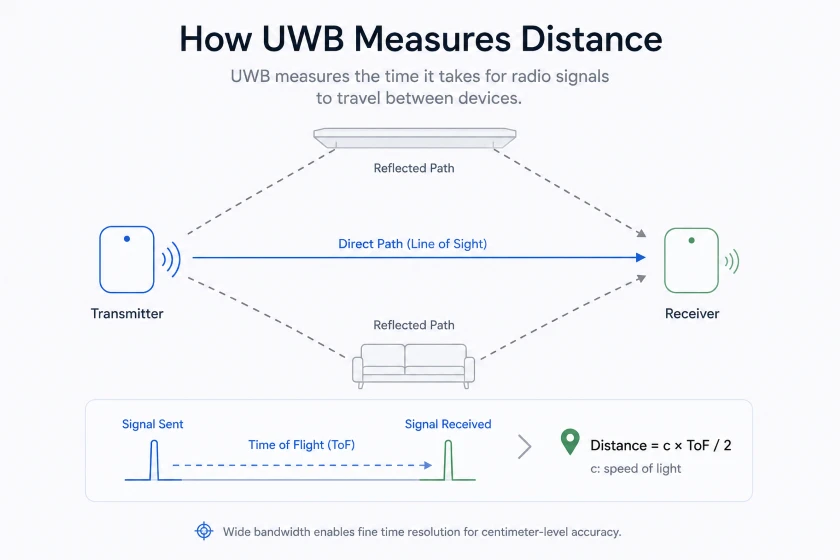
How UWB Measures Distance
UWB calculates distance by measuring how long radio signals take to travel between devices. Its wide bandwidth provides fine time resolution, helping the receiver distinguish direct signals from reflected paths. This supports centimeter-level ranging and makes UWB well suited to indoor environments where precise distance measurements are required.
How Bluetooth AoA Measures Direction
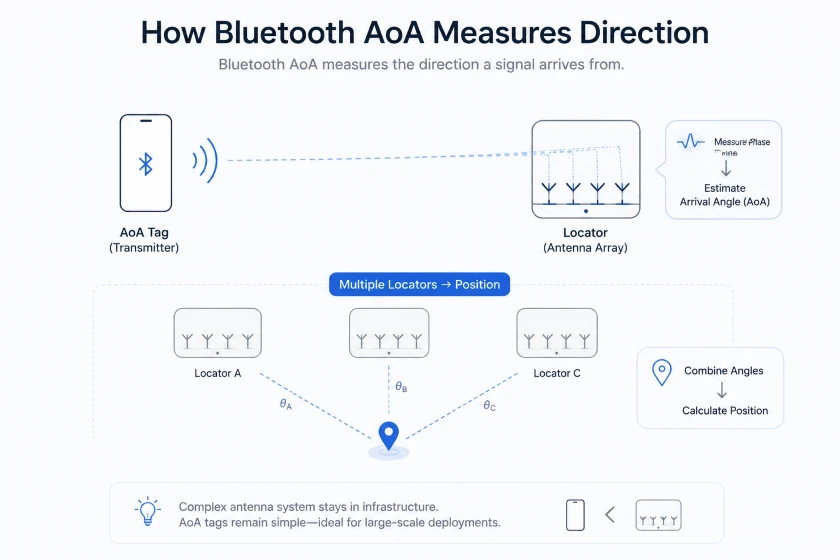
Bluetooth AoA measures the direction from which a Bluetooth signal arrives rather than its travel time. A mobile device transmits a Bluetooth Direction Finding signal, while a fixed locator uses an antenna array to collect phase information and estimate the arrival angle. Multiple locators can combine these measurements to calculate position. Because the more complex antenna system stays in the fixed infrastructure, AoA tags can remain relatively simple, which is useful for large-scale deployments.
AoA vs UWB Performance: What Changes in the Real World?
Datasheet accuracy is only part of the picture. In real deployments, walls, metal racks, machinery, people, and locator placement can all affect positioning performance.
| Performance Factor | UWB | Bluetooth AoA |
| Typical positioning accuracy | Often around 10 to 30 cm in well designed industrial systems | Often sub-meter, but results depend strongly on system design and environment |
| Multipath Resistance | Strong. Wide bandwidth helps separate direct and reflected signal paths | More sensitive to reflections, especially in metal rich environments |
| Security and Ranging Integrity | Strong when secure ranging features are properly implemented | Bluetooth communication can be secured, but AoA itself is not a secure distance bounding method |
| Power consumption | Can be higher when frequent ranging is required, depending on ranging mode and update rate | Often well suited to battery powered tags because the mobile device can remain relatively simple |
| Infrastructure requirements | Requires UWB tags, anchors, positioning software, and sometimes synchronization | Requires compatible tags, AoA locators with antenna arrays, and a positioning engine |
| Coverage planning | Depends on anchor geometry, line of sight, mounting, and required accuracy | Depends heavily on locator field of view, antenna geometry, mounting, and RF conditions |
| Update rate | Suitable for fast moving assets and applications that need frequent position updates | Suitable for real-time tracking, although higher update rates can increase power and processing demands |
| Best fit | Applications where centimeter-level location affects safety, automation, or access decisions | Large-scale tracking where sub-meter accuracy and lower tag complexity are more important |
Cost vs Complexity: Understanding RTLS Deployment Costs
RTLS cost goes beyond tag prices and includes infrastructure, installation, networking, software, calibration, maintenance, battery replacement, and system integration.
Bluetooth AoA Cost Structure
Bluetooth AoA can be attractive when the project contains a very large number of tracked assets.
IoT beacons or trackers can remain relatively simple because the antenna array and more complex signal processing sit on the infrastructure side.
Typical AoA deployment costs include:
• Bluetooth AoA tags or devices that support the required Direction Finding role.
• Fixed AoA locators with antenna arrays.
• Power and data connectivity for locators.
• Positioning software or an edge positioning engine.
• Site calibration and locator configuration.
• Integration with asset management, hospital, warehouse, or facility software.
The economics often improve as tag quantity rises because infrastructure cost is shared across more tracked devices.
UWB Cost Structure
A UWB RTLS normally requires UWB capable hardware at both sides of the ranging system.
Typical project components include:
• UWB tags or badges.
• Fixed UWB anchors.
• Synchronization infrastructure when required by the chosen ranging architecture.
• Gateways or network connections.
• Positioning software.
• Installation and site validation.
• Integration with business systems.
UWB radio hardware can cost more than simple Bluetooth hardware. Infrastructure may also become more demanding when high accuracy must be maintained throughout a complex facility.
The key question is not whether UWB costs more per device.
The question is whether centimeter-level positioning removes enough operational cost or risk to justify the additional system expense.
Hidden Costs Buyers Often Miss
Hidden costs can include ceiling installation, power and network cabling, calibration after site changes, software integration, and battery maintenance. For large deployments, these operating costs may matter more than the initial tag price, so buyers should compare total ownership cost rather than hardware cost alone.
Industry Use Cases: Where UWB and AoA Fit Best
Accuracy should always follow the operational problem.
The following scenarios show where each technology tends to make sense.
Smart Manufacturing: UWB for Machine Level Precision
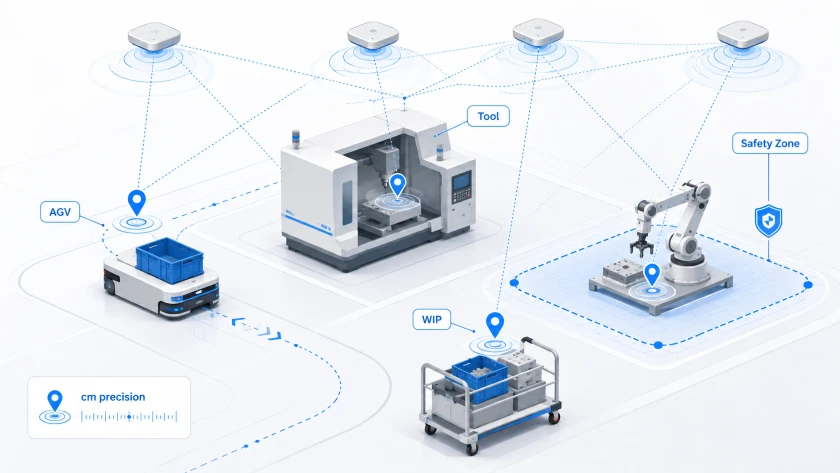
In smart manufacturing, UWB fits applications such as AGV positioning, production tool tracking, work in progress tracking, and precise safety zones. When location data directly affects machine movement or automated decisions, centimeter-level accuracy can justify the additional infrastructure.
Mining and High Risk Industrial Sites: Precision With Careful Certification
UWB can support precise personnel, vehicle, and equipment positioning in mines and other difficult industrial environments. In hazardous areas, however, positioning performance must be considered together with required electrical, environmental, and explosion protection certifications.
High Value Asset Protection: UWB Where Boundaries Must Be Precise
UWB is useful for high value asset protection when the system must distinguish movement near a boundary from an actual exit or restricted zone entry. More precise positioning can reduce false alerts around doors, storage areas, and controlled zones.
Hospital Asset Management: AoA Can Balance Scale and Precision
Hospitals often need to track thousands of mobile assets without requiring centimeter-level accuracy for every device. Bluetooth AoA can provide a useful balance between sub-meter positioning, tag cost, and deployment scale, while UWB can be reserved for selected assets that need tighter positioning in smart hospital.
Smart Offices: AoA for People, Equipment, and Space Operations
Smart offices often need room, desk, or area level visibility rather than exact centimeter coordinates. AoA can support shared equipment tracking, space utilization, emergency mustering, and other location aware workflows, with appropriate privacy controls for people tracking.
How to Choose Between AoA and UWB
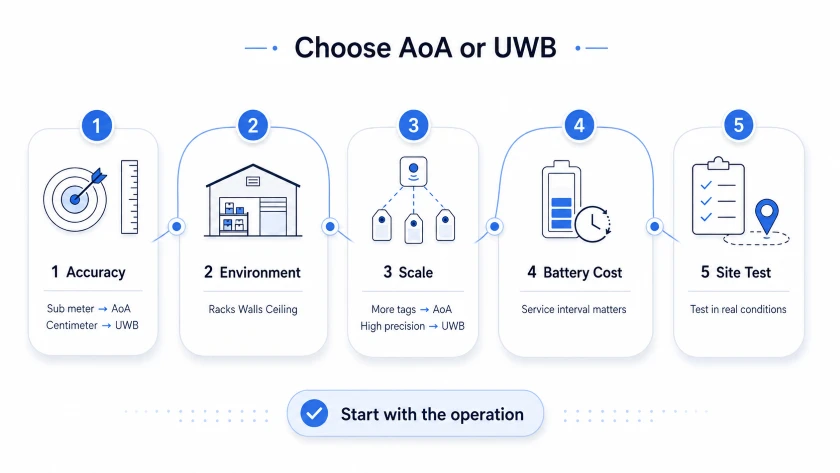
A useful selection process starts with the business operation, not the radio.
Step 1: Define the Accuracy You Really Need
Start with the smallest location difference that changes a business decision. If sub-meter accuracy is enough, AoA may fit. If the application depends on centimeter-level positioning, UWB is usually the stronger candidate.
Step 2: Evaluate the Physical Environment
Check metal racks, machinery, walls, ceiling height, corridors, and mounting options. The real RF environment can affect positioning performance much more than laboratory results suggest.
Step 3: Compare Tag and Infrastructure Scale
Compare tag volume and fixed infrastructure separately. AoA can become more economical at large tag volumes, while UWB is easier to justify when fewer assets need much higher precision.
Step 4: Include Battery Maintenance in the Cost
Include battery replacement, labor, downtime, and access difficulty in the cost model. Small differences in service intervals become significant across thousands of tags.
Step 5: Validate the Design With a Site Test
Test the system in the real operating environment before full deployment. Use planned mounting positions and normal obstacles, then measure both typical accuracy and weak areas.
The Future of RTLS: Channel Sounding and Hybrid Positioning
Bluetooth Channel Sounding, introduced with Bluetooth Core 6.0, adds standards based distance measurement to the Bluetooth ecosystem. Unlike AoA, which measures direction, Channel Sounding measures distance using phase-based ranging and round-trip timing. It gives RTLS designers another option for precise positioning rather than simply replacing AoA or UWB. Hybrid systems are also becoming more practical. Bluetooth can provide broad coverage or low-power discovery, while UWB can be activated in areas that require centimeter-level precision. Instead of using the highest precision technology everywhere, businesses can apply it only where smaller positioning errors create real operational value.
Conclusion: Choosing Between AoA and UWB
The AoA vs UWB decision should start with the accuracy the business process actually requires. UWB is usually the better choice when centimeter-level positioning directly affects safety, automation, or asset protection. Bluetooth AoA is often a better fit for large-scale tracking where sub-meter accuracy is sufficient. The best RTLS is not the one with the highest precision, but the one that delivers enough precision for the job at a sustainable total cost.
 Chat now