


Coverage is rarely a problem when an IoT device sits inside a city. Move the same device onto a fishing vessel, a remote pipeline, an isolated farm, or a piece of equipment far from a mobile tower, and connectivity can become the hardest part of the project.
That is where satellite IoT becomes useful.
Satellite connectivity gives IoT devices another way to send data when terrestrial networks cannot provide reliable coverage. In some systems, the device talks directly to a satellite. In others, satellite is used as backhaul for a local gateway. A third approach combines cellular and satellite so an asset can switch between them as its location changes.
This does not mean every remote IoT project should use satellite. Message size, reporting frequency, battery life, antenna placement, service cost, and coverage all affect the final choice.
Understanding those tradeoffs is the key to using satellite IoT well.
What Is Satellite IoT?
Satellite IoT refers to IoT systems that use satellite communication for part or all of the connection between field devices and business applications.
The basic purpose is simple. It extends connected sensing and asset visibility beyond places served by cellular towers, Wi-Fi, wired networks, or other terrestrial infrastructure.
A satellite connected device might report:
• GPS location
• Tank or water level
• Temperature and humidity
• Pressure
• Equipment status
• Soil or environmental conditions
• Alarm events
Most satellite IoT applications do not need to move large files. They often depend on short, useful messages sent at planned intervals.
This is one reason satellite connectivity fits remote monitoring so well. The business may not need a constant stream of data. It may only need to know that an asset is still operating, where it is, or whether a value has crossed a limit.
The Differences between Satellite IoT and Traditional IoT
Satellite and terrestrial IoT should not be viewed as competing answers to the same question.
Cellular IoT is often the practical choice when assets stay inside reliable mobile coverage. Satellite becomes more attractive when those assets operate offshore, across remote land, or through areas where cellular service is inconsistent. The comparison below reflects the main deployment factors in the project brief.
| Decision factor | Cellular or terrestrial IoT | Satellite IoT |
| Coverage | Depends on local network infrastructure | Can reach remote land, offshore areas, and terrestrial coverage gaps |
| Data pattern | Well suited to frequent reporting and larger data volumes | Often suited to periodic reports and smaller messages |
| Installation | Needs suitable terrestrial coverage | Needs compatible satellite service and suitable antenna conditions |
| Power and cost | Often practical for frequent communication | Requires close attention to transmit power, service cost, and hardware |
| Typical use | Cities, buildings, factories, urban fleets | Maritime, agriculture, energy, remote assets, environmental monitoring |
The important point is that wider coverage comes with design tradeoffs. A satellite link may solve a coverage problem while creating new questions about power, antenna position, transmission time, and data cost.
How Does Satellite IoT Connectivity Work?
A typical satellite IoT data path looks like this:
Sensor → communication module → antenna → satellite network → ground infrastructure → cloud platform → application
The details vary by system.
A remote level sensor, for example, may wake at scheduled times, collect a reading, and prepare a small message. Its communication module sends that message through the satellite network. The data then reaches a cloud service, where it can appear in a dashboard or trigger an alert.
If the device cannot send the message immediately, a well designed system may store it and try again later.
This matters because satellite communication depends on more than device location. Antenna orientation, surrounding structures, terrain, satellite availability, and network design can all affect the link.
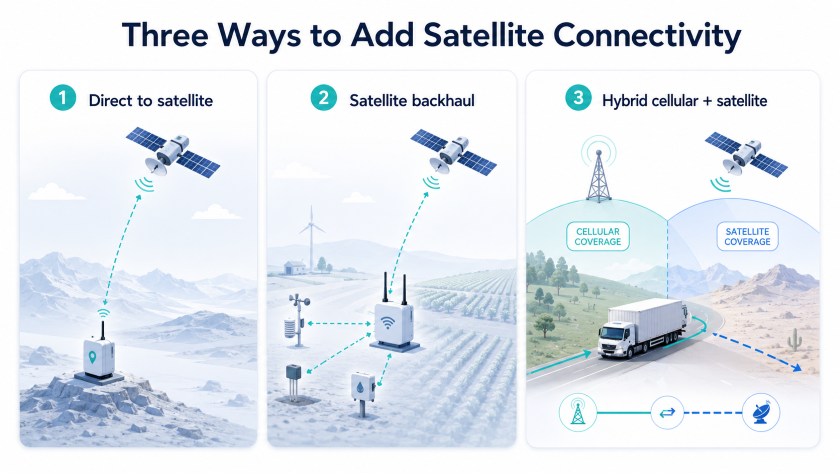
Three Ways to Add Satellite Connectivity
Satellite can enter an IoT architecture in more than one place.
Direct to satellite
The device itself includes the radio and antenna needed to communicate with a satellite network.
This approach is attractive when individual assets are spread across large remote areas and cannot depend on nearby infrastructure.
Satellite backhaul
Local sensors first connect to a nearby gateway. The gateway then sends their data through a satellite link.
This can be a practical architecture for a remote site with many local sensors, such as an energy installation, agricultural site, or isolated facility.
Hybrid cellular and satellite
The device uses cellular connectivity when it is available and satellite when terrestrial coverage is lost.
GSMA guidance identifies hybrid cellular and non-terrestrial connectivity as an important model for extending IoT services beyond terrestrial network boundaries.
This approach can make particular sense for vehicles, containers, and mobile equipment that spend much of their time inside cellular coverage but sometimes enter blind spots.
Key Technologies Behind Satellite IoT
Satellite IoT is not tied to one wireless standard. Several technologies can support different types of connected devices.
Direct to satellite LoRaWAN
LoRaWAN was designed for IoT applications that need long range communication with low power use. It is commonly associated with small sensor messages rather than high bandwidth traffic.
Satellite networks can extend this model by placing LoRaWAN gateway capability on satellites. The LoRa Alliance notes that LEO satellite gateways can communicate with suitable LoRaWAN sensors over long line of sight distances.
For applications such as environmental sensing or remote agriculture, this model can be attractive because the value often comes from small measurements rather than large data streams.
NB-IoT over NTN
NB-IoT is also moving beyond terrestrial networks.
3GPP Release 17 introduced standardized support for NB-IoT and eMTC over Non-Terrestrial Networks. This work helps bring satellite communication into the wider cellular IoT ecosystem.
For solution designers, standards based NTN can make it easier to think about cellular and satellite as parts of one connectivity strategy rather than two completely separate systems.
Modules and antennas still matter
A satellite capable module does not guarantee a successful deployment.
The hardware design must also account for antenna placement, power supply, enclosure materials, installation angle, message scheduling, retries, and local data storage.
This is especially important for battery-powered products. Radio transmission is usually one of the more energy demanding operations in a sensor, so the reporting strategy can have a direct effect on operating life.
Where Does Satellite IoT Deliver the Most Value?
The strongest applications tend to share one feature: the asset matters, but terrestrial coverage cannot be assumed.
The right connectivity strategy depends mainly on coverage, reporting frequency, data volume, and how the asset moves between network environments.
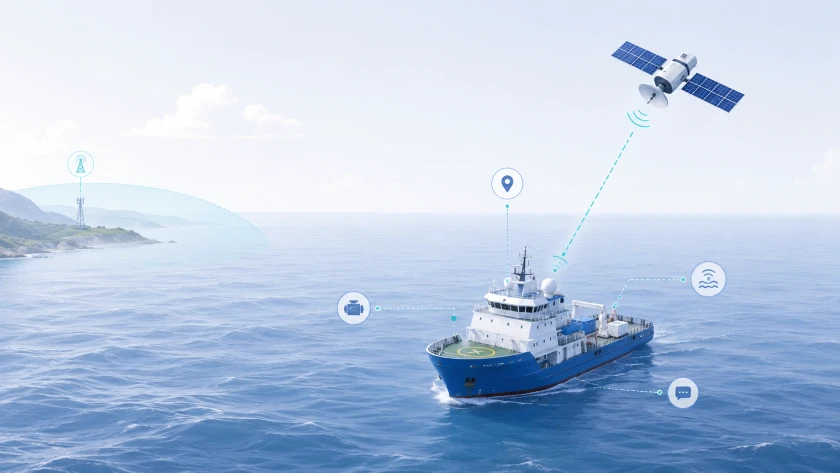
Maritime and vessel monitoring
Once a vessel moves away from the coast, terrestrial mobile coverage becomes less dependable.
Satellite IoT can support vessel location, equipment status, environmental sensing, and selected operational messages without relying on a nearby cell tower.
Agriculture and environmental monitoring
Fields, forests, rivers, reservoirs, and weather stations may sit far from communications infrastructure.
Satellite connected sensors can make it possible to collect selected field data without building a terrestrial network across the entire area.
Energy and utilities
Pipelines, wells, substations, renewable energy assets, and utility infrastructure are often spread across large territories.
In these applications, a small status message may be enough to show that an asset is operating normally or that a field inspection is needed.
Logistics and asset tracking
Containers, vehicles, trailers, and industrial equipment rarely remain in one network environment.
An asset may move from a city to a rural road, then to a port or offshore route. Hybrid connectivity can help reduce the gaps in visibility between those locations.
What Are the Main Benefits of Satellite IoT?
The first benefit is obvious: coverage beyond terrestrial networks.
The more useful business benefits come after that.
Satellite IoT can give operations teams better visibility into remote assets. It can reduce dependence on manual checks. It can help detect abnormal conditions earlier. It can also keep selected data moving when cellular coverage disappears.
Satellite can also support a second communication path in a hybrid system. GSMA describes NTN as a complement to terrestrial mobile infrastructure, particularly for remote and underserved areas.
That word, complement, is important.
For many IoT deployments, the goal is not to replace cellular. It is to remove the blind spots that cellular alone cannot cover.
Satellite IoT vs Cellular IoT: Which Should You Choose?
A good connectivity decision starts with the asset, not the network logo.
The outline provides a useful decision pattern based on coverage, reporting needs, and asset movement.
| Your operating condition | Strategy to evaluate first |
| Reliable urban coverage and frequent data reporting | Cellular IoT |
| Remote site with small, periodic messages | Satellite IoT |
| Mostly cellular coverage with occasional blind spots | Hybrid cellular and satellite |
| Offshore operation or movement across many network regions | Satellite led or hybrid connectivity |
| Large images, audio, or other high bandwidth data | Evaluate the specific satellite service in detail |
Before committing to satellite connectivity, answer six questions:
1. Where will the device actually operate? Check service coverage for the real deployment area.
2. How much data must it send? A location update and an image have very different requirements.
3. How often must it report? Reporting every few minutes can change both power use and service cost.
4. How will the device be powered? Battery-powered assets need a realistic energy budget.
5. Where will the antenna be installed? Enclosures, metal, buildings, terrain, and sky visibility can affect performance.
6. What happens when transmission fails? Decide whether the device should retry, store the message, or wait for the next reporting window.
These questions usually reveal more than a coverage map alone.
Conclusion
Satellite connectivity changes where IoT can operate, but it does not remove the need for careful system design.
A remote sensor still needs the right reporting interval. The antenna still needs a suitable installation position. The device still needs enough power. The application still needs a plan for delayed or missing messages.
That is why satellite IoT works best when the project starts with a simple question:
What information must this asset send when terrestrial connectivity is not available?
If the answer is a small, valuable piece of operational data, satellite may be a very good fit.
If the asset already has reliable cellular service and sends frequent or bandwidth heavy data, terrestrial connectivity may remain the better choice.
And when an asset moves between both worlds, a hybrid approach can often provide the most practical balance.
Satellite IoT is not about putting every connected device on a satellite network. It is about keeping the right assets visible when ordinary networks stop reaching them.
 Chat now