
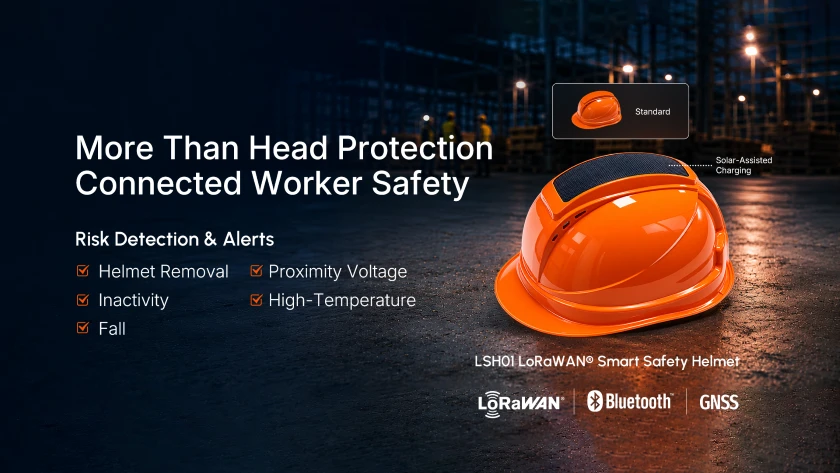
Safety helmets provide essential physical protection, but conventional helmets offer limited information about what is happening to personnel during operation. They cannot indicate whether a helmet has been removed, whether personnel have remained inactive or experienced a potential fall, whether someone is approaching a voltage source, or whether assistance has been requested.
These limitations become more significant when personnel move between outdoor work areas, indoor facilities, tunnels, underground zones, and restricted areas during the same shift. Safety teams need clearer location visibility and more direct information about personnel status and safety events.
Minew has launched the LSH01 LoRaWAN Smart Safety Helmet, combining outdoor GNSS positioning, Bluetooth-based indoor positioning, five safety detection functions, on-device voice alerts, location and event reporting, support for platform-based geofencing, and a dedicated SOS button in a single wearable product.
Maintain Location Visibility Across Changing Work Areas
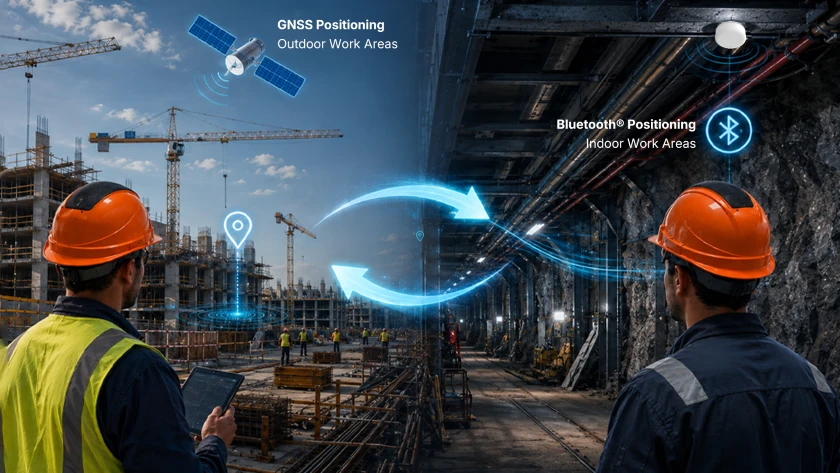
Personnel may move between open sites, enclosed facilities, tunnels, and underground areas as daily tasks change. Relying on a single positioning method can leave gaps when personnel move from one environment to another.
LSH01 uses GNSS for outdoor positioning and Bluetooth for indoor positioning. It automatically switches between the two positioning methods as the operating environment changes, allowing personnel to continue using the same helmet across different work areas.
Real-time locations and movement history can be viewed through the management platform. This helps safety teams coordinate on-site personnel, review patrol routes, and locate personnel more quickly when an incident occurs.
Detect Five Types of Personnel and Worksite Risk
LSH01 integrates five built-in sensors: a 6-axis gyroscope, barometer, light sensor, proximity voltage sensor, and temperature sensor. Together, they support five safety detection functions within the helmet.
Helmet Removal Detection
When the helmet remains removed for 5–10 seconds, LSH01 issues a voice alert to remind personnel to wear it properly during operation.
Inactivity Detection
LSH01 identifies when personnel remain motionless for 5–10 minutes, supporting earlier safety checks for those working alone or in isolated, confined, and high-risk areas.
Fall Detection
Movement patterns associated with a potential fall trigger an alarm, helping safety teams identify personnel who may require immediate assistance.
Proximity Voltage Detection
Five supported voltage levels—220 V, 10 kV, 35 kV, 110 kV, and 220 kV—provide proximity warnings during electrical inspection and maintenance.
High-Temperature Detection
LSH01 issues an alert when the temperature inside the helmet exceeds the preset threshold, supporting earlier action in high-temperature work environments.
When one of these safety conditions is detected, LSH01 provides an immediate on-device voice alert, while the corresponding alarm event is reported to the management platform for centralized review and response.
Manage Danger Zones and Assigned Work Areas with Platform-Based Geofencing
Signs and manual supervision alone may not provide sufficient visibility around excavation zones, high-voltage areas, restricted facilities, or changing work areas.
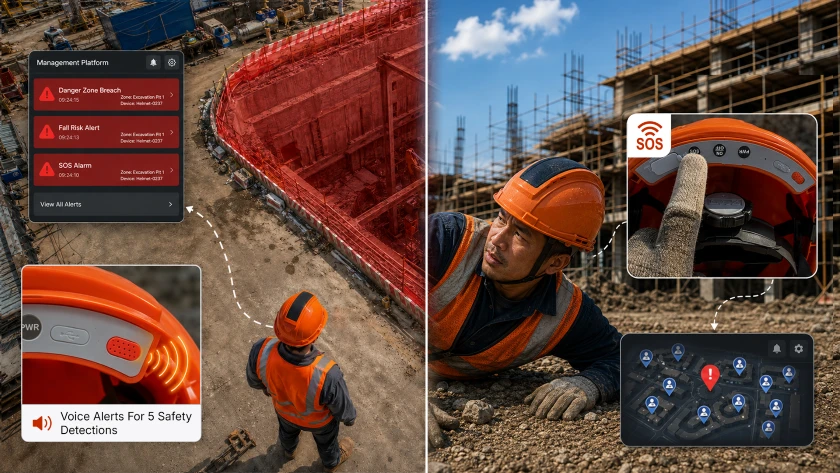
Geofences can be configured on the management platform around danger zones, restricted areas, and assigned work areas. LSH01 reports personnel location data to the platform, which uses the configured boundaries to identify when personnel enter a danger zone or move outside an assigned work area and generates the corresponding geofence alert.
Location history and geofence event records can also be reviewed for incident reconstruction and follow-up analysis.
Provide a Direct Way to Request Assistance
Not every emergency can be identified automatically. Equipment failure, physical discomfort, entrapment, or another unexpected incident may require personnel to request assistance directly.
When assistance is needed, personnel can press the dedicated SOS button to send an emergency alert to the connected system. Combined with the reported location data, the SOS request helps safety teams identify where assistance is needed and coordinate an appropriate response.
From Helmet Data to Management Platform
Outdoors, LSH01 obtains location data through GNSS. Indoors, it uses Bluetooth signals to support indoor positioning.
LSH01 transmits location data, detected safety events, and SOS requests through a LoRaWAN gateway to the management platform. Based on the reported location data and configured geofences, the platform identifies when personnel enter a danger zone or move outside an assigned work area and generates the corresponding geofence alert.
The platform provides access to real-time locations, movement history, alarm types, and event records for centralized review.
Support Extended Worksite Operation
LSH01 is powered by two 1,500 mAh rechargeable batteries and provides approximately 14 days of battery life under laboratory conditions. Type-C charging supports convenient wired charging for routine power replenishment.
LSH01 is available in two versions: V1 (Solar-Assisted) and V2 (Standard). Both versions share the same specifications, except that V1 includes an integrated 0.4 W solar panel for auxiliary charging between wired charging cycles.
With an IP65 protection rating, LSH01 resists dust and routine water exposure. It supports operation from −10°C to 60°C and at 10%–90% RH in non-condensing conditions, making it suitable for dusty, humid, and demanding work environments.
Built for Different High-Risk Work Environments
Construction Sites
Maintain personnel location visibility across open construction areas, indoor structures, tunnels, and partially covered zones. Helmet removal, inactivity, and fall detection provide additional information about personnel status, while platform-based geofencing supports monitoring of danger zones and assigned work areas.
Electric Power and Utility Grids
Use GNSS-based outdoor positioning and five supported proximity voltage levels during inspection and maintenance activities. On-device voice alerts, platform-based geofencing, and SOS reporting provide additional support around substations, utility corridors, and distributed work areas.
Chemical and Petrochemical Facilities
View personnel locations across complex indoor and outdoor facilities while monitoring inactivity, potential falls, high-temperature conditions, and helmet removal. Platform-based geofencing helps identify when personnel enter configured restricted areas.
Mining Operations
Combine GNSS positioning across open and surface areas with Bluetooth positioning in enclosed or underground zones. Inactivity and fall detection help identify potential incidents, while the dedicated SOS button gives personnel a direct way to request assistance.
Bring More Safety Functions into the Helmet
The LSH01 LoRaWAN Smart Safety Helmet extends the role of conventional head protection by integrating positioning, status detection, risk alerts, SOS, and LoRaWAN reporting into equipment personnel already wear, while supporting platform-based geofencing through reported location data.
When one of the five safety conditions is detected, the helmet provides an immediate on-device voice alert. The management platform also provides access to reported locations, movement history, safety events, geofence alerts, and SOS requests.
Learn more about the LSH01 LoRaWAN Smart Safety Helmet or contact Minew to discuss product integration and deployment requirements.

 Chat now