



At World Cup scale, visibility is just as important as stadium capacity. Managing millions of fans, thousands of vehicles, and tons of equipment at the same time means a single blind spot can delay matches or cause security risks. Today, the FIFA World Cup is a massive real-time technology operation. From the connected match ball to crowd logistics and climate control, modern football relies on a hidden layer of IoT devices and data infrastructure to turn complex physical environments into manageable systems.
The World Cup Has Become a Real-Time Data Event
The 2026 FIFA World Cup scales this challenge across multiple countries and venues. Every matchday requires real-time coordination of fans, teams, vehicles, and equipment in a high-density environment. The main operational challenge is not just hosting games, but syncing infrastructure and services instantly. This is where IoT becomes essential, connecting physical events to digital systems to turn complex logistics into actionable data.
How Connected Ball Technology Brings IoT to Football
The official match ball on the pitch is the most familiar example of this real-time data layer.
What is connected ball technology?
Connected ball technology places a motion sensor inside the match ball to capture movement data such as touch, speed, and position-related events. In elite football, this data can be combined with player tracking and video systems to support faster and more accurate officiating decisions.
The 2026 official match ball, TRIONDA, uses this connected ball technology. Its built-in motion sensor provides real-time ball movement data to the Video Assistant Referee (VAR) system. FIFA’s semi-automated offside technology shows how ball data and player-position data can work together. This is a powerful example of a sensor-enabled object becoming part of a real-time decision system, sending data through an edge-to-cloud data flow without interrupting the flow of the game.

From Ball Tracking to Broad Stadium IoT Visibility
The connected ball shows one basic principle: when physical movement can be measured, decisions become faster. The same principle applies across the stadium grounds:
• Where are people moving?
• Where are critical assets located?
• Which gates are becoming crowded?
• Which service areas need replenishment?
• Which environmental zones need attention?
The real story is not one smart device, but a network of connected devices working together. The smart ball may be the most visible sensor in the World Cup, but it is only one part of a much larger real-time visibility challenge.
Crowd Management: How RFID Helped Move Millions of Fans
Event visibility is not theoretical; it has already been deployed at World Cup scale. During Qatar 2022, organizers needed to manage millions of fans across stadiums and event facilities. To do this, they used Hayya cards enabled with RAIN RFID in a crowd management system.
RFID gates allowed fans to be detected without stopping for manual scans. This system gave organizers real-time insight into fan movement and helped them allocate crowd-control resources where they were needed most.
How can IoT improve crowd management at sports events?
IoT can improve crowd management by detecting movement through entrances, exits, corridors, and key transition points. When this data is visualized on real-time dashboards, event teams can identify bottlenecks, adjust staffing, open or redirect routes, and respond faster during peak crowd movement.
For stadiums, convention centers, hospitals, airports, and campuses, similar visibility principles can be applied. Operators can use technologies such as RFID cards, Bluetooth beacons, personnel tags, and IoT gateways to improve event staff visibility and visitor safety.
Managing Invisible Supply Chains in Stadium Logistics
Before each match, stadiums need to prepare food, beverages, merchandise, broadcast equipment, maintenance tools, medical supplies, and temporary infrastructure. Large venues often operate like temporary logistics hubs.
Why does a smart stadium need asset tracking?
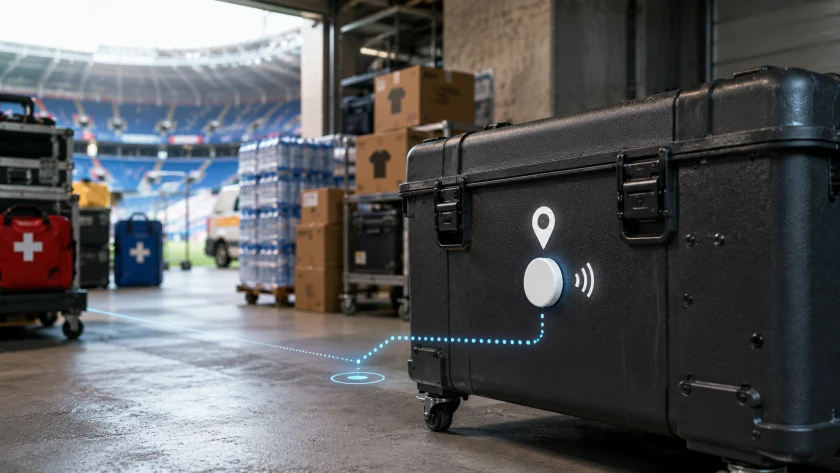
A smart stadium needs asset tracking because matchday operations depend on many movable assets, from technical equipment and medical kits to catering inventory and maintenance tools. Real-time asset visibility helps reduce loss, shorten search time, and improve operational readiness.
Using asset trackers allow managers to achieve full inventory visibility. These tracked assets constantly broadcast their status, which is captured by IoT gateways deployed throughout the venue and sent directly to a central cloud platform. This architecture allows logistics teams to view asset movements instantly on their dashboards, preventing missing equipment and keeping tight event schedules on track.
Optimizing Parking and Stadium Visitor Flow
For fans, the stadium experience begins long before kickoff. It starts with arrival: parking, shuttle buses, public transport, walking routes, and entry gates.
How does IoT support smart parking at large events?
IoT supports smart parking by using a parking or ToF sensor to detect parking occupancy, sending real-time occupancy data to cloud platforms or mobile apps, and guiding drivers to open spaces. This reduces search time, traffic congestion, and operational pressure around venues.
Once fans leave their cars, digital wayfinding and visitor flow analytics can help distribute crowds evenly across entrances and service areas. Bluetooth beacons placed throughout the venue support indoor navigation, helping fans find their seats, restrooms, or concession stands in complex, multi-level structures.
Managing Stadium Comfort and Safety With Sensors
Smart stadiums use sensors to monitor lighting, ventilation, and environmental conditions. Qatar 2022’s stadium cooling story clearly shows how comfort ties directly to data.
To combat extreme heat, venues deployed an AI-designed “spot-cooling” system inspired by car radiators. Instead of cooling the entire stadium, solar-powered chillers released cooled air directly through grilles under seats and field nozzles. Embedded environmental sensors interacted with a central command center, automatically adjusting airflow to keep temperatures between 64 and 75°F. This data-driven precision cut energy use by 40%.
In large event venues, small environmental problems can quickly become operational issues or safety hazards.
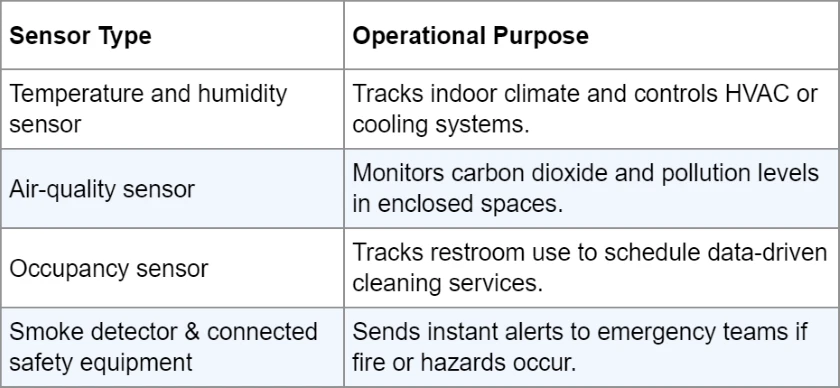
What sensors are used in smart stadiums?
Smart stadiums use a mix of specialized IoT sensors to keep the venue safe and comfortable. This table shows how operators use different devices to monitor venue health:
The IoT Architecture Behind a Smart Stadium
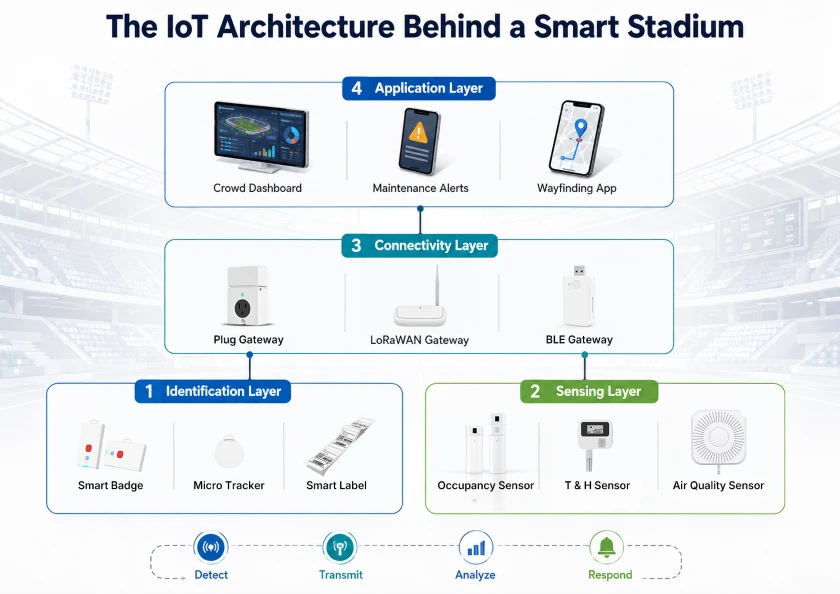
The value of IoT does not come from one device alone. It comes from connecting identification, sensing, communication, and software into one operational loop: detect, transmit, analyze, and respond. A smart stadium IoT system usually has four layers:
1. Identification Layer
This layer uses devices and credentials such as RFID cards, personnel tags, and asset trackers to identify people, assets, or objects across the venue.
2. Sensing Layer
IoT sensors collect physical-world data in real time, including motion sensors, temperature and humidity sensors, occupancy sensors, parking sensors, and air-quality sensors.
3. Connectivity Layer
Infrastructure equipment collects and transmits data across the venue, using BLE gateways, LoRaWAN gateways, and repeaters over Wi-Fi, Bluetooth, RFID, or private networks.
4 Application Layer
The application layer consists of software platforms and apps that convert raw data into actionable insights, including crowd dashboards, asset visibility platforms, environmental monitoring dashboards, maintenance alert systems, and wayfinding applications.
What Event Operators Can Learn from World Cup Technology
The smart stadium lessons learned at the World Cup apply to many other industries. The same IoT logic can support logistics, healthcare, retail, corporate campuses, factories, and public venues. Here are the key takeaways for any operator:
Real-time visibility is becoming a baseline requirement: Large venues need live data on people, assets, and conditions to stay efficient.
The best IoT systems are operational, not decorative: A sensor is valuable only when its data supports a concrete decision.
Crowd movement and asset movement should be managed together: Event operations depend on the coordination of both people and equipment.
Connectivity must be planned for density and complexity: Stadiums, airports, hospitals, and exhibition centers all face heavy wireless coverage challenges. Gateways and repeaters must be placed strategically to ensure reliable data flow.
Conclusion
The World Cup shows how far connected technology has moved into the physical world. A smart ball can support match decisions, RFID can manage crowd movement, sensors can monitor stadium comfort, and IoT gateway infrastructure can turn thousands of signals into real-time operational awareness. For modern venues and enterprises, IoT is no longer only about connecting devices. It is about making complex spaces visible, measurable, and easier to manage.
Need to build a smarter venue? For organizations building smart venues, event operations, logistics systems, or indoor visibility solutions, Minew provides a reliable hardware foundation for real-time operational intelligence. By deploying Minew industrial asset trackers, Bluetooth beacons, environmental sensors, and smart IoT gateways, enterprises can eliminate operational blind spots, streamline logistics, and ensure seamless data flow across any massive event space.
 Chat now