


Introduction: The Backbone of the Wireless World
If you looked around your office or home a decade ago, Bluetooth was likely just a way to link your phone to a pair of headphones. Fast forward to 2025 and 2026, and the landscape has shifted entirely. Bluetooth has evolved from a simple point-to-point connection into a comprehensive platform for Ambient Intelligence. With global shipments expected to exceed 5.3 billion units in 2025 and climb toward 8 billion by 2029, this technology has become the silent engine of the modern IoT ecosystem.
This growth is not just about volume. It is about a fundamental change in how devices perceive and interact with the physical world. We are moving away from “clunky” IoT toward a world where smart hardware is embedded into the very fabric of our environments, constantly whispering status updates to the infrastructure around them.
Precise Positioning: The Channel Sounding Revolution
The most significant technical leap in recent years is the introduction of Bluetooth Channel Sounding in the 6.0 specification. For a long time, Bluetooth distance estimation relied on signal strength (RSSI), which was often inaccurate due to walls or interference. This caused “blind spots” in industrial IoT applications where precision is non-negotiable.
Channel Sounding changes the game by using Phase-Based Ranging (PBR) and Round-Trip Time (RTT) to achieve centimeter-level accuracy. By measuring the phase difference of signals across multiple frequencies, devices can calculate distance with incredible precision, even in challenging indoor environments with many reflections.
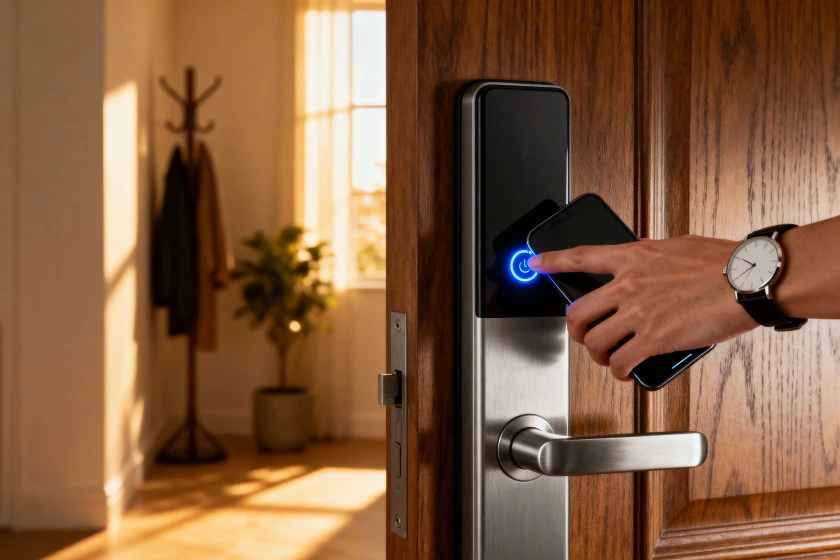
This precision is a major win for IoT security. Traditional signal-based locks were vulnerable to relay attacks, where a hacker could trick a system into thinking an authorized user was closer than they actually were. Channel Sounding uses the Normalized Attack Detector Metric (NADM) to verify the physical distance, ensuring that a door only unlocks when the person is truly standing in front of it.
Industrial Efficiency and the Asset Tracking Leap
In a busy warehouse or hospital, simply knowing a piece of equipment is “somewhere in the building” is no longer enough. To achieve true operational efficiency, you need to know exactly which shelf or room it occupies. This precision is where high-performance hardware meets the Bluetooth Low Energy (BLE) protocol, transforming passive tracking into an active, manageable system.
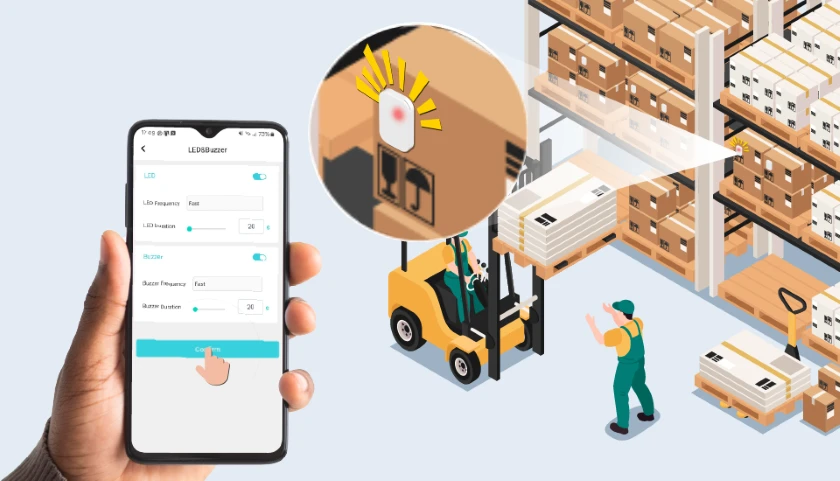
The MBT02 Bluetooth LE Connectable Asset Tag exemplifies this leap. Unlike tags that only broadcast data in one direction, the MBT02 enables bidirectional communication. This connectivity allows managers to do more than just “see” an asset; they can interact with it. By sending commands back to the tag to trigger a “Pick-to-Light” or sound alert, the system guides personnel directly to a specific package among thousands, turning “searching” into “finding” in real-time.
To complement this precision with long-term reliability, the MBT02 utilizes an intelligent movement-triggered mode. The tag remains in a deep sleep to conserve power, but the built-in accelerometer ensures that any movement triggers an immediate wake-up to report its status and location updates instantly. By balancing high-speed responsiveness with ultra-low power consumption, these tags can operate for several years on a single coin battery, effectively reducing the “battery swap fatigue” that once hindered large-scale IoT deployments.
Sustainability and the “Better World” Initiative
Sustainability is no longer a buzzword; it is a core requirement for global industries. Bluetooth technology is playing a vital role in the “Better World” initiative by helping businesses optimize resources and reduce waste.
One of the most exciting trends for 2026 is Ambient IoT. This refers to a class of tiny, battery-free trackers or sensors that harvest energy from radio waves, light, or vibrations. By eliminating the need for traditional batteries, these devices can be embedded in everything from food crates to medicine bottles, providing a “live video feed” of their condition rather than just a snapshot.
Minew has also contributed to this green shift through the development of Ambient IoT hardware like the MTB11 Ambient Light Harvesting BLE Tag. Unlike traditional trackers that rely on replaceable batteries, the MTB11 is designed to be self-sustaining by capturing energy from its surrounding environment, such as indoor light. This approach significantly reduces the environmental impact of discarded batteries and minimizes the manual labor required for maintenance. By integrating these “set-and-sustain” trackers into the supply chain, facilities can achieve continuous monitoring and asset visibility while moving closer to a carbon-neutral operational model.

The Convergence: Bluetooth meets Edge AI
Another trend in 2026 is the marriage of Bluetooth Mesh and edge computing. In the past, all data had to be sent to a central cloud server for analysis, which caused delays. Today, we use edge computing to process information locally on the device or a nearby gateway.
By running AI models at the edge, systems can make real-time decisions. For example, a Bluetooth-connected sensor on a production line can analyze vibration patterns locally. If it detects a signature of an impending mechanical failure, it can trigger an immediate shut-down command through the Bluetooth Mesh network before the machine is damaged.
This distributed intelligence allows the network to be self-healing. If one node in a Bluetooth Mesh fails, the network automatically finds a new path to deliver the data, ensuring high reliability for industrial IoT applications where downtime is costly.
Conclusion
As we look toward the end of the decade, it is clear that Bluetooth has moved far beyond its origins. It has become a sophisticated platform for Ambient Intelligence that prioritizes precision, security, and sustainability.
By combining high-accuracy distance measurement with the real-time decision-making of Edge AI, we are creating environments that are not just connected, but truly smart. Whether it is reducing waste in the supply chain or ensuring workers’ safety in a factory, Bluetooth is the invisible force making the world more efficient and livable.
 Chat now