



A cold-chain shipment can look normal on a dashboard until the truck leaves cellular coverage. The temperature logger may still be working. The goods may still be safe. But the operations team cannot see what is happening until the device reconnects.
That gap creates real business risk. Food can spoil. Medicine can fall outside its safe temperature range. Rental tools can disappear from a job site. Pallets can sit in the wrong yard for days. The problem is not always the sensor. The problem is often the network between the sensor and the cloud.
This is why Hubble Network is getting attention in the IoT market now. It gives teams a new way to connect low-power Bluetooth devices across a much wider area. Instead of relying only on cellular modules, local gateways, or expensive satellite hardware, Hubble Network uses standard Bluetooth Low Energy chips and a large receive network to move small asset data packets to the cloud.
For IoT solution buyers and system integrators, this matters because it can lower device cost, reduce power draw, and make asset tracking practical in more places.
The Limits of Traditional IoT Positioning
Cellular Coverage Is Not Everywhere
Cellular network works well in many cities, factories, stores, and warehouses. It is often a good fit for vehicles, powered devices, and assets that move along well-covered routes.
But many assets do not stay in those places. A container may cross the ocean. A reefer truck may pass through rural areas. A pallet may sit in a port yard. A tool may move to a remote construction site. A farm sensor may sit far from the nearest tower.
When cellular coverage drops, many trackers can only store data and upload it later. That may be acceptable for reports, but it is not enough when a team needs to act quickly.
Traditional Satellite Hardware Can Be Too Costly
Satellite communication can solve coverage gaps, but it often adds cost and design work. A product may need a special module, a larger antenna, a bigger battery, and more certification effort.
That can make sense for high-value machines, vehicles, or critical infrastructure. It is harder to justify for lower-cost assets like bins, pallets, reusable containers, tools, labels, and portable medical packages.
For many IoT buyers, the question is simple: can we track more assets without making every asset carry expensive hardware?
Gateway-Based Systems Add Planning Work
Bluetooth gateways work well in a controlled site. A warehouse can install gateways near docks, aisles, cold rooms, and storage zones. A yard can add gateways near gates and loading points.
But gateway systems take planning. Teams must install hardware, power it, connect it, maintain it, and replace it when the site changes.
This is why a model that does not require extra on-site gateways is attractive. It can reduce installation work and help tracking projects move from pilot to rollout faster.
Hubble Network Technology Explained
Bluetooth Direct to Satellite
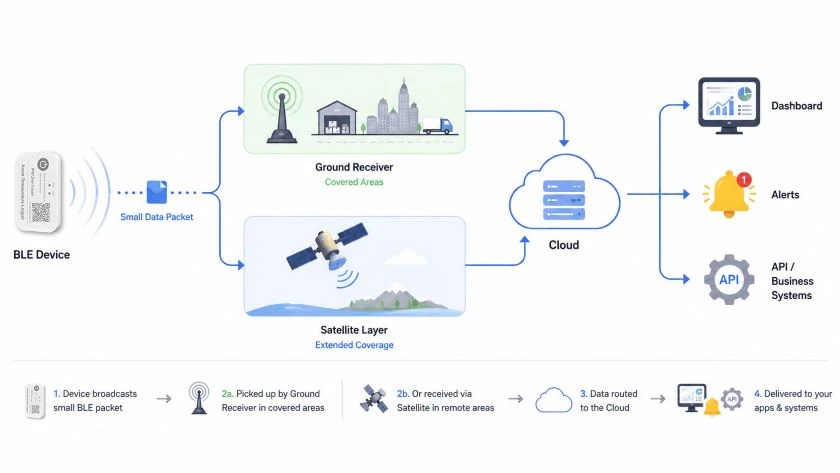
Hubble Network does not work like GPS. The satellite is not mainly used to calculate the device’s position. Instead, Hubble uses satellites and terrestrial receivers to collect small data packets from Bluetooth Low Energy devices and send them to the cloud.
The process is simple:
- A Bluetooth device broadcasts a small data packet, such as device ID, sensor data, battery status, or location information.
- A nearby Hubble terrestrial receiver may pick up the packet in cities, warehouses, logistics routes, or other covered areas.
- If the device is outside ground network coverage, Hubble’s satellite layer is designed to help extend coverage by receiving Bluetooth Low Energy signals from orbit.
- Hubble then routes the data to the cloud, where customers can use it in dashboards, alerts, APIs, or business systems.
This is why Hubble Network is different from a normal beacon setup. A normal beacon depends on nearby phones or local gateways. Hubble provides Bluetooth devices with a wider receiving network, using both ground infrastructure and a developing satellite layer to extend coverage.
Low Earth Orbit Satellite Coverage
Hubble Network uses low Earth orbit satellites as part of its receive network. These satellites are designed to listen for Bluetooth signals from supported devices and help move that data to the cloud.
TechCrunch reported in 2025 that Hubble had seven spacecraft on orbit and aimed to operate 60 satellites by 2028. Hubble also describes its satellite layer as a way to extend visibility to remote places such as oceans, deserts, national parks, and off-grid sites.
For buyers, this matters. Satellite-based Bluetooth tracking should be evaluated against real routes, coverage needs, and update timing. A cold-chain route across North America may have different needs than an ocean container, a cattle tag, a remote pipeline sensor, or outdoor safety gear.
Terrestrial Bluetooth Network Support
Hubble Network is not only a satellite company. Its terrestrial Bluetooth network is also a major part of the system.
Hubble says its Terrestrial Network can unlock 90M+ scanning gateways, helping receive Bluetooth signals across cities, facilities, logistics routes, and other infrastructure-rich areas.
This hybrid model is important. In a warehouse or city, a nearby terrestrial receiver may see the device first. In a remote area, the satellite layer can help extend visibility as coverage grows.
In short, the terrestrial layer improves coverage in places where ground infrastructure already exists, while the satellite layer is designed to extend visibility into more remote areas.
Key Radio and Protocol Breakthroughs
The technical challenge is not the Bluetooth chip alone. The hard part is hearing a weak Bluetooth signal from a long distance, then turning it into usable cloud data.
Hubble’s public information and reporting point to several important technical pieces.
A phased array receiver helps the satellite detect weak signals from small Bluetooth devices. This is one reason a low-power device can be detected from orbit.
Doppler handling is also important. Low Earth orbit satellites move fast. That motion changes the apparent radio frequency. Hubble had to solve frequency shift issues so the system could receive Bluetooth packets from moving satellites.
The device protocol and cloud path are also key. Hubble’s model lets a Bluetooth device broadcast a small packet, then route that packet through Hubble’s receive network and cloud platform.
For product teams, the result is easier to understand than the radio engineering behind it. A supported Bluetooth device can send small messages without becoming a cellular device or carrying a special satellite modem.
Hardware Compatibility and Ease of Use
Existing Bluetooth Low Energy Chips
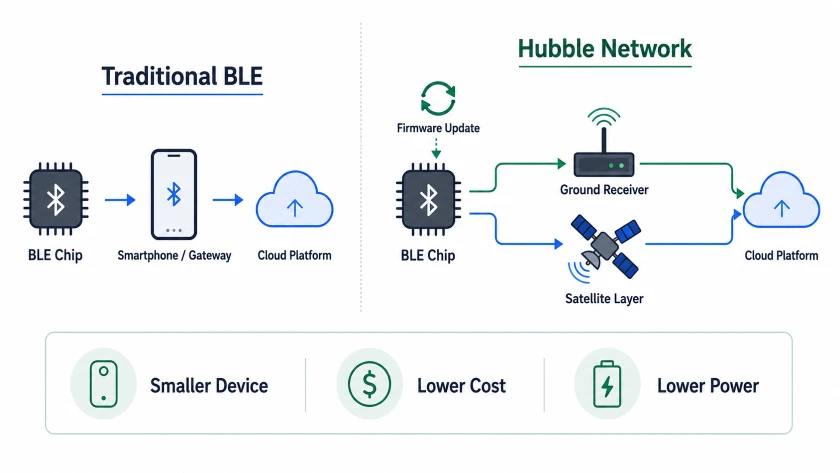
Hubble Network says its platform can work with off-the-shelf Bluetooth chips through firmware changes in supported designs. This is important because Bluetooth Low Energy is already common in tags, sensors, beacons, loggers, and smart labels.
This does not mean every old Bluetooth product can connect with no engineering work. Teams still need to check chip support, firmware access, antenna design, payload size, test results, power settings, and certification needs.
Still, the direction is valuable. If a product can use a standard Bluetooth chip instead of a cellular modem or special satellite module, the device can be smaller, cheaper, and easier to power.
Firmware-Based Access
A firmware-based path can lower the barrier for device makers. Instead of redesigning the hardware from scratch, teams may be able to update how the device advertises data.
For device makers, this means existing Bluetooth-based products may be able to add wide-area tracking through firmware and SDK integration, without a full hardware redesign.
For system integrators, this means more freedom. They can focus on use case design, backend integration, alert rules, and operational workflows instead of building a private network from the ground up.
Developer-Friendly SDK and API Model
Hubble describes open APIs and modular SDKs for device and cloud integration. This matters because most IoT projects fail when field data cannot flow into daily tools.
A shipment alert should reach the logistics team. A cold-chain event should create a quality record. A misplaced rental asset should appear in a recovery workflow. A warehouse location update should connect to the WMS or ERP system. A good SDK and API model helps teams turn device signals into alerts, records, and daily workflows.
Core Advantages of Hubble Network
Lower Device and Operating Cost
Many asset tracking projects fail at scale because each device costs too much. The bill of materials may include a cellular module, SIM support, larger battery, antenna, and ongoing data plan.
Hubble Network changes the cost model by using Bluetooth Low Energy chips that are already common and low cost. In many designs, that can reduce the need for cellular or satellite-specific hardware.
Operating cost can also improve. Low-power Bluetooth devices can send short updates and sleep for long periods. This can reduce battery replacements, field service, and device downtime.
Wider Coverage Across Mixed Environments
Assets rarely move through one clean environment. A product may start in a warehouse, ride in a truck, sit at a port, cross an ocean, pass through customs, and enter another warehouse.
A single tracking method may not cover every step. Hubble Network combines terrestrial Bluetooth reception with a growing satellite layer. This helps reduce blind spots across indoor, urban, in-transit, remote, and off-grid settings.
For IoT buyers, the value is not just global reach. It is visibility across the real journey of the asset.
Ultra-Low Power Design
Bluetooth Low Energy is built for devices that must run on small batteries. A tracker can wake up, send a short packet, and sleep again.
That makes the architecture useful for coin-cell-powered devices, smart labels, small beacons, sensor tags, and portable loggers.
Battery life still depends on the setup. Advertising interval, transmit power, temperature, enclosure material, battery type, sensor workload, and firmware design all matter. But for small asset messages, Hubble Network is a better match than high-data-rate systems.
Data Security and Reliability
Asset tracking data can be sensitive. It may show shipment routes, warehouse activity, inventory status, theft risk, or customer behavior.
Hubble says its platform uses end-to-end AES encryption from device to destination. It also positions the platform for enterprise-scale data streaming into existing systems.
This means Hubble Network should be evaluated as both a connectivity layer and a data path. Security, API access, platform fit, and alert handling all matter.
Minew Smart Devices for Hubble Network
Minew MST03 Asset Temperature Logger
The Minew MST03 Asset Temperature Logger is built for mobile assets that need both temperature records and location tracking during transport or storage.
It supports real-time temperature monitoring, alert records, asset location, up to 60,000 temperature records, IP67 protection, 2-year service life, PDF and Excel reports, and batch device management.
In a cold-chain project, location data alone is not enough. Teams also need to know whether goods stayed within the safe temperature range. MST03 helps by linking temperature records with asset movement. If a temperature event happens, the team can see where it happened and respond faster.
With Hubble Network integration, MST03 can support wider-area asset tracking without extra on-site gateways, depending on service availability and deployment conditions. This is useful for teams that want fewer site devices and less installation work.
Common MST03 use cases include:
- Food and beverage cold-chain tracking
- Pharmaceutical shipment monitoring
- Medical storage and transport
- Warehouse temperature checks
- High-value temperature-sensitive asset tracking
- Quality and compliance record keeping
Minew E9 Waterproof Beacon
The Minew E9 Waterproof Beacon is a durable Bluetooth beacon for assets that need reliable presence, movement, and location visibility.
Its waterproof housing, replaceable battery, long advertising range, and optional motion sensing make it well suited for warehouses, logistics assets, tools, equipment, retail spaces, and indoor tracking projects. Screw mounting also helps teams attach it securely to target items in daily operations.
With Hubble Network support, E9 can extend from local beacon use cases into wider area asset tracking. Teams can use it to track reusable containers, returnable packaging, inventory items, event equipment, and warehouse assets without building a full private gateway system everywhere.
Common E9 use cases include:
- Large warehouse asset tracking
- Logistics and supply chain visibility
- Inventory tracking
- Indoor location
- Activity monitoring
- Event equipment management
- Tool and container tracking
For teams that need a simple rugged beacon, E9 offers a practical starting point. It is small, waterproof, powered by a replaceable battery, and built for common Bluetooth tracking workflows.
Why Choose Hubble Network With Minew Devices
Global Visibility With Fewer Blind Spots
Hubble Network helps Bluetooth devices move beyond the limits of local gateways. Its terrestrial network supports visibility in populated and infrastructure-rich areas. Its satellite layer is designed to extend coverage into remote and off-grid places as the constellation grows.
Minew devices bring the physical tracking layer. MST03 adds temperature measurement and records. E9 adds rugged beacon-based tracking. They both help teams track different asset types across warehouses, logistics routes, yards, and remote sites.
Easier Deployment
Many IoT projects get delayed because on-site setup takes too much time and effort. Teams must install gateways, plan power, manage backhaul, maintain hardware, and train local staff.
A Hubble Network-based model can reduce that burden. Devices can send Bluetooth packets to existing Hubble receive infrastructure where available. That means teams can reduce private gateway dependence in many scenarios.
For buyers, this can lower project risk. For integrators, it can shorten deployment cycles.
Longer Device Life
Low-power Bluetooth devices are well suited for long life tracking. MST03 offers a 2-year service life. E9 uses a replaceable coin battery and is designed for long advertising range.
With careful firmware and advertising settings, teams can balance update frequency and battery life. That is important when devices are attached to assets that are hard to reach.
Device Choice for Different Needs
This table shows how MST03 and E9 fit different project needs.
| Decision Point | MST03 Asset Temperature Logger | E9 Waterproof Beacon |
| Main job | Track temperature and asset location | Track asset presence, movement, and location |
| Best fit | Cold chain, healthcare, food, warehouse storage | Logistics, inventory, equipment, indoor location |
| Key sensor value | Temperature measurement and alert records | Optional accelerometer for movement events |
| Data storage | Up to 60,000 temperature records | Beacon broadcast data, depending on setup |
| Protection | IP67 waterproof and dustproof | IP67 waterproof and dustproof |
| Battery design | 2-year service life | Replaceable coin battery |
Where Hubble Network Fits Best
Asset Tracking and Logistics Management
Hubble Network and Minew devices fit asset tracking projects where goods move across warehouses, trucks, yards, ports, and remote routes.
MST03 is useful for cold-chain goods such as food and medicine, where teams need both temperature records and location data. E9 is a good fit for tools, pallets, containers, and reusable assets that often move between sites or get lost inside large facilities.
Industrial IoT
Industrial IoT often focuses on assets that are far from reliable network coverage, such as field equipment, pipelines, tanks, pumps, and outdoor sensors.
These assets usually do not need to send large files. They only need to report key data, such as location, temperature, pressure, battery level, or an alert when something changes.
Hubble Network can help send low-bandwidth data from equipment, sensors, and field assets in oil and gas, utilities, agriculture, and other outdoor environments where cellular coverage is limited.
Smart Agriculture
Farms often cover large areas that are hard to serve with cellular networks or private gateways. With low-power Bluetooth devices, teams can track farm tools, mobile machines, livestock tags, or soil sensors with simple location and status updates.
Outdoor Safety and Asset Tracking
For outdoor gear, pets, and valuable personal items, Hubble Network can help keep location updates available even when the item is away from a phone or local gateway. This makes lost items easier to find and urgent events easier to handle.
Conclusion
Hubble Network gives IoT teams a new way to think about Bluetooth tracking. Instead of treating Bluetooth as a short range only technology, it turns Bluetooth Low Energy devices into part of a wider receive network that includes a large terrestrial layer and a growing satellite layer.
That matters for asset tracking, logistics, cold chain, industrial IoT, agriculture, and outdoor safety. It can reduce hardware cost, lower power use, reduce gateway dependence, and help close coverage gaps.
Minew MST03 and E9 devices make this model practical at the device level. MST03 helps teams track temperature sensitive assets with location and records. E9 helps teams track rugged assets, inventory, equipment, and movement events.
For IoT buyers, the next step is clear. Start with the asset, the data needed, the update rate, and the route. Then test Hubble-compatible Bluetooth devices, such as Minew MST03 or E9, in the real operating environment. If the coverage, battery life, and data flow match the use case, this combination can help teams build a lower-cost and easier to deploy tracking system across far more places.
 Chat now