
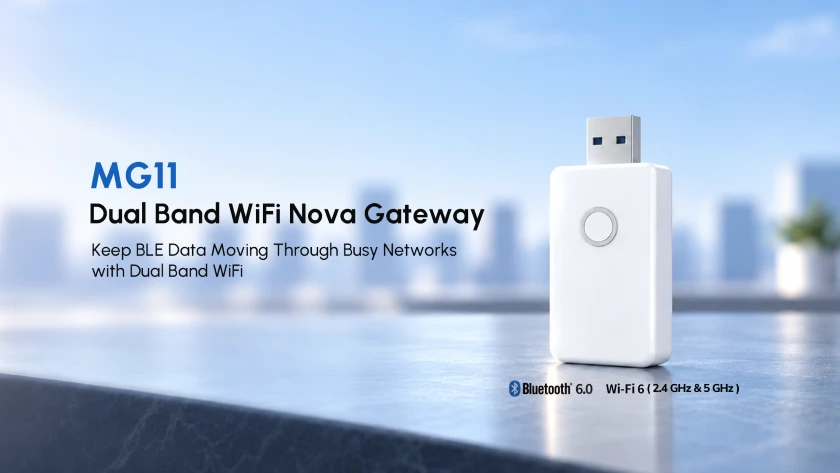
MG11 デュアルバンド WiFi Nova ゲートウェイ is now available for indoor IoT deployments facing two common problems: BLE devices outside the current collection area and increasing congestion on 2.4 GHz networks. Its compact USB format brings BLE collection closer to monitored devices, while dual-band WiFi 6 provides a 5 GHz uplink option when 2.4 GHz is crowded.
Coverage gaps often appear as deployments expand. A hospital may add tagged pumps to another nurses’ station. An office may extend occupancy monitoring to a shared floor. A hotel may need leak and temperature data from a service area beyond the existing collection zone. 同時に, Wi-Fi, ブルートゥース, ジグビー, and other wireless systems may compete within the 2.4 GHz帯, increasing the risk of delayed or interrupted uploads.
Closing a local gap with a conventional infrastructure gateway can require Ethernet, permanent mounting, and functions the location does not need. A gateway limited to 2.4 GHz also leaves data uploads dependent on the most crowded band.
MG11 connects to USB power and existing WiFi, allowing teams to place BLE collection closer to monitored devices without installing Ethernet. Sites can use 2.4 GHz for wider coverage or move uploads to 5 GHz to avoid congestion. If interference disrupts the active connection, MG11 switches bands to keep data moving to the server. The gateway can also be relocated when devices or coverage requirements change.
Keep Scanning While Data Uploads
A gateway must listen for BLE broadcasts while sending collected data to the server. If these jobs share the same processing resources, upload activity can reduce the capacity available for scanning as device traffic rises.
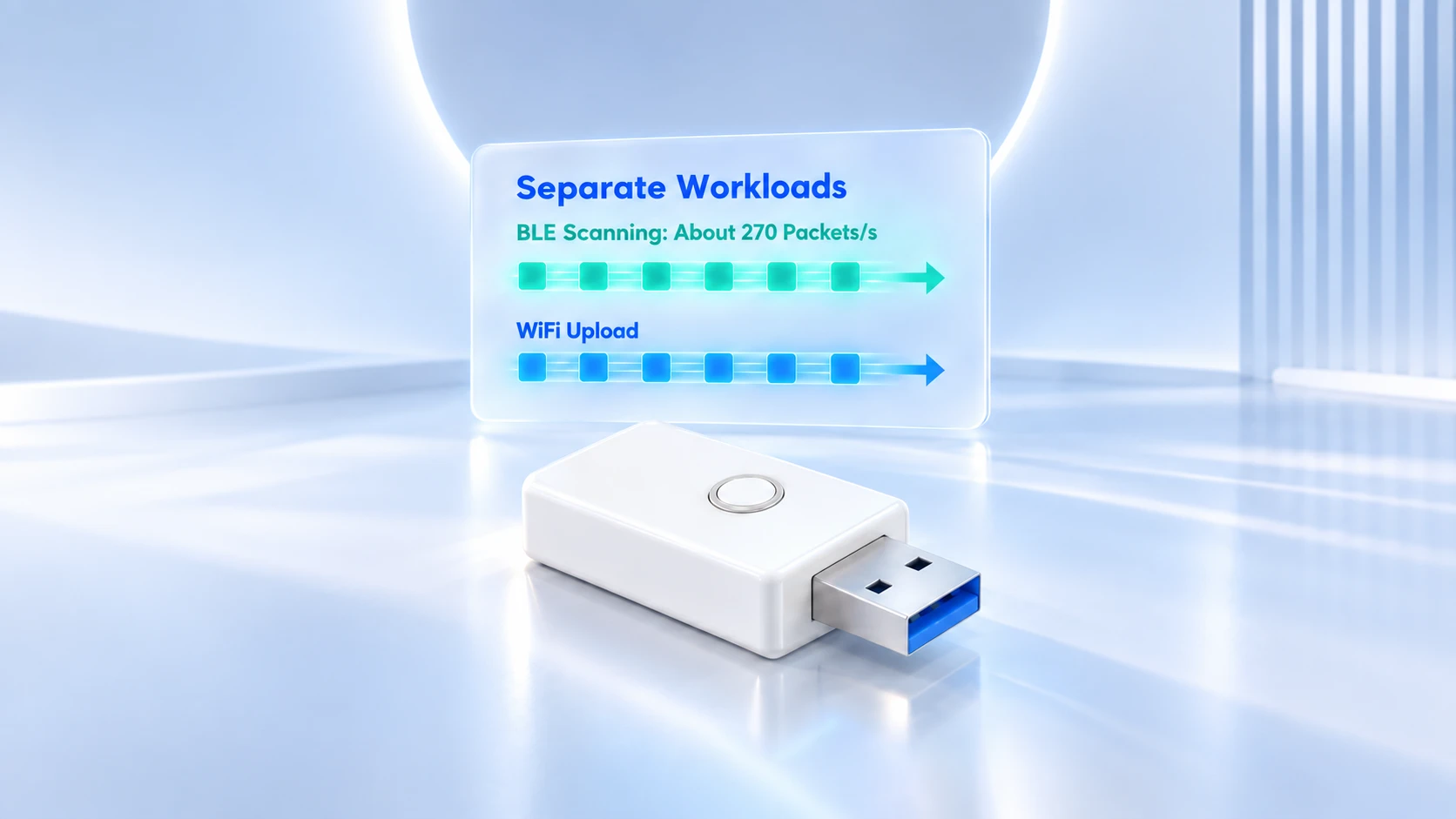
MG11 uses a dual-chip architecture to keep the workloads separate. The Nordic nRF54L15 remains focused on BLE scanning while separate processing manages the WiFi uplink. Uploads do not take over the processor reserved for BLE capture.
MG11 processes about 270 BLE advertising packets per second, helping busy collection points keep up as more tags, ビーコン, and sensors report. BLE data continues to enter the system while earlier packets are uploaded.
This gives hospitals, オフィス, ホテル, and event venues more headroom in areas where many devices may broadcast within the same period. Teams can expand the monitored fleet without adding another gateway solely because scanning and uploading compete for processing time.
Keep Data Moving When 2.4 GHz Is Crowded
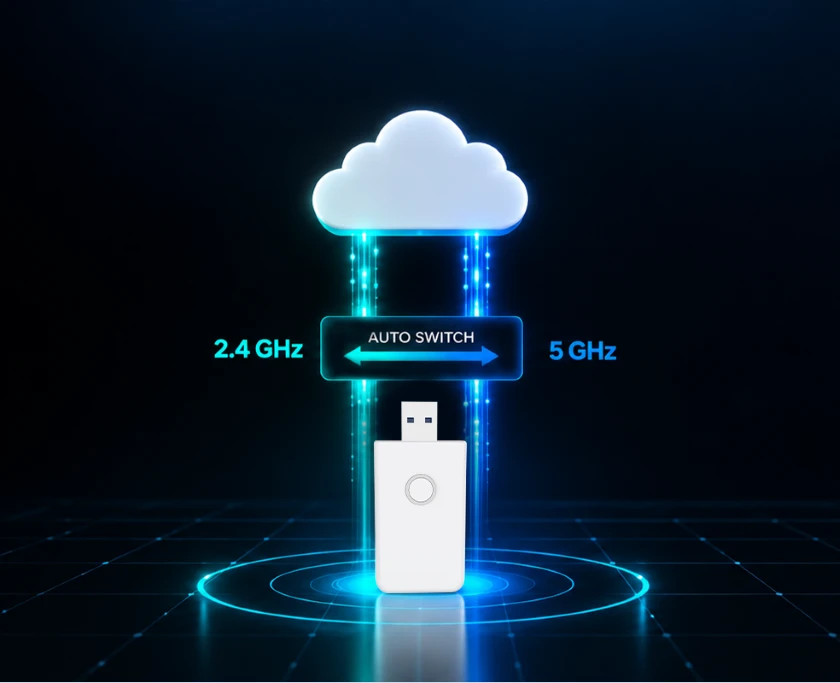
Indoor wireless conditions change throughout the day. Wi-Fi, ブルートゥース, ジグビー, and other wireless systems can crowd the 2.4 GHz帯. In busy locations, that interference can delay uploads or drop the WiFi connection.
MG11 supports 2.4 ghzと 5 GHz WiFi 6. Sites can use 2.4 GHz for wider coverage or move uploads to 5 GHz to avoid congestion. If interference disrupts the active connection, automatic band switching gives collected data another route to the server.
The gateway can therefore work with the WiFi infrastructure already available while reducing dependence on one crowded band. Installed BLE devices do not need to be replaced or reconfigured because local WiFi traffic increases.
Send Less Unnecessary Data
A gateway may hear more devices than the application needs. Nearby consumer devices, unrelated tags, and weak signals can create records that add no value to the deployment.
MG11 applies MAC address rules and RSSI thresholds before upload. These filters remove unrelated devices and low-signal packets from the outgoing stream. The server receives fewer unnecessary records, and WiFi bandwidth is not spent forwarding every broadcast detected nearby.
For asset tracking, 占有監視, および環境センシング, this creates a data stream tied more closely to the devices the platform is expected to monitor.
A Compact Collection Point for Indoor Coverage Gaps
MG11 joins the Nova Series, which sits between basic BLE bridges and full infrastructure gateways. Not every indoor location requires wired backhaul, local buffering, or permanent installation. Some locations simply need another collection point closer to hard-to-reach devices.
The name comes from a nova, a star that suddenly becomes much brighter and brings a faint point into view. Nova gateways follow the same principle by bringing nearby IoT data into view through a compact device.
MG11 applies that principle to BLE over WiFi. Its compact housing fits near monitored devices wherever USB power and WiFi are available. If assets or sensors move to another room, floor, or service area, the gateway can move with them.
For sites that already have WiFi and USB power, MG11 provides a direct way to close BLE coverage gaps, keep scanning active during uploads, and move data through 5 GHz when 2.4 GHz becomes crowded.
The MG11 Dual Band WiFi Nova Gateway is now available for indoor IoT deployments.

 今すぐチャット