


Un empleado híbrido puede visitar la oficina sólo dos o tres días a la semana.. cuando lleguen, Esperan que lo básico funcione.
Quieren encontrar un escritorio. Quieren una sala de reuniones que aún no esté ocupada. Quieren aire que no se sienta viciado. Quieren localizar equipos compartidos sin preguntar a cinco personas. Quieren sentirse seguros en un edificio grande.. Quieren que la oficina les haga el día más fácil, no más lento.
Por eso la experiencia en el lugar de trabajo se ha convertido en una cuestión empresarial., no es sólo un tema de instalaciones. CBRE 2026 investigación en el lugar de trabajo cubre los datos del cliente de 303 millones de pies cuadrados de espacio para oficinas y muestra cómo las empresas todavía están adaptando sus propiedades inmobiliarias, operaciones, y cultura en torno al trabajo híbrido. JLL 2026 informe de ocupación dice que la utilización global de oficinas aumentó a 56%, arriba de 54% en 2025 y 49% en 2024.
El mensaje es claro. Los espacios de oficinas están viendo una actividad renovada, pero las expectativas de los empleados y los patrones de uso han cambiado. Los empleados llegan con un propósito. Esperan que oficina apoye reuniones, enfocar, aprendiendo, trabajo en equipo, y bienestar. IoT ayuda porque convierte las conjeturas en el lugar de trabajo en evidencia en el lugar de trabajo.
Decodificando la experiencia en el lugar de trabajo: El núcleo de las oficinas inteligentes
¿Qué es la experiencia laboral?? En inglés sencillo, Así es como los empleados experimentan el trabajo a través de los espacios., herramientas, servicios, e interacciones a su alrededor.
Una oficina inteligente añade una capa más: conciencia en tiempo real.
En lugar de planificar la oficina únicamente a partir de encuestas o pases de credenciales, Los equipos pueden usar datos de IoT para ver qué está sucediendo ahora.. Pueden aprender qué espacios están llenos., ¿Qué habitaciones están vacías?, donde la gente lucha por encontrar su camino, y donde el confort ambiental necesita atención.
| Capa del lugar de trabajo | Lo que notan los empleados | ¿Qué puede medir o respaldar el LoT? |
| Espacio | “¿Puedo encontrar un escritorio o una habitación??” | Ocupación, Uso de escritorio, Uso de la habitación, Flujo de personas |
| Comodidad | “¿Es fácil trabajar en este lugar??” | Temperatura, Humedad, Luz, CO2, Voces, Calidad del aire |
| Seguridad | “¿Puedo obtener ayuda si pasa algo??” | Alertas de pánico, Insignias de ubicación, Posicionamiento de emergencia |
| Productividad | “¿Puedo encontrar lo que necesito??” | Ubicación de activos, Estado del equipo, Historial de uso |
| Operaciones | “¿La oficina funciona sin problemas?? | Señales de mantenimiento, Uso de energía, Demanda de limpieza |
Esto es importante porque un programa de experiencia en el lugar de trabajo no puede mejorar lo que no puede ver.. Los comentarios de los empleados le dicen cómo se sienten las personas. Los datos de IoT muestran lo que está haciendo el edificio.
Los mejores resultados se obtienen cuando ambos se usan juntos..
Por qué IoT es más importante para la experiencia en el lugar de trabajo en 2026
Muchos problemas de la oficina no son visibles en un plano de planta..
Una sala de reuniones puede parecer disponible pero sentirse congestionada después de que seis personas se sientan en ella durante una hora. Un área de colaboración puede parecer popular, pero los datos del sensor pueden mostrar que solo se usa los martes. Una impresora compartida puede estar “en algún lugar del suelo,”pero los empleados todavía pierden el tiempo buscándolo. Un equipo de las instalaciones puede limpiar todas las habitaciones en el mismo horario., incluso cuando la mitad de ellos no fueron utilizados ese día.
hardware de iot ayuda a cerrar estas brechas.
Los sistemas comunes de lugares de trabajo inteligentes respaldan casos de uso como el monitoreo de ocupación, seguimiento de activos, navegación interior, encontrar sala de reuniones, eficiencia energética, habitaciones inteligentes, utilización del espacio, y escritorios inteligentes. Los sistemas de ocupación recopilan señales de uso del espacio de tecnologías como Sensores PIR, Sensores ToF, y Sensores de onda mm. Luego, la plataforma convierte estas señales en información histórica y en tiempo real sobre la ocupación..
Ese es el verdadero cambio. La oficina se convierte en un sistema de retroalimentación.
7 Formas clave en que el hardware de IoT mejora la experiencia en el lugar de trabajo
1. Gestión inteligente del espacio
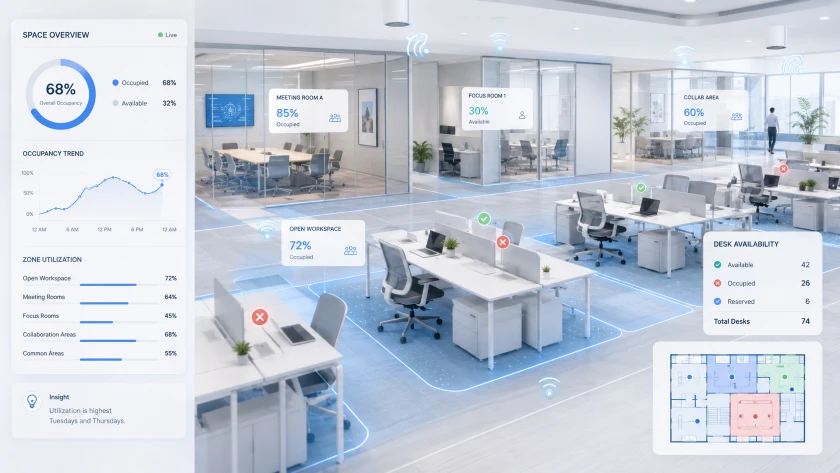
El trabajo híbrido ha dificultado la planificación del espacio. Algunos días son tranquilos. Otros días se desbordan. Un equipo puede necesitar salas de concentración, mientras que otro necesita zonas de proyecto.
Sensores de ocupación, sensores de presencia, balizas BLE, datos de ubicación de la insignia inteligente, y los dispositivos de conteo de personas muestran cómo se utilizan realmente los espacios.
Esto ayuda a los equipos:
• Convierta escritorios no utilizados en habitaciones útiles
• Agregue salas de reuniones pequeñas cuando se utilicen mal las salas grandes
• Ajustar la limpieza según el uso real
• Reducir el uso de energía en zonas vacías
• Planificar arrendamientos con datos reales
Esta es una respuesta clara sobre cómo mejorar la experiencia en el lugar de trabajo.: hacer que la oficina coincida con el comportamiento real.
2. Navegación inteligente y orientación
Puede ser difícil moverse por oficinas y campus grandes. Nuevas contrataciones, visitantes, y los empleados suelen perder tiempo buscando habitaciones, escritorios, o áreas de servicio.
Tecnología de navegación interior puede guiar a las personas a las salas de reuniones, escritorios, cafeterías, zonas de impresión, salas de entrenamiento, puntos de registro de visitantes, y salidas de emergencia.
Para empleados, esto elimina el estrés. Para gerentes, Reduce retrasos y mejora el flujo diario..
3. Iluminación inteligente, Temperatura, y humedad
La comodidad afecta cómo se sienten y trabajan las personas.
Los sensores de calidad del aire pueden rastrear la temperatura, humedad, Encendiendo, y uso de la habitación. Luego, los sistemas del edificio pueden ajustar la iluminación y el HVAC en función de la ocupación y la luz natural..
Los EE. UU.. La EPA señala que el confort interior se ve afectado por la temperatura, movimiento de aire, deslumbramiento, ruido, olores, y otros factores de construcción. OSHA también vincula la mala calidad del aire interior con dolores de cabeza, fatiga, y problemas para concentrarse.
IoT hace que la comodidad sea más fácil de gestionar porque los equipos pueden ver patrones en lugar de reaccionar únicamente a las quejas..
4. Monitoreo de la calidad del aire interior
Los empleados no siempre pueden ver la mala calidad del aire, pero pueden sentirlo.
Sensores de calidad del aire interior puede rastrear:
• CO₂
• Temperatura
• Humedad
• COV
• Materia particulada
• Necesidades de ventilación
La EPA dice que la calidad del aire interior puede afectar la salud, comodidad, bienestar, y productividad. La guía de los CDC también enfatiza el valor de una buena ventilación para un ambiente interior más saludable..
Para equipos de trabajo, IAQ ahora es parte de la confianza de los empleados. Una habitación no debe considerarse lista sólo porque esté vacía en el calendario..
5. Seguimiento y gestión de activos
Búsqueda de equipos compartidos como kits de prueba de prototipos, proyectores portátiles, o herramientas especializadas desperdician horas de tiempo productivo. Colocación de un pequeño Bluetooth de bajo consumo (BLE) Las etiquetas de activos para el hardware corporativo permiten a los empleados encontrar exactamente dónde se encuentra un artículo a través de un panel centralizado.. Esto mantiene los inventarios precisos y garantiza que las herramientas estén disponibles cuando sea necesario..
6. Sistemas de evacuación de emergencia y localización en tiempo real
Durante emergencias críticas en edificios, Los equipos de seguridad necesitan saber exactamente dónde están las personas.. Los sistemas de ubicación en tiempo real utilizan insignias inteligentes o dispositivos portátiles para proporcionar recuentos de ocupación instantáneos en las zonas de reunión designadas.. Esto permite a los socorristas identificar ubicaciones perdidas y coordinar más rápido., evacuaciones más seguras.
7. Mantenimiento predictivo para sistemas de construcción
Cuando el ascensor de una oficina se estropea o la unidad principal de aire acondicionado falla inesperadamente, La comodidad de los empleados cae instantáneamente.. Los sensores de vibración y temperatura de IoT monitorean equipos pesados de construcción las 24 horas del día. Identificando señales tempranas de desgaste antes de que ocurra una falla completa del sistema., Los equipos de mantenimiento pueden programar reparaciones fuera del horario laboral., Garantizar cero tiempo de inactividad para los trabajadores..
Cómo mejorar la experiencia en el lugar de trabajo con IoT
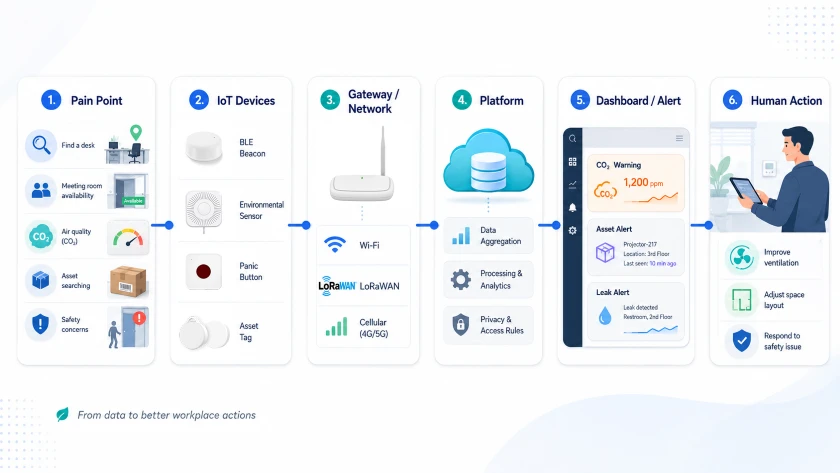
Un proyecto de oficina inteligente funciona mejor cuando comienza con algo pequeño y resuelve un problema visible.
Paso 1: Elija el punto débil de los empleados
Haz una pregunta sencilla. ¿La gente tiene dificultades para encontrar escritorios?? ¿Es difícil reservar salas de reuniones?? ¿La calidad del aire no está clara?? ¿Son los activos difíciles de localizar?? ¿Es la seguridad una preocupación??
No empiece con "necesitamos sensores". Comience con el problema de los empleados.
Paso 2: Mapear la ruta de datos
Todo sistema de IoT necesita un flujo claro:
Dispositivo → Puerta de enlace o red → Plataforma → Panel o alerta → Acción humana
Si nadie actúa sobre los datos, el sistema añade poco valor.
Paso 3: Elija el hardware adecuado
Las oficinas pequeñas pueden necesitar balizas BLE, puertas de enlace, y sensores simples. Los sitios grandes pueden necesitar LoRaWAN, Wifi, celular, o sistemas mixtos. Las áreas sensibles a la privacidad pueden necesitar detección sin cámaras.
Paso 4: Establecer reglas de privacidad
Los empleados no deben sentirse vigilados.
Definir qué datos se recopilan, quien puede verlo, cuanto tiempo se almacena, y si está vinculado a individuos. En muchos casos, los datos agregados son suficientes.
Paso 5: Conecte los datos a las operaciones
Los paneles de control no mejoran la experiencia en el lugar de trabajo por sí solos. Los flujos de trabajo sí.
Por ejemplo:
• Alto CO₂ → aumentar la ventilación
• Habitación no utilizada → revisar el diseño
• El activo sale de la zona aprobada → enviar alerta
• Fuga detectada → despacho de mantenimiento
• Botón de pánico presionado → notificar al equipo de respuesta
IoT crea valor cuando cambia lo que hacen los equipos a continuación.
Optimice su espacio de trabajo corporativo con Minew
Un lugar de trabajo inteligente depende de un hardware fiable. Los sensores deben recopilar datos precisos. Las etiquetas deben ajustarse a activos reales. Las puertas de enlace deben reducir los puntos ciegos. Los dispositivos deben admitir el rango correcto, duración de la batería, tamaño, y conectividad.
minas proporciona hardware IoT para espacios inteligentes, seguimiento de activos, detección ambiental, gestión de personas, y operaciones conectadas. Su gama de productos incluye rastreadores de activos., balizas bluetooth, etiquetas de personal, sensores, repetidores, y puertas de enlace
.
Minew también apoya el diseño de hardware, diseño mecánico, diseño integrado, prototipos rápidos, Ingeniería de calidad, producción en fábrica, etiquetado blanco, y cumplimiento normativo.
Para proyectos en el lugar de trabajo, Mi nuevo puede apoyar:
• Detección de ocupación para escritorios y habitaciones
• Orientación interior basada en baliza BLE
• Monitoreo de la calidad del aire y el confort.
• Seguimiento de activos para equipos compartidos
• Insignias de personal para seguridad y conocimiento de ubicación
• Botones de pánico para alertas de emergencia
• Puertas de enlace para BLE, LoRaWAN, Wifi, y otros sistemas de IoT
• Hardware personalizado para integradores de sistemas y proveedores de soluciones
Para equipos inmobiliarios corporativos, El nuevo hardware puede ayudar a que el rendimiento de la oficina sea mensurable. Para integradores de sistemas, proporciona la capa de dispositivo para plataformas de trabajo inteligentes. Para administradores de instalaciones, hace que las operaciones sean más fáciles de ver y actuar.
Conclusión: El futuro del trabajo es inteligente
Una sólida experiencia laboral en 2026 significa que los empleados pueden entrar a la oficina, encontrar lo que necesitan, mantente cómodo, siéntete seguro, y trabajar con menos retrasos.
IoT hace esto posible al brindar a los equipos del lugar de trabajo señales en vivo desde los espacios, activos, y condiciones de construcción.
Las mejores oficinas inteligentes se sentirán simples. Las habitaciones serán más fáciles de encontrar.. El equipo será más fácil de localizar. Las alertas de seguridad serán más rápidas. El mantenimiento se realizará antes de que los empleados sientan el problema..
Ésta es la forma práctica de responder cómo mejorar la experiencia en el lugar de trabajo con IoT: eliminar la fricción de la jornada laboral, un problema real a la vez.
Para obtener más información sobre cómo crear una mejor experiencia en el lugar de trabajo, vea nuestra lectura recomendada:
👉 Arriba 5 Consejos de seguridad en el lugar de trabajo
👉 IoT en el lugar de trabajo: Cómo IoT mejoró el servicio de gestión de espacio de oficina?
👉 Tecnologías de navegación en interiores: Iluminando el “sentido de dirección” en espacios interiores
👉 Cómo la tecnología de conteo de personas está revolucionando la inteligencia empresarial
 Chatea ahora