A hybrid employee may visit the office only two or three days a week. When they arrive, they expect the basics to work.
They want to find a desk. They want a meeting room that is not already taken. They want air that does not feel stale. They want to locate shared equipment without asking five people. They want to feel safe in a large building. They want the office to make their day easier, not slower.
That is why workplace experience has become a business issue, not just a facilities topic. CBRE’s 2026 workplace research covers client data from 303 million square feet of office space and shows how companies are still adjusting their real estate, 运营, and culture around hybrid work. JLL’s 2026 occupancy report says global office utilization rose to 56%, up from 54% 在 2025 和 49% 在 2024.
The message is clear. Office spaces are seeing renewed activity, but employee expectations and usage patterns have changed. Employees come in with purpose. They expect the office to support meetings, 重点, learning, teamwork, 和福祉. IoT helps because it turns workplace guessing into workplace evidence.
Decoding Workplace Experience: The Core of Smart Offices
What is workplace experience? In plain English, it is how employees experience work through the spaces, 工具, 服务, and interactions around them.
A smart office adds one more layer: real-time awareness.
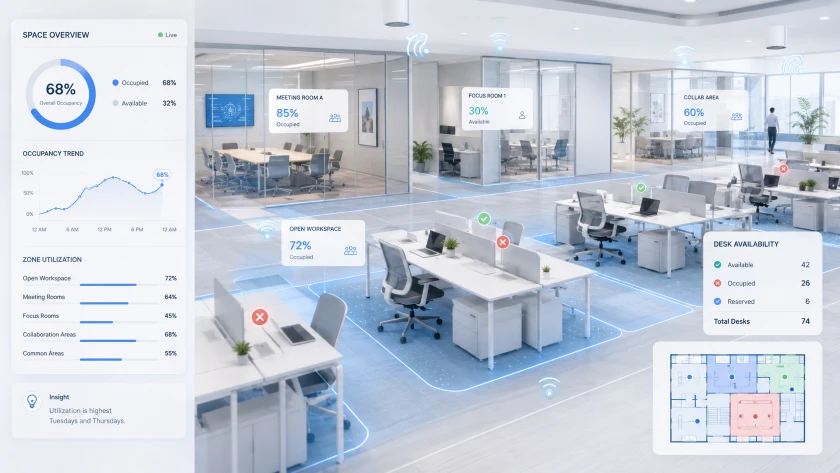
Instead of planning the office only from surveys or badge swipes, teams can use IoT data to see what is happening now. They can learn which spaces are full, which rooms sit empty, where people struggle to find their way, and where environmental comfort needs attention.

This matters because a workplace experience program cannot improve what it cannot see. Employee feedback tells you how people feel. IoT data shows what the building is doing.
The best results come when both are used together.
Why IoT Matters More for Workplace Experience in 2026
Many office problems are not visible from a floor plan.
A meeting room may look available but feel stuffy after six people sit in it for an hour. A collaboration area may look popular, but sensor data may show it is only used on Tuesdays. A shared printer may be “somewhere on the floor,” but employees still waste time looking for it. A facility team may clean every room on the same schedule, even when half of them were not used that day.
IoT hardware helps close these gaps.
Common smart workplace systems support use cases such as occupancy monitoring, 资产追踪, 室内导航, meeting room finding, 能源效率, smart rooms, space utilization, and smart desking. Occupancy systems collect space-use signals from technologies such as PIR传感器, ToF传感器, 和 毫米波传感器. The platform then turns these signals into real-time and historical occupancy insights.
That is the real shift. The office becomes a feedback system.
7 Key Ways IoT Hardware Enhances Workplace Experience
1. Intelligent Space Management
Hybrid work has made space planning harder. Some days are quiet. Other days overflow. One team may need focus rooms, while another needs project zones.
Occupancy sensors, presence sensors, BLE 信标, smart badge location data, and people-counting devices show how spaces are actually used.
This helps teams:
• Turn unused desks into useful rooms
• Add small meeting rooms when large rooms are misused
• Adjust cleaning based on real use
• Reduce energy use in empty zones
• Plan leases with real data
This is one clear answer to how to improve workplace experience: make the office match real behavior.

2. Smart Navigation and Wayfinding
Large offices and campuses can be hard to move through. New hires, 访客, and employees often lose time finding rooms, 桌子, or service areas.
Indoor navigation technology can guide people to meeting rooms, 桌子, cafeterias, print zones, training rooms, visitor check-in points, and emergency exits.
For employees, this removes stress. For managers, it reduces delays and improves daily flow.
3. 智能照明, 温度, and Humidity
Comfort affects how people feel and work.
Air quality sensors can track temperature, 湿度, 灯光, and room use. Building systems can then adjust lighting and HVAC based on occupancy and daylight.
美国. EPA notes that indoor comfort is affected by temperature, air movement, 强光, 噪音, odors, and other building factors. OSHA also links poor indoor air quality with headaches, fatigue, and trouble concentrating.
IoT makes comfort easier to manage because teams can see patterns instead of only reacting to complaints.
4. 室内空气质量监测
Employees cannot always see poor air quality, but they can feel it.
IAQ sensors can track:
• CO₂
• 温度
• Humidity
• VOCs
• Particulate matter
• Ventilation needs
The EPA says indoor air quality can affect health, 舒适, well-being, 和生产力. CDC guidance also stresses the value of good ventilation for a healthier indoor environment.
For workplace teams, IAQ is now part of employee trust. A room should not be treated as ready just because it is empty on the calendar.
5. Asset Tracking and Management
Searching for shared equipment like prototype testing kits, portable projectors, or specialized tools wastes hours of productive time. Affixing small Bluetooth Low Energy (低功耗蓝牙) asset tags to corporate hardware lets employees find exactly where an item is located through a centralized dashboard. This keeps inventories accurate and ensures tools are available when needed.
6. Emergency Evacuation and Real-Time Location Systems
During critical building emergencies, safety teams need to know exactly where people are. Real-time location systems use smart badges or wearables to provide instant occupancy headcounts across designated muster zones. This allows first responders to identify missed locations and coordinate faster, safer evacuations.
7. Predictive Maintenance for Building Systems
When an office elevator breaks or the main air conditioning unit fails unexpectedly, employee comfort drops instantly. IoT vibration and temperature sensors monitor heavy building equipment around the clock. By identifying early wear signs before a complete system failure happens, maintenance teams can schedule repairs during off-hours, ensuring zero downtime for workers.
How to Improve Workplace Experience with IoT
A smart office project works best when it starts small and solves a visible problem.
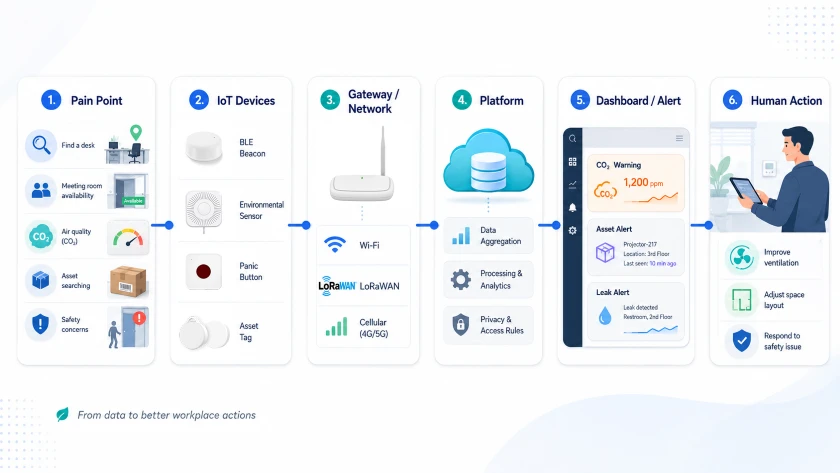
步 1: Pick the employee pain point
Ask a simple question. Are people struggling to find desks? Are meeting rooms hard to book? Is air quality unclear? Are assets hard to locate? Is safety a concern?
Do not start with “we need sensors.” Start with the employee problem.
步 2: Map the data path
Every IoT system needs a clear flow:
Device → Gateway or network → Platform → Dashboard or alert → Human action
If no one acts on the data, the system adds little value.
步 3: Choose the right hardware
Small offices may need BLE beacons, 网关, and simple sensors. Large sites may need LoRaWAN, Wi-Fi, 细胞的, or mixed systems. Privacy-sensitive areas may need camera-free sensing.
步 4: Set privacy rules
Employees should not feel watched.
Define what data is collected, who can see it, how long it is stored, and whether it is tied to individuals. 在很多情况下, aggregated data is enough.
步 5: Connect data to operations
Dashboards do not improve workplace experience by themselves. Workflows do.
例如:
• High CO₂ → increase ventilation
• Unused room → review layout
• Asset leaves approved zone → send alert
• Leak detected → dispatch maintenance
• Panic button pressed → notify response team
IoT creates value when it changes what teams do next.

Optimize Your Corporate Workspace with Minew
A smart workplace depends on reliable hardware. Sensors must collect accurate data. Tags must fit real assets. Gateways must reduce blind spots. Devices must support the right range, 电池寿命, 尺寸, 和连通性.
Minew provides IoT hardware for smart spaces, 资产追踪, 环境传感, 人员管理, and connected operations. Its product range includes asset trackers, 蓝牙信标, 人员标签, 传感器, 中继器, 和网关
.
Minew also supports hardware design, mechanical design, embedded design, 快速原型制作, 质量工程, 工厂生产, 白色标签, and regulatory compliance.
For workplace projects, Minew can support:
• Occupancy sensing for desks and rooms
• BLE beacon-based indoor wayfinding
• Air quality and comfort monitoring
• Asset tracking for shared equipment
• Personnel badges for safety and location awareness
• Panic buttons for emergency alerts
• Gateways for BLE, 洛拉万, Wi-Fi, and other IoT systems
• Custom hardware for system integrators and solution providers
For corporate real estate teams, Minew hardware can help make office performance measurable. 对于系统集成商, it provides the device layer for smart workplace platforms. For facility managers, it makes operations easier to see and act on.
结论: The Future of Work is Intelligent
A strong workplace experience in 2026 means employees can enter the office, find what they need, stay comfortable, feel safe, and work with fewer delays.
IoT makes this possible by giving workplace teams live signals from spaces, 资产, and building conditions.
The best smart offices will feel simple. Rooms will be easier to find. Equipment will be easier to locate. Safety alerts will be faster. Maintenance will happen before employees feel the problem.
That is the practical way to answer how to improve workplace experience with IoT: remove friction from the workday, one real problem at a time.
For more on building a better workplace experience, see our recommended reading:
👉 室内导航技术: Illuminating the “Sense of Direction” in Indoor Spaces
现在聊天