


Ein Hybrid-Mitarbeiter darf das Büro nur zwei oder drei Tage pro Woche besuchen. Wenn sie ankommen, Sie erwarten, dass die Grundlagen funktionieren.
Sie wollen einen Schreibtisch finden. Sie wollen einen Besprechungsraum, der noch nicht belegt ist. Sie wollen Luft, die sich nicht abgestanden anfühlt. Sie möchten gemeinsam genutzte Geräte ausfindig machen, ohne fünf Personen zu fragen. Sie möchten sich in einem großen Gebäude sicher fühlen. Sie möchten, dass das Büro ihnen den Alltag erleichtert, nicht langsamer.
Aus diesem Grund ist die Erfahrung am Arbeitsplatz zu einem Geschäftsthema geworden, nicht nur ein Einrichtungsthema. CBRE’s 2026 Arbeitsplatzforschung deckt Kundendaten ab 303 Millionen Quadratmeter Bürofläche und zeigt, wie Unternehmen ihre Immobilien immer noch anpassen, Operationen, und Kultur rund um hybrides Arbeiten. JLLs 2026 Belegungsbericht sagt, dass die weltweite Büroauslastung auf gestiegen ist 56%, aufwärts von 54% In 2025 Und 49% In 2024.
Die Botschaft ist klar. In den Büroräumen herrscht erneut reges Treiben, Aber die Erwartungen und Nutzungsmuster der Mitarbeiter haben sich geändert. Mitarbeiter kommen mit Absicht. Sie erwarten, dass das Büro Besprechungen unterstützt, Fokus, Lernen, Teamarbeit, und Wohlbefinden. IoT hilft, weil es Vermutungen am Arbeitsplatz in Beweise am Arbeitsplatz umwandelt.
Arbeitsplatzerfahrung entschlüsseln: Der Kern intelligenter Büros
Was ist Arbeitsplatzerfahrung?? Im Klartext, Es ist die Art und Weise, wie Mitarbeiter ihre Arbeit in den Räumen erleben, Werkzeuge, Dienstleistungen, und Interaktionen um sie herum.
Ein intelligentes Büro fügt eine weitere Ebene hinzu: Echtzeitbewusstsein.
Anstatt das Büro nur anhand von Umfragen oder Ausweiskarten zu planen, Teams können IoT-Daten nutzen, um zu sehen, was gerade passiert. Sie können lernen, welche Räume voll sind, welche Räume leer stehen, wo Menschen Schwierigkeiten haben, sich zurechtzufinden, und wo der Umweltkomfort Aufmerksamkeit erfordert.
| Arbeitsplatzebene | Was Mitarbeiter bemerken | Was loT messen oder unterstützen kann |
| Raum | „Kann ich einen Schreibtisch oder ein Zimmer finden??“ | Belegung, Verwendung am Schreibtisch, Raumnutzung, Menschen fließen |
| Komfort | „Lässt es sich an diesem Ort leicht arbeiten??“ | Temperatur, Feuchtigkeit, Licht, CO2, VOCs, Luftqualität |
| Sicherheit | „Kann ich Hilfe bekommen, wenn etwas passiert??“ | Panikwarnungen, Standortabzeichen, Notfallpositionierung |
| Produktivität | „Kann ich finden, was ich brauche??“ | Standort des Vermögenswerts, Ausrüstungsstatus, Nutzungsverlauf |
| Operationen | „Läuft das Büro reibungslos?? | Wartungssignale, Energieverbrauch, Reinigungsbedarf |
Dies ist wichtig, da ein Workplace-Experience-Programm nicht das verbessern kann, was es nicht sieht. Mitarbeiterfeedback verrät Ihnen, wie sich die Menschen fühlen. IoT-Daten zeigen, was das Gebäude tut.
Die besten Ergebnisse werden erzielt, wenn beide zusammen verwendet werden.
Warum IoT für das Arbeitsplatzerlebnis wichtiger ist 2026
Viele Büroprobleme sind aus einem Grundriss nicht ersichtlich.
Ein Besprechungsraum sieht vielleicht frei aus, fühlt sich aber stickig an, nachdem sechs Personen eine Stunde lang darin gesessen haben. Ein Bereich für die Zusammenarbeit könnte beliebt sein, Sensordaten zeigen jedoch möglicherweise, dass es nur dienstags verwendet wird. Ein gemeinsam genutzter Drucker befindet sich möglicherweise „irgendwo auf dem Boden“.,Aber die Mitarbeiter verschwenden immer noch Zeit damit, danach zu suchen. Ein Einrichtungsteam kann jeden Raum nach demselben Zeitplan reinigen, auch wenn die Hälfte davon an diesem Tag nicht genutzt wurde.
IoT-Hardware hilft, diese Lücken zu schließen.
Gängige Smart-Workplace-Systeme unterstützen Anwendungsfälle wie die Belegungsüberwachung, Nachverfolgung von Gütern, Indoor-Navigation, Besprechungsraum finden, Energieeffizienz, Intelligente Zimmer, Raumnutzung, und intelligentes Schreibtischen. Belegungssysteme sammeln Raumnutzungssignale von Technologien wie z PIR-Sensoren, ToF-Sensoren, Und mmWave-Sensoren. Die Plattform wandelt diese Signale dann in Echtzeit- und historische Belegungsinformationen um.
Das ist der wahre Wandel. Das Büro wird zum Feedbacksystem.
7 Wichtige Möglichkeiten, wie IoT-Hardware das Arbeitsplatzerlebnis verbessert
1. Intelligentes Raummanagement
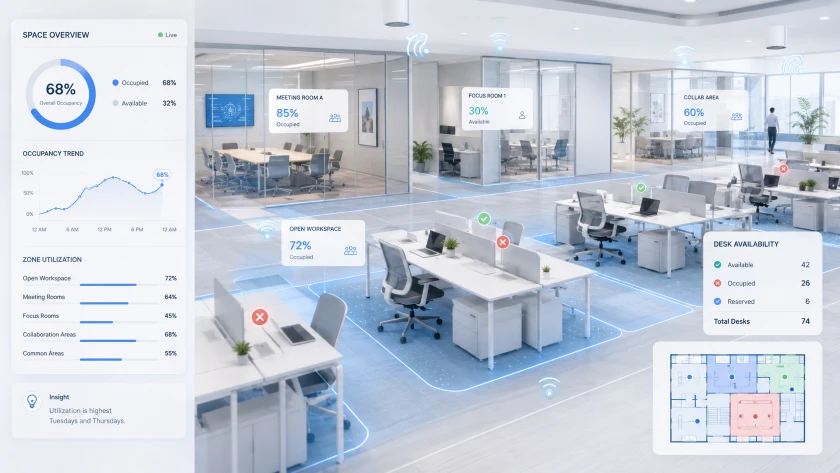
Hybrides Arbeiten hat die Raumplanung schwieriger gemacht. Manche Tage sind ruhig. Andere Tage überlaufen. Ein Team benötigt möglicherweise Fokusräume, während ein anderer Projektzonen benötigt.
Anwesenheitssensoren, Anwesenheitssensoren, BLE-Beacons, Smart-Badge-Standortdaten, und Personenzählgeräte zeigen, wie Räume tatsächlich genutzt werden.
Das hilft Teams:
• Verwandeln Sie ungenutzte Schreibtische in nützliche Räume
• Fügen Sie kleine Besprechungsräume hinzu, wenn große Räume missbraucht werden
• Passen Sie die Reinigung an die tatsächliche Nutzung an
• Reduzieren Sie den Energieverbrauch in leeren Zonen
• Planen Sie Mietverträge mit realen Daten
Dies ist eine klare Antwort darauf, wie sich das Arbeitsplatzerlebnis verbessern lässt: Sorgen Sie dafür, dass das Büro dem tatsächlichen Verhalten entspricht.
2. Intelligente Navigation und Orientierung
Große Büros und Campusgelände können schwierig zu durchqueren sein. Neueinstellungen, Besucher, und Mitarbeiter verlieren oft Zeit bei der Zimmersuche, Schreibtische, oder Servicebereiche.
Indoor-Navigationstechnologie kann Personen zu Besprechungsräumen führen, Schreibtische, Cafeterien, Druckzonen, Schulungsräume, Besucher-Check-in-Punkte, und Notausgänge.
Für Mitarbeiter, Dadurch wird Stress abgebaut. Für Manager, Es reduziert Verzögerungen und verbessert den täglichen Ablauf.
3. Intelligente Beleuchtung, Temperatur, und Luftfeuchtigkeit
Komfort beeinflusst, wie Menschen sich fühlen und arbeiten.
Luftqualitätssensoren können die Temperatur verfolgen, Feuchtigkeit, Beleuchtung, und Raumnutzung. Gebäudesysteme können dann Beleuchtung und HVAC je nach Belegung und Tageslicht anpassen.
Die USA. Die EPA weist darauf hin, dass der Innenraumkomfort von der Temperatur beeinflusst wird, Luftbewegung, Blendung, Lärm, Gerüche, und andere bauliche Faktoren. OSHA bringt auch schlechte Raumluftqualität mit Kopfschmerzen in Verbindung, Ermüdung, und Konzentrationsschwierigkeiten.
Durch IoT lässt sich Komfort einfacher verwalten, da Teams Muster erkennen können, anstatt nur auf Beschwerden zu reagieren.
4. Überwachung der Raumluftqualität
Mitarbeiter können eine schlechte Luftqualität nicht immer erkennen, aber sie können es fühlen.
IAQ-Sensoren verfolgen kann:
• CO₂
• Temperatur
• Luftfeuchtigkeit
• VOCs
• Feinstaub
• Belüftungsbedarf
Die EPA sagt, dass die Luftqualität in Innenräumen Auswirkungen auf die Gesundheit haben kann, Komfort, Wohlbefinden, und Produktivität. Die Leitlinien des CDC betonen außerdem den Wert einer guten Belüftung für ein gesünderes Raumklima.
Für Arbeitsplatzteams, IAQ ist jetzt Teil des Mitarbeitervertrauens. Ein Raum sollte nicht als fertig betrachtet werden, nur weil er im Kalender leer ist.
5. Asset-Tracking und -Management
Suche nach gemeinsam genutzter Ausrüstung wie Prototypen-Testkits, tragbare Projektoren, oder Spezialwerkzeuge verschwenden Stunden produktiver Zeit. Anbringen eines kleinen Bluetooth Low Energy (BLE) Mithilfe von Asset-Tags an Unternehmenshardware können Mitarbeiter über ein zentrales Dashboard genau herausfinden, wo sich ein Artikel befindet. Dadurch bleiben die Lagerbestände korrekt und die Werkzeuge sind bei Bedarf verfügbar.
6. Notfallevakuierung und Echtzeit-Ortungssysteme
Bei kritischen Gebäudenotfällen, Sicherheitsteams müssen genau wissen, wo sich Menschen befinden. Echtzeit-Ortungssysteme nutzen Smart Badges oder Wearables, um sofortige Belegungszahlen in bestimmten Sammelzonen zu ermitteln. Dadurch können Ersthelfer verpasste Standorte identifizieren und schneller koordinieren, sicherere Evakuierungen.
7. Vorausschauende Wartung für Gebäudesysteme
Wenn ein Büroaufzug kaputt geht oder die Hauptklimaanlage unerwartet ausfällt, Der Komfort der Mitarbeiter sinkt sofort. IoT-Vibrations- und Temperatursensoren überwachen rund um die Uhr schwere Baumaschinen. Durch frühzeitiges Erkennen von Verschleißerscheinungen, bevor es zu einem vollständigen Systemausfall kommt, Wartungsteams können Reparaturen außerhalb der Geschäftszeiten planen, Gewährleistung, dass es für die Arbeitnehmer keine Ausfallzeiten gibt.
So verbessern Sie das Arbeitsplatzerlebnis mit IoT
Ein Smart-Office-Projekt funktioniert am besten, wenn es klein anfängt und ein sichtbares Problem löst.
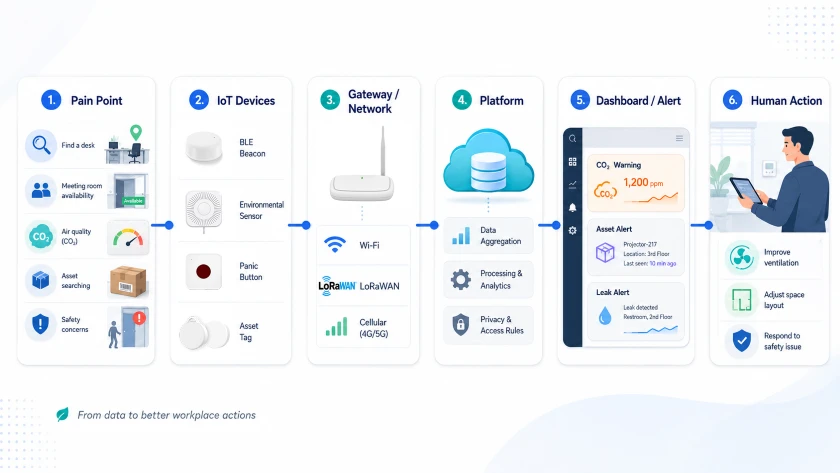
Schritt 1: Wählen Sie den Schmerzpunkt des Mitarbeiters aus
Stellen Sie eine einfache Frage. Haben die Leute Schwierigkeiten, Schreibtische zu finden?? Sind Tagungsräume schwer zu buchen?? Ist die Luftqualität unklar?? Sind Vermögenswerte schwer zu finden?? Ist Sicherheit ein Problem??
Beginnen Sie nicht mit „Wir brauchen Sensoren“. Beginnen Sie mit dem Mitarbeiterproblem.
Schritt 2: Ordnen Sie den Datenpfad zu
Jedes IoT-System braucht einen klaren Ablauf:
Gerät → Gateway oder Netzwerk → Plattform → Dashboard oder Warnung → Menschliches Handeln
Wenn niemand auf die Daten einwirkt, Das System bietet wenig Mehrwert.
Schritt 3: Wählen Sie die richtige Hardware
Kleine Büros benötigen möglicherweise BLE-Beacons, Gateways, und einfache Sensoren. Große Standorte benötigen möglicherweise LoRaWAN, W-lan, zellular, oder gemischte Systeme. In datenschutzrelevanten Bereichen ist möglicherweise eine kameralose Erfassung erforderlich.
Schritt 4: Legen Sie Datenschutzregeln fest
Mitarbeiter sollten sich nicht beobachtet fühlen.
Definieren Sie, welche Daten erfasst werden, wer kann es sehen, wie lange es gelagert wird, und ob es an Einzelpersonen gebunden ist. In vielen Fällen, Aggregierte Daten reichen aus.
Schritt 5: Verbinden Sie Daten mit Vorgängen
Dashboards allein verbessern das Arbeitsplatzerlebnis nicht. Workflows tun es.
Zum Beispiel:
• Hoher CO₂-Gehalt → Belüftung erhöhen
• Ungenutzter Raum → Layout überprüfen
• Asset verlässt die genehmigte Zone → Benachrichtigung senden
• Leck erkannt → Wartung einleiten
• Paniktaste gedrückt → Einsatzteam benachrichtigen
IoT schafft Mehrwert, wenn es verändert, was Teams als nächstes tun.
Optimieren Sie Ihren Unternehmensarbeitsbereich mit Minew
Ein intelligenter Arbeitsplatz ist auf zuverlässige Hardware angewiesen. Sensoren müssen genaue Daten sammeln. Tags müssen zu echten Vermögenswerten passen. Gateways müssen tote Winkel reduzieren. Geräte müssen den richtigen Bereich unterstützen, Akkulaufzeit, Größe, und Konnektivität.
Minen bietet IoT-Hardware für Smart Spaces, Nachverfolgung von Gütern, Umweltsensorik, Mitarbeiterführung, und damit verbundene Abläufe. Die Produktpalette umfasst Asset-Tracker, Bluetooth-Beacons, Personal-Tags, Sensoren, Repeater, und Gateways
.
Minew unterstützt auch Hardware-Design, mechanisches Design, eingebettetes Design, schnelles Prototyping, Qualitätstechnik, Fabrikproduktion, weiße Beschriftung, und Einhaltung gesetzlicher Vorschriften.
Für Arbeitsplatzprojekte, Minew kann unterstützen:
• Belegungserkennung für Schreibtische und Räume
• BLE-Beacon-basierte Wegfindung im Innenbereich
• Überwachung der Luftqualität und des Komforts
• Asset-Tracking für gemeinsam genutzte Geräte
• Personalausweise für Sicherheit und Standortbewusstsein
• Paniktasten für Notfallalarme
• Gateways für BLE, LoRaWAN, W-lan, und andere IoT-Systeme
• Maßgeschneiderte Hardware für Systemintegratoren und Lösungsanbieter
Für Unternehmensimmobilienteams, Minew-Hardware kann dabei helfen, die Leistung im Büro messbar zu machen. Für Systemintegratoren, Es stellt die Geräteschicht für intelligente Arbeitsplatzplattformen bereit. Für Facility Manager, Es macht Vorgänge einfacher zu erkennen und zu handhaben.
Abschluss: Die Zukunft der Arbeit ist intelligent
Eine starke Arbeitsplatzerfahrung in 2026 bedeutet, dass Mitarbeiter das Büro betreten können, finden, was sie brauchen, Bleiben Sie bequem, sich sicher fühlen, und arbeiten Sie mit weniger Verzögerungen.
IoT macht dies möglich, indem es Arbeitsplatzteams Live-Signale aus Räumen sendet, Vermögenswerte, und Baubedingungen.
Die besten Smart Offices werden sich einfach anfühlen. Zimmer werden leichter zu finden sein. Die Ausrüstung wird leichter zu finden sein. Sicherheitswarnungen werden schneller sein. Die Wartung wird durchgeführt, bevor die Mitarbeiter das Problem spüren.
Das ist die praktische Antwort darauf, wie sich das Arbeitsplatzerlebnis mit IoT verbessern lässt: Reibungsverluste im Arbeitsalltag beseitigen, ein echtes Problem nach dem anderen.
Weitere Informationen zum Aufbau eines besseren Arbeitsplatzerlebnisses, Sehen Sie sich unsere empfohlene Lektüre an:
👉 Spitze 5 Tipps zur Sicherheit am Arbeitsplatz
👉 IoT am Arbeitsplatz: Wie IoT den Service für Büroraummanagement erweiterte,?
👉 Innennavigationstechnologien: Den „Richtungssinn“ in Innenräumen beleuchten
👉 Wie die People-Counting-Technologie die Business Intelligence revolutioniert
 Jetzt chatten