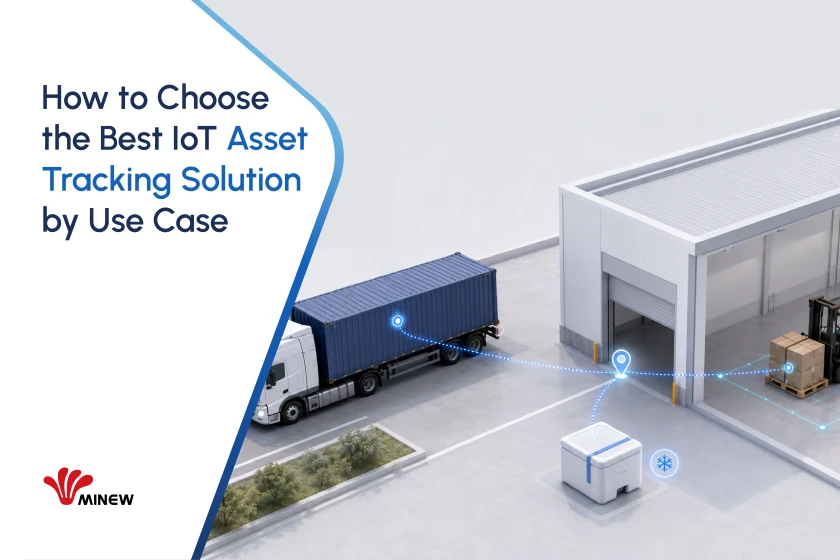
How to Choose the Best IoT Asset Tracking Solution by Use Case

The best IoT asset tracking solution depends on your specific environment. For long-range tracking, GPS and cellular networks are ideal. LoRaWAN excels in campuses and industrial sites, while BLE and UWB lead in precise indoor positioning. This article explores the top options and technical considerations for each scenario.

最后更新: 七月 31, 2026 3 阅读分钟数
How to Choose the Best IoT Asset Tracking Solution by Use Case

A missing tool can delay production. A misplaced medical device can slow patient care. A temperature change can put an entire shipment at risk. 在每种情况下, the business needs the same basic answers: Where is the asset? What condition is it in? Is it being used as planned?

IoT asset tracking helps teams answer these questions with connected tags, 传感器, 网关, 和软件. It can reduce search time, improve inventory accuracy, prevent loss, and help staff respond to problems sooner.

然而, no single tracking technology fits every environment. A container moving between countries has different needs from a tool inside a factory. A hospital may need room-level visibility for some devices and centimeter-level location for critical equipment.

The best IoT asset tracking solution therefore depends on the use case. GPS and cellular connectivity are often suitable for remote outdoor assets. LoRaWAN supports low-power monitoring across campuses and industrial sites. BLE offers a practical option for indoor tracking, while UWB supports applications that need very precise location data.

This guide explains how these technologies work, where each one fits, and what to consider before moving from a pilot to a larger deployment.


What Should You Define Before Choosing a Solution?

The most effective asset tracking projects begin with an operational goal. Technology selection becomes much easier once the business knows what event it wants to detect.

Common goals include:

• Finding equipment inside a facility
• Confirming that an asset remains in an approved zone
• Tracking a vehicle or shipment during transport
• Identifying unauthorized asset movement
• Monitoring temperature, 湿度, 震惊, 或振动
• Improving asset utilization
• Reducing manual inventory work
• Supporting safety rules around vehicles and machinery


A project designed to confirm whether a pallet is in a warehouse does not need the same accuracy as a system that guides an automated vehicle. Clear requirements help the team control cost, 电力使用, and infrastructure needs.

Deployment Environment

The first question is where the asset will operate.

Indoor environments often contain walls, metal racks, 机器, 人们, and stored goods. These objects can affect radio signals. 低功耗蓝牙, UWB, 和 Wi-Fi are common indoor options because they work with local infrastructure.

Outdoor assets may travel across cities, regions, or countries. GNSS can provide outdoor coordinates, while cellular networks can send the data to a cloud platform.

Some assets move between both environments. A shipment may travel on a highway, enter a distribution center, and remain inside a warehouse for several days. These journeys may benefit from a hybrid tracker that can use different positioning methods.

Asset Movement and Value

A moving vehicle may require frequent location updates. A fixed machine may only need presence, 状况, and tamper monitoring.

Asset value also shapes the system design. High-value equipment may justify more precise tracking, shorter reporting intervals, and stronger physical protection. 例如, a hospital may use precise location tracking for mobile imaging equipment, while a construction company may add tamper alerts and frequent movement reports to valuable machinery.

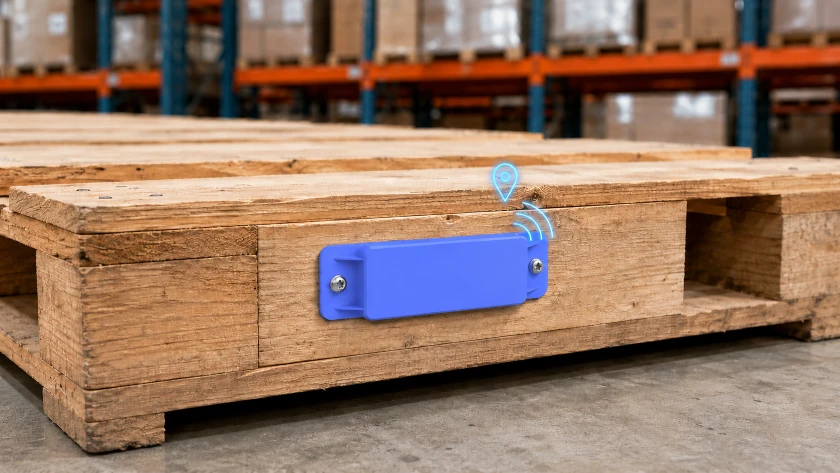
Lower value items often need an economical tag that can be deployed in large numbers. A warehouse may attach simple 蓝牙低功耗标签 to thousands of pallets, 垃圾箱, or reusable containers. 在这种情况下, low device cost, 电池寿命长, and simple installation may matter more than exact location.

Asset Movement and Value of asset tracking

Available Power

Vehicles and powered machines can often support frequent data transmission. 托盘, 容器, 工具, and returnable packaging usually depend on batteries.

Battery life can vary with:

• Reporting frequency
• Sensor sampling rate
• Network signal quality
• Positioning method
• Transmission retries
• Operating temperature
• Motion detection settings
• Battery type and capacity

Reviewing these factors together helps teams estimate maintenance needs more accurately. It also makes product comparisons more meaningful.

Required Location Accuracy

Accuracy should match a real business decision.

A logistics team may only need to know that a container has arrived at a port. A warehouse may need aisle-level location. A hospital may need to identify the room containing a device. A factory safety application may need the exact distance between a worker and a moving vehicle.

Selecting the right accuracy level helps avoid unnecessary infrastructure while still delivering the information that staff need.

IoT Asset Tracking Technologies Compared

The following table provides a practical overview. Actual performance depends on device design, 安装, building materials, gateway placement, network conditions, and software configuration.

技术Typical location result覆盖范围Power profileRelative costSuitable applications
低功耗蓝牙Zone, 房间, or meter-level location, depending on system designLocal indoor coverage低的低的工具, 存货, hospital equipment, and personnel badges
UWBDecimeter or centimeter-level locationDefined indoor area中等的Medium to highPrecise asset location, process control, and safety applications
Wi-FiZone or room-level location in many deploymentsBuildings with Wi-Fi coverage中等的Low to mediumWi-Fi enabled devices and general indoor visibility
洛拉万地点, 区, or broad location, depending on the positioning source校园, industrial site, farm, or city低的Low to mediumSlow-moving assets, 工业设备, 和传感器网络
GNSS with cellularMeter-level outdoors under suitable conditionsRegional or global, based on cellular coverageMedium to highMedium to highVehicles, 容器, trailers, and outdoor equipment
Cellular positioningBroad area or cell-level location宽面积中等的中等的Remote monitoring and backup location

These technologies often work together. One radio may calculate or support location, while another carries data to the platform.

例如, a tracker may use GNSS to determine its outdoor position and LTE-M to send the coordinates. A cold chain system may use BLE sensors to collect temperature readings and a cellular gateway to upload them.

Best IoT Asset Tracking Solutions by Use Case

1. Remote and Outdoor Mobile Assets

Recommended Approach: GNSS With Cellular Connectivity

GNSS combined with LTE-M or NB-IoT is a strong choice for assets that travel across wide outdoor areas.

Typical applications include:

• Fleet and trailer tracking
• Shipping containers
• Construction machines
• Mobile generators
• High-value cargo
• Field equipment
• Remote infrastructure

GNSS provides location coordinates when the tracker has suitable access to satellite signals. Cellular connectivity sends location and sensor data to the tracking platform.

Real-world GNSS performance depends on satellite geometry, receiver design, 大气条件, and nearby signal obstructions.

Design Considerations

Update frequency should reflect the asset’s movement and available power. A powered vehicle may support frequent reporting. A battery-powered container may use scheduled reports and movement-triggered updates.

The project team should also consider:

• Cellular coverage along the complete route
• Supported carrier bands
• Regional roaming
• Local data storage during network loss
• Device enclosure rating
• Temperature range
• Tamper detection
• Remote configuration
• Firmware update support

米纽的 MTB04 5G运输标签 combines GPS with NB-IoT and LTE-M connectivity. It is designed for shipment visibility and can also support condition monitoring for sensitive or high-value goods.

MG5 室外移动 LTE 网关 combines GPS, cellular connectivity, and Bluetooth data collection. It can collect data from nearby BLE sensors and send that information to a cloud platform.

When a Hybrid Design May Help

Satellite signals can become weaker inside buildings, under dense structures, or inside metal containers. Assets that move between outdoor and indoor areas may benefit from a second positioning method, 例如蓝牙低功耗.

This allows the same device or system to provide outdoor coordinates during transport and indoor presence information after arrival.

2. 校园, Industrial Sites, Farms, 一个d Yards

Recommended Approach: 洛拉万

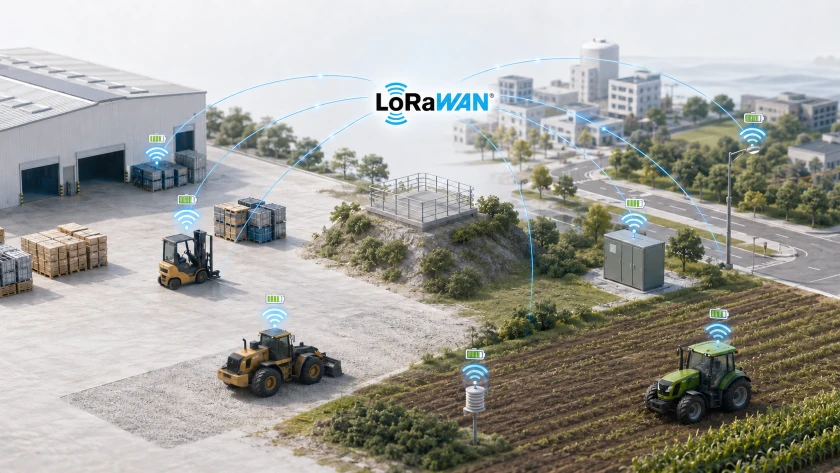
洛拉万 is designed to send small amounts of data across long distances while keeping device power use low. It is well suited to large sites where organizations can install private gateways or connect to an available public network.

Common applications include:

• Industrial equipment monitoring
• Yard asset tracking
• Agricultural equipment
• Utility infrastructure
• Smart city assets
• Returnable transport items
• Slow-moving outdoor equipment
• Environmental sensors


LoRaWAN can support long operating periods because devices can remain inactive between reports.

Recommended Approach of asset tracking LoRaWAN

Understanding LoRaWAN Positioning

LoRaWAN mainly provides communication. The asset’s location can come from several sources:

• GNSS inside the tracker
• Gateway coverage zones
• Network-based geolocation
• Nearby BLE or Wi-Fi signals
• A known installation record

This gives system designers several ways to balance accuracy, 电池寿命, 和成本.

The LoRa Alliance states that network geolocation can support slow-moving assets that send location updates at longer intervals. Applications requiring very frequent updates may need a different design because faster reporting increases energy and network use.

米纽的 LTB01-S LoRaWAN® Solar-Powered GPS Asset Tracker combines GPS positioning, LoRaWAN communication, and tamper detection. It can support outdoor asset visibility within areas covered by suitable LoRaWAN gateways.

Where LoRaWAN Fits Best

LoRaWAN is a strong candidate when the business needs periodic location or status information rather than a continuous movement trail.

If an application needs exact indoor positioning or very fast proximity alerts, BLE or UWB may provide a closer match.

3. Indoor Tools, 设备, and Inventory

Recommended Approach: 低功耗蓝牙

BLE offers an economical and low-power way to track large numbers of indoor assets.

A BLE tag regularly broadcasts its identifier so that fixed gateways, 移动设备, or Bluetooth locators can detect it. Some BLE trackers also contain sensors for movement, 温度, 湿度, 光, or tamper detection. These devices can provide location information and condition monitoring through the same wireless connection.

Software uses the received data to report presence, 区, 房间, estimated position, or asset condition.

BLE is suitable for questions such as:

• Is the asset inside the building?
• Which room or zone contains it?
• When was it last detected?
• Has it left an approved area?
• Has someone removed the tag?
• Does the battery need attention?


Typical applications include:

• Warehouse tools
• Medical equipment
• Manufacturing assets
• Office equipment
• Inventory containers
• Reusable packaging
• Personnel badges

Planning BLE Coverage

蓝牙范围 is not one fixed distance. It depends on radio power, 接收器灵敏度, 天线设计, physical barriers, and local radio conditions.

The Bluetooth SIG explains that effective Bluetooth range can vary from less than one meter to more than one kilometer, depending on the product and environment.

For an indoor project, teams should test:

• Gateway positions
• Mounting height
• Walls and room boundaries
• Metal shelving
• Tag placement on the asset
• Normal staff and vehicle movement
• Busy and quiet operating periods

Testing under normal working conditions helps the team confirm coverage and adjust gateway placement before wider deployment.

Improving BLE Location Results

BLE systems can support different accuracy levels.

Basic gateway detection can show whether a tag is present in a zone. Signal analysis can estimate which gateway is closest. More advanced Bluetooth locating methods can support finer location results when the infrastructure and software are designed for that purpose.

The right option depends on the required accuracy and project budget.

4. Precise Indoor Asset Location

Recommended Approaches: Bluetooth AoA and UWB

Bluetooth Angle of Arrival and UWB are suitable when room or zone detection does not provide enough detail. Both technologies can locate assets more precisely within a defined indoor area, but they use different methods and infrastructure.

蓝牙迎角

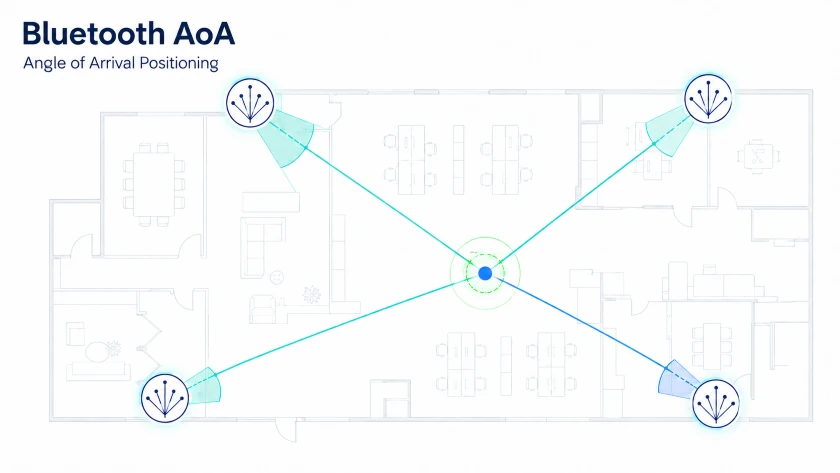
蓝牙迎角 uses antenna arrays in fixed locators to measure the direction from which a Bluetooth signal arrives. The location system combines angle measurements from one or more locators to estimate the position of the transmitting tag.

AoA can be a practical choice for businesses that want more precise indoor tracking while continuing to use low-power Bluetooth tags. Typical applications include:

• Tools and equipment in factories
• Medical devices in hospitals
• Warehouse inventory
• Work in progress
• Personnel location
• Indoor navigation

A Bluetooth AoA deployment may include compatible tags, 迎角定位器, 网关, and location software. Locator height, 方向, 覆盖范围, and line of sight can affect accuracy.

米纽的蓝牙 5.1 AoA Indoor Positioning combines AoA locators, a gateway, and compatible Bluetooth beacons. It is designed to support sub-meter indoor positioning under suitable deployment conditions.

Bluetooth aoa Precise Indoor Asset tracking

UWB

UWB measures signal travel time between tags and fixed anchors. This allows a well-designed system to locate assets with very high accuracy.

The FiRa Consortium states that UWB can provide real-time positioning with up to centimeter-level accuracy. These systems commonly use synchronized anchors and UWB tags.

Typical applications include:

• Critical hospital equipment
• Manufacturing tools
• Work in progress
• Automated vehicle guidance
• Restricted area monitoring
• Worker and vehicle proximity
• High-value indoor assets

Choosing Between AoA and UWB

Bluetooth AoA can suit projects that need sub-meter positioning, 低功耗标签, and compatibility with a wider Bluetooth system. UWB is often considered when the application needs centimeter-level accuracy or precise distance measurement.
The final choice should reflect:

• Required accuracy
• Tag power needs
• Number of tracked assets
• Update frequency
• Existing wireless infrastructure
• Installation conditions
• Integration requirements
• Project budget


A pilot should include:

• Corners and doorways
• High shelving
• Large metal objects
• Elevators and stair areas
• Fast-moving assets
• Crowded production zones
• Areas with limited installation access

Teams that only need room-level visibility may find that standard BLE provides enough information. Bluetooth AoA can support finer indoor positioning, while UWB becomes valuable when exact position supports a clear safety, 工作流程, or productivity goal.

5. Cold Chain Logistics and Storage

Recommended Approach: Location Plus Condition Sensing

Cold chain asset tracking must provide more than a location point. The system also needs to show whether goods remained within their approved environmental limits.

A typical mobile solution may include:

• GNSS for outdoor location
• Cellular connectivity for data transmission
• Temperature and humidity sensors
• Light or door detection
• Shock and vibration sensing
• Local data storage
• Automatic alerts
• A cloud platform for records and reports

This design supports pharmaceuticals, 食物, fresh produce, biological materials, and other temperature-sensitive goods.

Turning Sensor Data Into an Operational Response

Cold chain alerts should be based on the product and shipping process. The team should define:

• Approved temperature and humidity limits
• How long an excursion can continue
• Who receives the alert
• How quickly staff should respond
• What action staff should take
• How the event is documented
• How records are exported for review

Location and condition data are most useful when they share the same shipment record. This helps the business understand where an excursion happened and how long it continued.

Minew offers several devices for this architecture. 这 MST01工业温度和湿度传感器 is intended for cold storage, 仓库, 和环境监测.

The MTB04 shipping label can combine outdoor position with condition data. The MG5 gateway can collect readings from nearby BLE sensors and upload them through a cellular connection.

Quick Asset Tracking Selection Matrix

The following matrix can help teams create an initial technology shortlist.

Business needTechnology to assess firstMain benefitKey planning point
Track vehicles across wide areasGNSS with cellularOutdoor position and wide area communication覆盖范围, roaming, and power
Monitor equipment across an industrial siteLoRaWAN with a suitable location sourceLong range and low powerGateway coverage and reporting interval
Find assets by room or work zone低功耗蓝牙Low tag cost and long battery lifeGateway placement and indoor signal conditions
Locate an asset at an exact indoor positionUWBVery high positioning accuracyAnchor design and installation
Monitor sensitive goods in transitGNSS, 细胞的, and condition sensorsLocation and environmental visibilityAlert limits, 校准, and offline records
Follow assets from road to warehouseHybrid GNSS and BLEIndoor and outdoor visibilityPositioning handover and asset identity

From Pilot to Full Deployment

A structured pilot helps confirm technical performance and business value before the system expands.

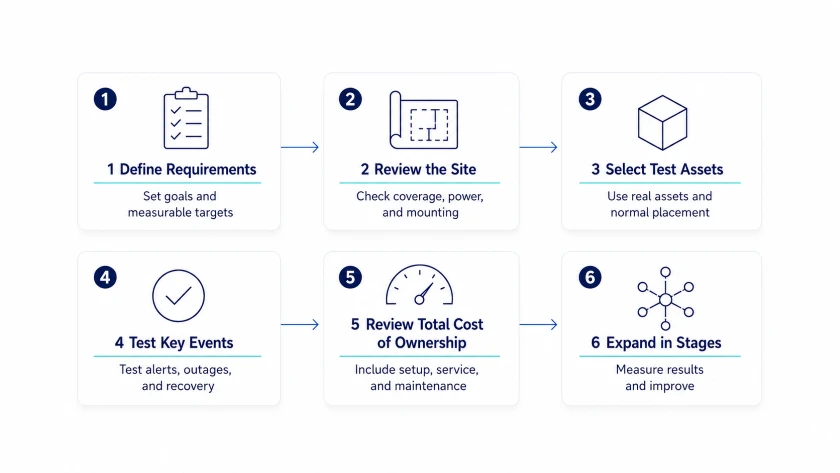
Full Deployment of asset tracking

步 1: Define Measurable Requirements

Before selecting a solution, define:

• Asset types and quantities
• Indoor and outdoor areas
• Required location accuracy
• Reporting frequency
• Battery life target
• Environmental conditions
• Sensor requirements
• Security needs
• Platform and integration requirements
• Available budget

Replace broad terms with measurable targets. Instead of requesting real-time updates, state the acceptable delay between asset movement and platform visibility.

步 2: Review the Operating Environment

Inspect building materials, 搁架, outdoor boundaries, available power, network connections, and mounting options.

This review helps determine the number and position of gateways or anchors.

步 3: Select Representative Assets

Test real assets with their normal mounting positions. Metal equipment, plastic containers, wooden pallets, and moving vehicles can produce different radio results.

The pilot should include common operating areas as well as locations that may be more difficult to cover.

步 4: Test Normal Events and Exceptions

Create a practical test plan that includes:

• Asset movement
• Zone entry and exit
• Temporary network loss
• Low battery
• Gateway interruption
• Tag removal
• Temperature excursions
• Missed reports
• Recovery after connectivity returns

This confirms that the system can detect the event, notify the correct person, and preserve the necessary data.

步 5: Review Total Cost of Ownership

Total cost may include:

• Tags, 追踪器, 传感器, 网关, and anchors
• Cellular and platform subscriptions
• Installation
• Network planning
• Device provisioning
• Battery replacement
• Firmware management
• Calibration
• Software integration
• Device replacement
• Technical support

The most suitable option balances hardware cost with installation, 维护, and operational value.

步 6: Expand in Stages

A business can scale by building, 路线, asset class, or operating team. Each stage should measure:

• Successful location updates
• Alert delivery time
• Battery performance
• Gateway availability
• Device failure rate
• Staff response
• Time saved
• Asset loss or recovery results

These measurements help teams improve settings and operating procedures as the deployment grows.

Minew Asset Tracking Hardware at a Glance

Minew provides four main device categories for different asset tracking needs:

信标: 袖珍的, 轻的, and low-power designs make them easy to install or integrate. 蓝牙信标 are suitable for indoor positioning, asset presence detection, and zone management.

追踪器: 资产追踪器 support indoor, outdoor, or hybrid positioning. Selected models combine location tracking with temperature, 移动, 倾斜, 环境光, or tamper monitoring. Pick-to-light and sound functions can also help warehouse staff find items faster.

传感器: Support condition monitoring for industrial and logistics applications. 物联网传感器 options include vibration monitoring for predictive maintenance, temperature and humidity monitoring for cold chains, ambient light and tamper detection for shipment security, and ToF sensing for stock or material level monitoring.

网关: Collect BLE or LoRaWAN data and send it to business platforms. Indoor and outdoor models are available with backhaul options such as 4G, Wi-Fi, 以太网, and PoE.

结论: Build Asset Tracking Around the Use Case

The best IoT asset tracking solution in 2026 is the one that fits the asset, 环境, and business goal.

GNSS with cellular connectivity is a strong choice for remote outdoor movement. LoRaWAN supports low-power reporting across large managed sites. BLE provides an economical path to indoor asset visibility. UWB supports applications that need very precise indoor location. Cold chain projects can combine tracking with environmental sensors to protect sensitive goods.

The final design should balance accuracy, 覆盖范围, 电池寿命, reporting speed, 基础设施, 安全, and total cost. A focused pilot can confirm these factors under real operating conditions.

With its range of tags, 追踪器, 网关, 和传感器, Minew can support asset tracking across indoor, outdoor, 工业的, 后勤, and cold chain environments. By matching the right hardware to each use case, businesses can create a reliable system that improves visibility and supports faster operational decisions.

常问问题
  • What Business Value Can IoT Asset Tracking Provide?
    IoT asset tracking can reduce equipment loss, search time, manual inventory work, rental costs, product damage, and process delays. It can also improve inventory accuracy and asset utilization. Businesses can measure the value by comparing these operating costs and performance indicators before and after deployment.
  • Is GPS Always the Best Option for Outdoor Assets?
    GPS or another GNSS is often a suitable outdoor positioning source when the tracker has access to satellite signals. The complete solution must also consider data communication, 力量, sensor needs, local storage, and indoor operation. Cellular, 洛拉万, 低功耗蓝牙, or other technologies may work with GNSS as part of the final design.
  • Can LoRaWAN Provide Asset Location?
    是的, but the location method depends on the system. A LoRaWAN tracker may include GNSS. It may also use network geolocation, gateway zones, 低功耗蓝牙, or Wi-Fi observations. The best method depends on the required accuracy, 报告频率, 覆盖范围, and battery target.
  • Is BLE Accurate Enough for Indoor Asset Tracking?
    BLE is often suitable for presence, 区, 房间, and approximate indoor location. Results depend on gateway placement, building materials, tag position, and software design. A site pilot can confirm whether BLE meets the required accuracy. If the application needs an exact position, UWB or Bluetooth AoA may be more suitable.
  • When Should a Business Choose UWB?
    UWB is a strong option when very precise indoor location supports a valuable operational result. Examples include locating critical medical equipment, controlling work at a production station, monitoring restricted areas, or supporting worker and vehicle safety. For general room or zone visibility, BLE may offer a more economical approach.
  • How Can Businesses Protect Tracking Data?
    Use authenticated devices, encrypted communication, controlled user access, secure firmware updates, and clear data retention rules. Security requirements should be included during initial system planning. This helps the hardware, 网络, and software teams follow the same protection model.
  • How Should a Company Begin a Minew Asset Tracking Project?
    Start by documenting the asset, 环境, 准确性, 报告间隔, power source, sensor needs, and software interfaces. Minew or an integration partner can then recommend suitable tags, 追踪器, 网关, 和传感器. A small pilot with real assets can confirm coverage, battery performance, and workflow before the project expands.
上一篇: 物联网如何解决常见的最后一英里物流挑战
在线聊天

想知道该产品是否适合您的业务? 与真实的人聊天.

现在聊天 现在聊天 电子邮件
谢谢 我们的团队将通过电子邮件回复您 24 小时. 如果您没有收到, 请检查您的垃圾邮箱.