How to Reduce Cold Chain Spoilage Using Real-time IoT Solutions

Minew 四月. 30. 2026
目录

    Ensuring product integrity in modern cold chain management is no longer just a logistical requirement; it is a global necessity. From life-saving vaccines and sensitive pharmaceuticals to fresh produce and seafood, temperature-sensitive goods must remain within strict specifications at every stage: in storage, during loading, in transit, and at final delivery. A single delayed handoff or a warehouse door left open for just minutes can compromise an entire batch, leading to massive financial loss and public health risks.

    Reduce Cold Chain Spoilage Using Real-time IoT Solutions

    截至 2026, the global cold chain market has grown into a $400 billion industry. 然而, financial growth hasn’t fully solved thewasteepidemic. 大约 14% of food is still lost before it even reaches the shelf, and a staggering 50% of vaccines are wasted annually due to inadequate cooling. These figures highlight a critical gap: as the market scales, the need for smarter, more reliable temperature management has never been more urgent.


    What is Cold Chain Management?

    Cold chain management is the strategic process of managing and optimizing the flow of temperature- and humidity-sensitive products. While often confused with simple temperature monitoring, cold chain management is a comprehensive discipline that goes beyondkeeping things cold.

    To solve the limitations of basic data collection, management focuses on ensuring products stay within validated limits across every link in the chain. Any deviation must be detected, handled, and documented for compliance.

    This process covers controlled storage, location visibility, and the compliance records required for GDP (Good Distribution Practice) and HACCP (Hazard Analysis and Critical Control Point) audits.

    What is Cold Chain Management

    Primary Risks in Cold Chain Logistics

    • Temperature Excursions: Out-of-range events that degrade product efficacy.
    • Spoilage & Waste: Financial losses from unmarketable food or expired medicine.
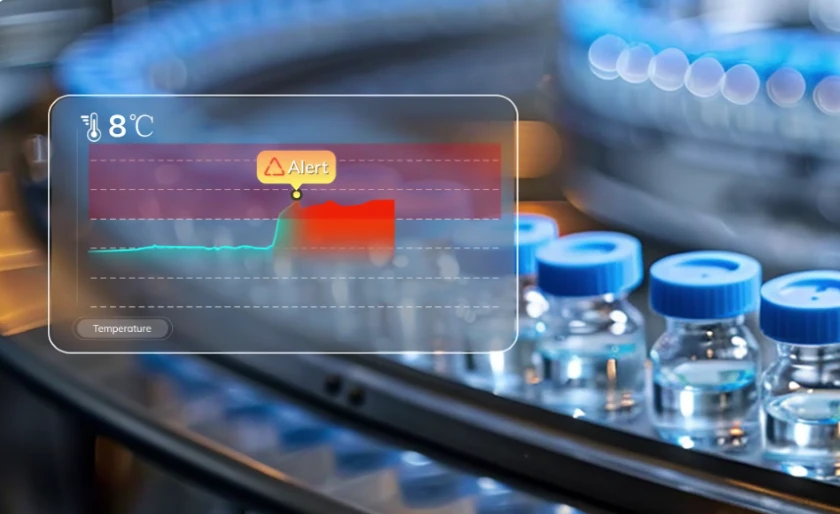
    • 这 “Danger Zone”: For food, the range between 4°C and 60°C where bacteria flourish. 为了 药品, even a narrow deviation from the standard 2°C to 8°C range can render biological products ineffective.
    • Compliance Gaps: Failure to provide a continuous, 24/7 audit trail for regulatory inspectors.


    Why is IoT Critical for Modern Cold Chain Logistics?

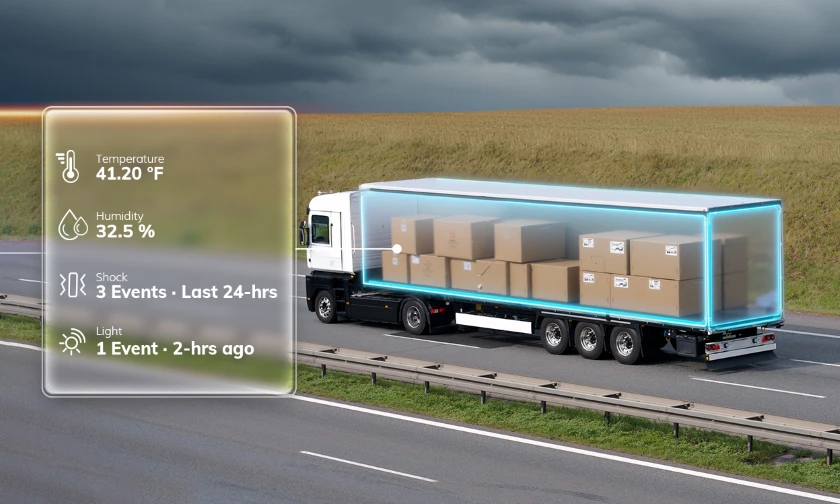
    Traditional cold chain management often relies on manual data logging, which creates “盲点” during transit. To solve the problem of delayed visibility, IoT technology introduces 自动化的, wireless systems that monitor environments continuously.

    • Risk Mitigation: IoT systems identify temperature excursions the moment they happen. This allows for immediate corrective action before product loss occurs, saving thousands in potential waste.
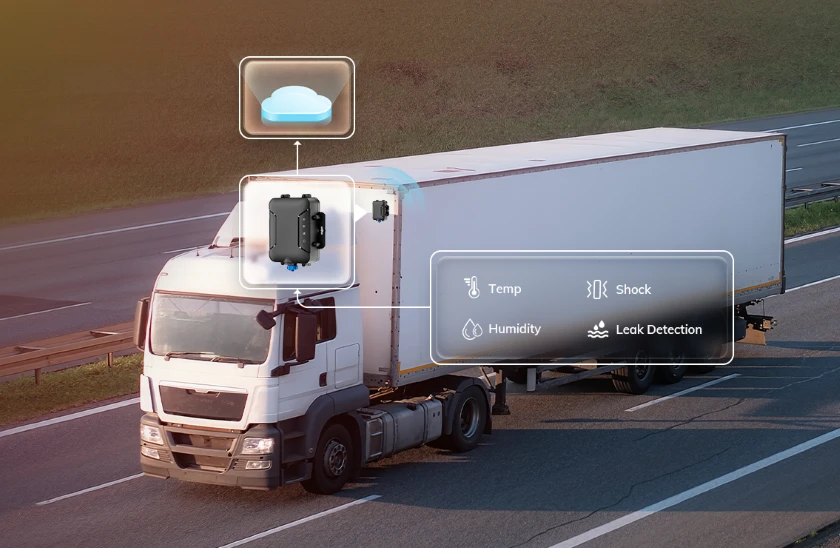
    • Overcoming Traditional Barriers: Unlike passive loggers that require physical retrieval to download data, 物联网传感器 transmit data to a locally positioned gateway within the refrigerated unit, which then relays the information to the cloud via specfc


    How an End-to-End IoT Cold Chain System Works

    A robust cold chain solution functions through a three-layer architecture designed for data integrity and persistent connectivity.

    1.Data Collection Layer

    The process begins with BLE Temperature and Humidity Sensors. These devices are placed inside containers or pallets. They utilize low-energy protocols to broadcast environmental data at set intervals without draining battery life.

    Data Collection Layer

    2.Transmission Layer

    物联网网关 act as the bridge. These devices scan for BLE signals and transmit the gathered data to the cloud via Wi-Fi, LTE (Cellular), 或以太网. This ensures that even if a vehicle is in motion, the data reaches the management dashboard.

    Transmission Layer

    3.Data Visualization and Actionable Alerts

    The final layer involves API integration. Raw data is converted into actionable insights, triggering SMS or email alerts if temperatures deviate from the pre-set safety range.

    Data Visualization and Actionable Alerts

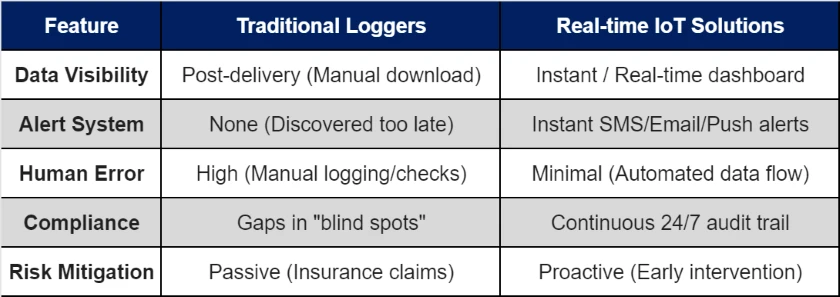
    Technology Comparison: Traditional vs. IoT Real-time Monitoring

    Traditional vs. IoT Real-time Monitoring

    案例研究: Mitigating Risk During a Cross-Border Pharmaceutical Shipment

    To understand the practical impact of IoT, consider the logistical challenge of transporting biologics (such as insulin or specialized vaccines) from a manufacturing hub in Europe to a distribution center in North America. This scenario involves multiple hand-offs between air cargo, customs, and local trucking.

    Case Study of Reduce Cold Chain

    挑战: 这 “Black Boxof Transit

    Without Iot, the manufacturer only knows the condition of the cargo at the start and end of the journey. If a refrigeration unit fails during a 6-hour customs delay, the damage is only discovered days later, leading to the total loss of the shipment and potential patient safety risks. Beyond temperature loss, the shipment is also vulnerable to theft or unauthorized access.


    The IoT Solution: 这 “LiveLogistics Workflo

    1. Preparation Phase: Ruggedized BLE sensors are attached to individual pallets and activated upon dispatch. This initial step establishes a unique digital identity for each shipment unit, enabling granular tracking throughout the supply chain.

    2. Transit Phase: During movement, sensors broadcast real-time temperature, 湿度, and light data at preset intervals to a mobile IoT gateway located in the truck or cargo hold. This continuous data stream ensures that environmental visibility remains uninterrupted, preventing data gaps during transit.

    3. Border and Customs Phase: If logistics delays occur and temperatures exceed the threshold, the gateway triggers an instant SMS alert to the manager for temperature excursions or unauthorized container openings detected by light sensors. This immediate notification allows for rapid intervention, such as relocating the pallet to cold storage, before product degradation occurs.

    4. Delivery Phase: Upon arrival, the system automatically generates a comprehensive PDF compliance report via API. By digitizing the verification process, this phase eliminates the need for manual inspections and significantly accelerates theRelease to Markettimeline.


    Real-World Success of IoT Sensors in Hong Kong Medical Facilities

    Beyond transit, real-time visibility is equally vital for static healthcare infrastructure. To eliminate operational blind spots in complex medical environments, Minew deployed a large-scale LoRaWAN sensor network across Hong Kong medical facilities. LoRaWAN was specifically chosen for its superior long-range penetration and ability to transmit data through the thick concrete walls and dense infrastructure typical of hospital campuses.

    By integrating specialized door, 被动红外, environment, and air quality sensors, the system provides real-time visibility into room occupancy and climate stability.

    Real-World Success of IoT Sensors in Hong Kong Medical Facilities

    This unified infrastructure automates compliance, strengthens security, and streamlines facility management through ultra-low-power, 远程连通性. By replacing manual processes with real-time data, the system has already achieved measurable gains in operational efficiency and environmental safety across all active healthcare sites.


    Comprehensive Hardware Ecosystem for Scalable Cold Chain Success

    To solve the complexities of diverse logistical environments, Minew provides a robust ecosystem of BLE, 洛拉万, and Cellular sensors paired with multi-protocol gateways. Our specialized hardware kits offer immediate deployment capabilities, while our flexible OEM/ODM services ensure tailored designs for specific industrial needs. Backed by expert technical support, we help integrators minimize downtime and maximize ROI through seamless hardware-to-cloud integration and durable, long-life IoT devices. Contact our team for services and support at any time.


    常问问题: Essential IoT Cold Chain Knowledge

    What is the best IoT technology for cold chain tracking?

    It depends on the use case. 低功耗蓝牙 (paired with LTE-M gateways) is the gold standard for in-transit tracking due to its cost-efficiency and pallet-level granularity. 然而, for static facilities like hospitals or large warehouses, 洛拉万 is the superior choice for its deep building penetration and long-range coverage.

    How does IoT ensure compliance with GDP and HACCP?

    IoT systems satisfy Good Distribution Practice (GDP) and Hazard Analysis and Critical Control Points (HACCP) by providing unalterable digital logs. Automated reporting replaces prone-to-error paper trails with time-stamped, 加密数据.

    Can IoT sensors work inside deep-freeze environments?

    是的. Industrial-grade IoT sensors are specifically rated for temperatures as low as -30°C or even lower. These devices use specialized lithium batteries and ruggedized, moisture-resistant enclosures to prevent hardware failure in extreme cold.

    How do IoT sensors handle signal interference in metal containers?

    To solve signal attenuation in dense metal environments, industrial gateways utilize high-gain antennas and strategic placement. 此外, BLE sensors use frequency hopping to maintain stable connections, while the sensorsinternal memory buffers data locally to ensure no information is lost if a temporary disconnect occurs during transit.


    上一篇: 弥合差距: 室内外追踪的演变