


IoT applications help businesses use device data in everyday operations. They can show where equipment is, flag changes in storage conditions, or adjust building systems based on occupancy. What each application does depends on the task, the data available, and how people or systems respond.
Across industries, the technology often overlaps, but the requirements differ. Tracking a shipment involves different coverage and reporting needs from monitoring a factory motor or managing hospital equipment. Understanding those differences helps teams decide what to measure, how often to collect it, and where IoT can be useful.
What Is an IoT Application?
An IoT application is software that uses data from connected physical devices to support a specific task, such as locating equipment, monitoring storage conditions, or controlling lighting. It can run locally, в облаке, or across both.
• Интернет вещей is the broader network of physical objects that collect and exchange data.
• IoT-устройства смысл, measure, общаться, or perform an action. Examples include temperature sensors, теги активов, and connected valves.
• IoT platform provides shared services for connecting and managing devices, handling data, and running rules or integrations.
• Приложение IoT turns those capabilities into a usable workflow, with interfaces, оповещения, predictions, or controls.
• IoT-решение includes the wider deployment, potentially covering hardware, возможность подключения, программное обеспечение, интеграция, установка, and ongoing support.
Например, a sensor measures refrigerator temperature. A gateway forwards its readings, and a platform stores them. The application shows the history, flags a sustained temperature excursion, and assigns someone to investigate. These functions may come from one supplier or several.
How Device Data Becomes an Action
A typical workflow begins with a measurement or event. Data travels directly over a network or through a gateway, and then software checks it against rules or analyzes it alongside earlier readings. The application presents the result or sends a command through an authorized control system.
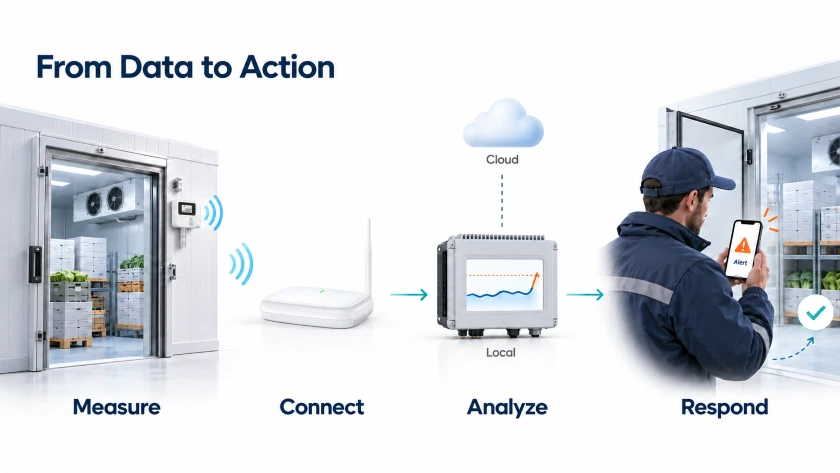
The response matters as much as the measurement. A cold storage alert needs a responsible person, an escalation path, and a record of what happened next. Local processing can keep selected functions working during an internet outage, while cloud services support remote access and analysis across sites. Update frequency should match the task; not every application needs continuous transmission.
The Main Types of IoT Applications
Condition Monitoring and Visibility
These applications show where assets are, how equipment is operating, or whether environmental conditions remain acceptable. Common outputs include location maps, inventory views, energy reports, and temperature histories. They provide information people need before deciding whether to act.
Alerts and Event Response
Rules identify events that need attention, such as a reading remaining outside its limit. Useful alert design considers duration, severity, repeated notifications, and who should respond. Connecting an alert to a service workflow can turn a notification into an assigned task with a record of the response.
Predictive Maintenance and Risk Prediction
Predictive applications use historical and current data to estimate a developing fault or future risk. A vibration threshold alert is condition monitoring; estimating an approaching bearing failure requires additional analysis and validation. Reliable predictions depend on suitable measurements, operating context, and evidence that the model performs adequately for the equipment involved.
New Services, Usage-Based Pricing, and Outcome-Based Models
IoT applications help equipment suppliers provide ongoing support after installation. Operating data allows service teams to investigate faults remotely and plan maintenance based on equipment condition. Recorded operating hours or consumption can also support usage-based billing. Customers can pay according to how much they use a machine or service, while suppliers use the data to manage maintenance and service delivery.
Вершина 11 Applications of IoT in the World
1. Логистика, Транспорт, and Supply Chain
Between dispatch and delivery, goods pass through vehicles, складские помещения, and multiple organizations. IoT in supply chain combines shipment identification, обновления местоположения, and condition readings to make those handovers easier to verify. Teams can investigate an unexpected stop, a missing pallet, or a temperature excursion before the next scheduled check.
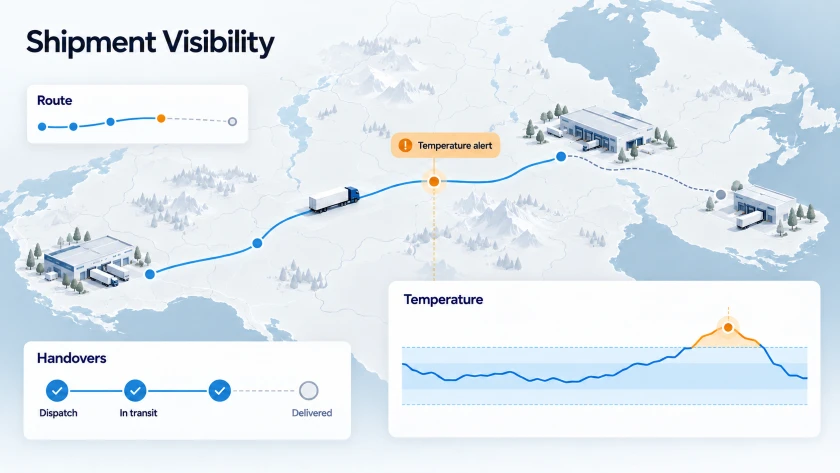
Cold chain logistics monitoring is a practical example. Sensors record conditions around sensitive goods, while the application compares readings with defined limits and notifies the responsible team. DHL describes using connected sensors and tracking devices to monitor shipment conditions and identify potential exposure risks.
Connectivity determines how quickly action is possible. A logger that uploads after arrival provides a history for review; an actively connected system can support intervention during transit. The choice depends on the shipment’s risk, потребности в отчетности, и стоимость.
2. Healthcare and Patient Monitoring
IoT in healthcare serve both clinical care and hospital operations. Connected medical devices can share measurements with care teams for remote review, while asset tracking helps staff find wheelchairs, инфузионные насосы, and other mobile equipment. These workflows need different devices, permissions, and response procedures.
For operational visibility, tags and readers can record equipment movements between hospital zones. Zebra reports that InCor in Brazil deployed RFID readers at zone transitions to monitor assets, including wheelchairs, and used handheld readers to speed inventory counts.
For patient monitoring, measurement quality and clinical suitability take priority. A consumer wearable should not be assumed to support diagnosis or treatment. Before deployment, define which readings clinicians will review, how alerts reach them, and what happens when a device stops reporting. Collect only the personal information the workflow needs.
3. Manufacturing and Industrial Operations
Industrial IoT applications help maintenance and production teams understand equipment behavior between inspections. Sensors collect vibration, температура, and operating data, while connected systems bring machine status and production records into the same view. Интернет вещей в производстве helps teams investigate interruptions and identify where equipment needs attention.
A motor’s rising vibration level, например, may justify an inspection. Comparing that change with load and operating speed makes the reading more useful than an isolated alarm. Historical data can later support predictive maintenance if suitable models and validation are available.
Production visibility also extends to materials and tools. Tracking their movement can expose delays between workstations.
4. Energy and Environmental Management
A monthly utility bill shows total consumption but gives little detail about when or where waste occurred. Connected meters and environmental sensors provide a closer view of energy use and operating conditions across equipment, зоны, or sites. Teams can compare consumption with schedules and investigate unexpected demand.
By leveraging IoT in workspace решения, например, electricity use that remains high after a building closes may warrant checking equipment schedules. Temperature data can help explain whether heating or cooling is operating unnecessarily. Readings become more useful when they share consistent timestamps and can be compared with occupancy or production activity.
Environmental monitoring follows a similar approach, using connected measurements to identify changes that require investigation. When evaluating energy savings, use a suitable baseline that accounts for weather, operating hours, and output.
5. Управление объектом
Facility teams often manage equipment spread across rooms, полы, и здания. IoT in facility bring operating data and fault notifications into maintenance workflows, helping technicians decide where to go and what to check before a service visit. This is particularly useful when routine inspections leave long gaps between observations.
An air handling unit offers a concrete example. Pressure measurements across a filter can help identify increasing resistance and support a maintenance decision. Schneider Electric describes this use of pressure sensors in building management. Linking the finding to a work order gives the technician equipment details and a record of the issue.
The deployment should also monitor itself. A missing sensor update needs attention, since silence does not confirm normal operation. Include device connectivity, battery condition where available, and replacement responsibilities in the maintenance plan.
6. Строительство
Tools and equipment move frequently between storage areas, транспортные средства, and jobsites. Connected asset management applications give contractors a shared record of equipment identity, assignment, and recent detections. IoT in consturction can help crews locate available tools and reduce unnecessary trips or duplicate purchases.
Bluetooth-теги attached to tools and equipment can be detected by nearby gateways or compatible mobile devices. The application records when and where each asset was last detected, helping crews find nearby equipment and check whether assigned tools have been accounted for before leaving a jobsite.
7. Гостеприимство
Hotels need to balance room comfort with the cost of conditioning spaces that are temporarily empty. IoT in hospitality can combine occupancy information, room controls, and property management data to adjust settings while keeping staff informed about room conditions.
Guest room management applications use occupancy information to adjust temperature, осветительные приборы, and blinds automatically. Integrating room controls with hotel management systems also helps staff identify issues that need attention, such as a room that fails to reach its set temperature.
8. Buildings and Offices
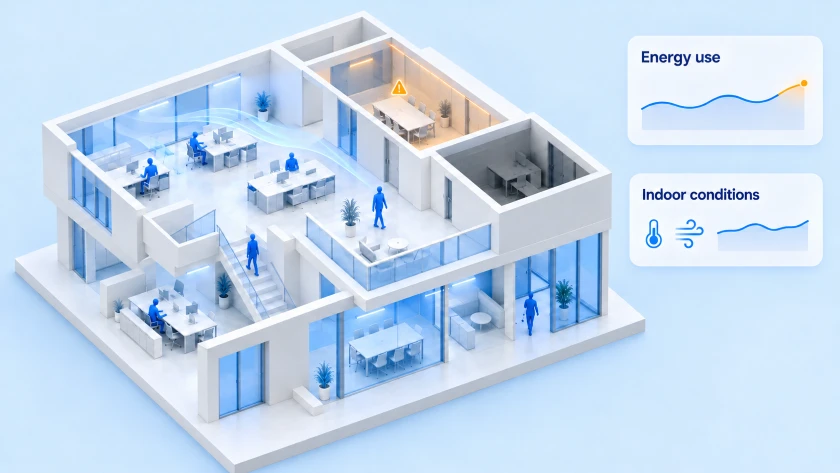
Office IoT applications help workplace teams compare how space is booked with how it is actually used. Occupancy sensors indicate whether meeting rooms or desks are in use, while temperature, влажность, and air quality measurements add context about comfort. Aggregated patterns can inform space planning without requiring individual movement histories.
When linked to building systems, occupancy and environmental data can help adjust heating, вентиляция, кондиционер, and lighting based on actual room use. IoT in events can also combine this data with booking records to show available spaces and flag equipment faults that need attention.
9. Retail and Consumer Applications
Keeping store shelves stocked depends on knowing what is available and where it is. RFID readers or Bluetooth-трекеры record item movements across stores and stockrooms, helping staff complete stock checks, locate products, and prepare online orders. IoT in retail can use these updates to flag replenishment needs.
At home, connected thermostats, осветительные приборы, and security sensors let users control settings remotely and receive alerts. Occupancy signals and schedules can also trigger automatic adjustments to heating and lighting.

10. Кампус
Across a campus, connected safety badges can let students and staff request help through an SOS button. When the badges are integrated with a positioning system, alerts can include location information so security teams can identify where assistance is needed and coordinate a response.
Occupancy and environmental sensors also help facilities teams adjust lighting and ventilation around classroom and laboratory use. IoT in education makes shared equipment easier to locate and coordinate between departments.
11. Умные города и общественная инфраструктура
Water networks, streetlights, and parking spaces are spread across areas too large for constant manual inspection. Connected sensors report conditions remotely, allowing city operators to identify problems and prioritize maintenance visits.
Flow and water level readings can reveal developing sewer blockages or rising overflow risks. Take IoT in airports as an example, streetlights can report faults and follow dimming schedules, while parking sensors provide availability updates that help drivers find open spaces.
What to Consider Before Building an IoT Application
Define the problem, необходимые данные, and how people or systems will respond. Choose devices and connectivity that meet your accuracy, покрытие, and reporting requirements, and plan integration with existing systems.
Build in device authentication, Управление доступа, защита данных, and software updates. Test the workflow in a focused pilot, checking data reliability, false alerts, and response times. Budget for ongoing connectivity, программное обеспечение, замена батареи, и обслуживание.
Заключение
The strongest starting point for an IoT application is a recurring operational problem with a clear response. Pick one workflow, establish how it performs today, and test whether connected data changes the outcome. Expand when the measurements are dependable, the response works, and the benefit justifies the ongoing cost.
 Теперь говорите