Tracking assets across warehouses, fábricas, and outdoor locations can become complicated when existing systems fail to provide accurate or timely information. Devices may report outdated locations, lose connectivity in certain areas, or require more frequent battery replacement than expected.
These problems often come from choosing tracking technology without considering the asset, ambiente, communication infrastructure, and data collection requirements together. Understanding how IoT tracking devices work and where different technologies perform best can help businesses build more reliable asset tracking systems.
What Are IoT Tracking Devices?
Dispositivos de rastreamento de IoT are connected hardware solutions that collect and transmit information about physical assets through wireless technologies, sensores, or positioning systems. Depending on their design, they can identify assets, estimate their locations, detect movement, and monitor environmental conditions.
Unlike traditional tracking methods that rely heavily on manual checks, connected tracking systems allow businesses to access asset information remotely and review historical records.
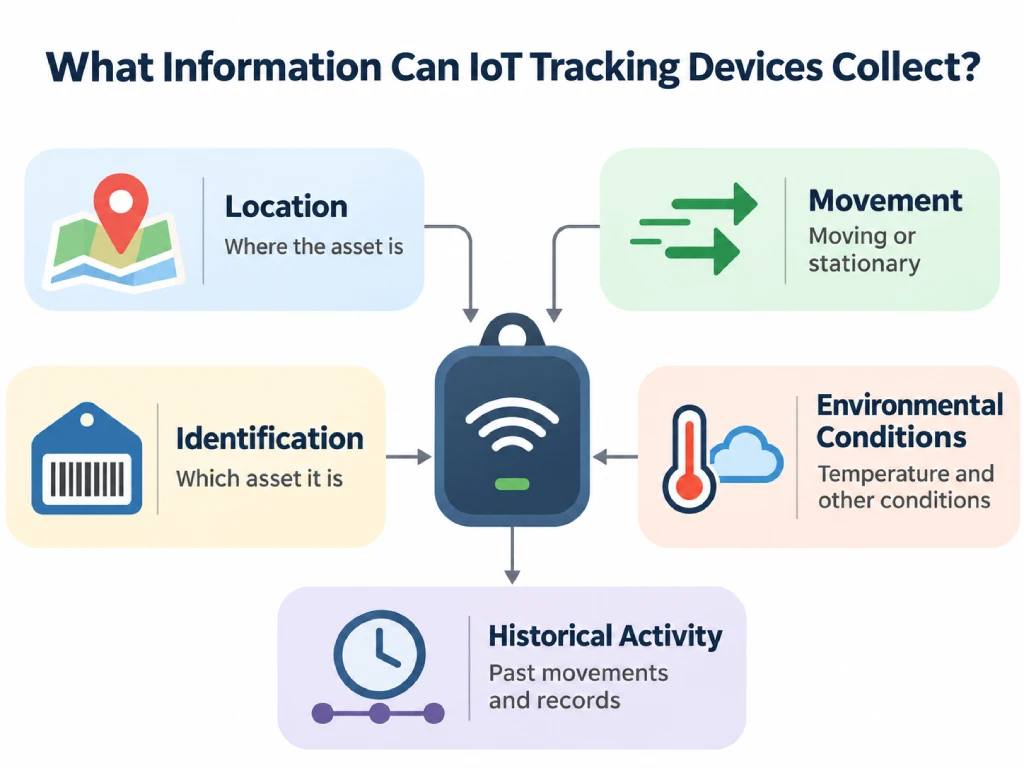
What Information Can IoT Tracking Devices Collect?
IoT tracking devices can provide more than location information, depending on their built-in capabilities.
● Location: Identifies an asset’s geographical position or indoor location.
● Movement: Detects whether an asset is stationary, moving, or has entered or left an area.
● Identification: Associates tracking data with a specific asset.
● Environmental Conditions: Monitors temperature, umidade, or other conditions through integrated sensors.
● Historical Activity: Records previous movements, atualizações de localização, and sensor readings.
Not every tracker supports all these functions. Businesses should match device capabilities with their actual monitoring requirements.
Why Do IoT Tracking Devices Matter?
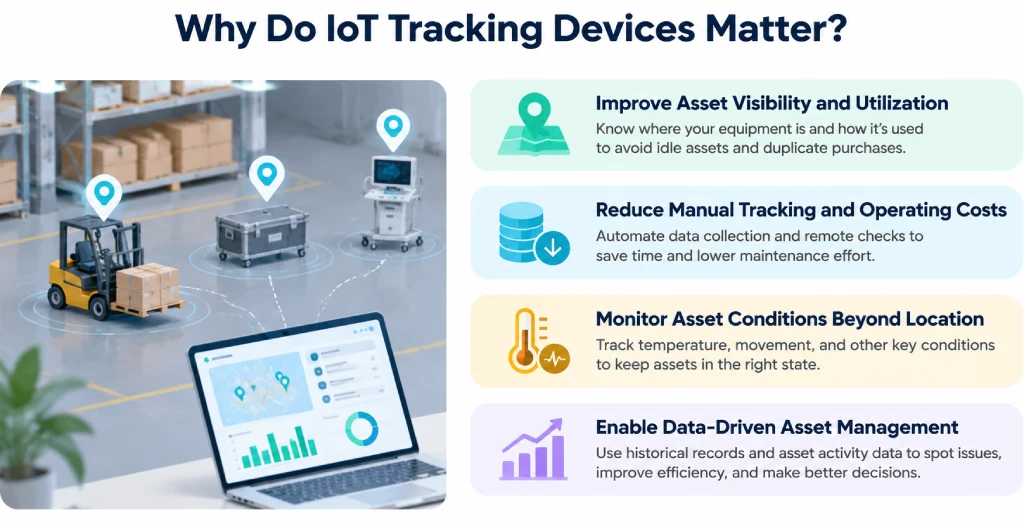
Reliable Asset Visibility Helps Reduce Operational Costs
IoT tracking devices help businesses improve asset visibility, reduce manual work, and make better decisions about equipment utilization. Their value comes from turning scattered asset information into accessible operational data.
Improve Asset Visibility and Utilization
Knowing where equipment is located helps employees find tools, maquinaria, and inventory without repeatedly checking storage areas. Historical tracking records can also reveal underused assets and help businesses allocate existing resources more efficiently.
Reduce Manual Tracking and Maintenance Work
Automated data collection reduces dependence on manual inventory checks and physical inspections. When devices support remote monitoring and configurable reporting, maintenance teams can review asset activity without visiting every tracking point.
Monitor Asset Conditions Beyond Location
Location data alone cannot explain whether an asset has been exposed to unsuitable conditions. Devices equipped with temperature or movement sensors can provide additional information for monitoring sensitive equipment, bens armazenados, and industrial assets.
What Are the Different Types of IoT Tracking Devices?
GPS, Bluetooth de baixa energia (BLE), RFID, UWB, and LoRaWAN address different tracking requirements rather than offering interchangeable solutions. The right choice depends on positioning needs, operating environments, infraestrutura, and power consumption.
GPS Tracking Devices for Outdoor Assets
Rastreadores GPS calculate geographical positions using signals transmitted by navigation satellites. They are commonly used for vehicles, outdoor equipment, and mobile assets that operate across large geographical areas.
No entanto, GPS performance can deteriorate indoors, underground, or near buildings where satellite signals are blocked or reflected. De acordo com GPS.gov , actual positioning accuracy depends on satellite geometry, condições de sinal, and receiver quality.
Bluetooth and BLE Tracking Devices for Indoor Assets
BLE tracking devices use Bluetooth de baixa energia to identify nearby assets and transmit information to gateways or locators. They are suitable for indoor asset management, particularly in warehouses, hospitais, fábricas, e edifícios comerciais.
Basic BLE tracking can use received signal information for proximity or zone detection, while more advanced systems can support positioning through technologies such as Angle of Arrival (AoA). O Bluetooth SIG Direction Finding specification describes how specialized antenna arrangements enable more accurate indoor positioning.
RFID Tracking Devices for Inventory Identification
RFID systems use tags and readers to identify objects through radio-frequency communication. Passive RFID tags obtain operating energy from the reader’s electromagnetic field, while active RFID tags have their own power source and can transmit signals.
RFID is particularly useful for inventory identification, Operações de armazém, and applications requiring multiple items to be read efficiently. Its performance depends on tag type, reader configuration, colocação da antena, and the surrounding environment.
UWB Tracking Devices for High-Accuracy Indoor Positioning
Banda ultralarga (UWB) uses short radio pulses and time-based measurements to estimate distances and determine device positions. With appropriately deployed anchors and tags, it supports high-accuracy indoor positioning.
UWB is useful for industrial facilities and other environments where knowing an asset’s precise location is important. No entanto, its infrastructure requirements and deployment costs should be evaluated before implementation.
LoRaWAN Tracking Devices for Long-Range Communication
LoRaWAN enables low-power devices to communicate over wide areas through connected gateways. It is suitable for remote assets, agricultural equipment, and applications where frequent high-bandwidth communication is unnecessary.
LoRaWAN itself is a communication protocol rather than a standalone positioning method. Asset locations may be obtained through GNSS or network-based geolocation, depending on the device and system design.
How Do IoT Tracking Devices Work?
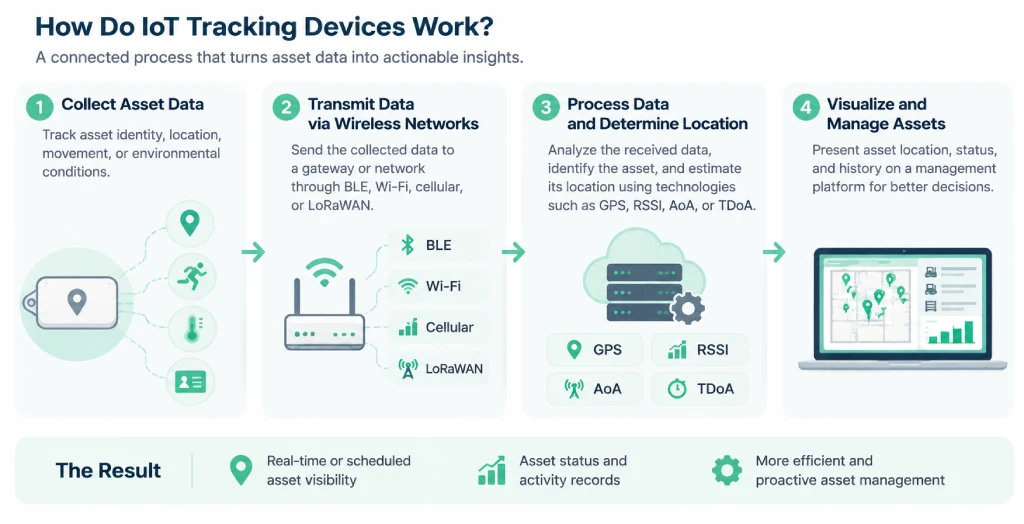
An IoT tracking system collects asset information, transmits it through a suitable network, processes the data, and presents useful results through a management platform. Understanding each stage helps identify where an existing deployment may be failing.
Etapa 1: Collect Asset Data
Tracking devices collect identification, localização, movimento, or environmental information through integrated sensors and wireless technologies. The collection method varies by device: GPS receivers calculate geographical positions, BLE tags broadcast signals, and RFID tags respond to reader requests.
Etapa 2: Transmit Data Through Wireless Networks
Collected information travels through communication technologies such as BLE, Wi-fi, redes celulares, ou LoRaWAN. Some devices send data directly to a network, while others rely on gateways or readers to receive information and forward it.
Etapa 3: Process Data and Estimate Locations
Portais, locators, leitores, or servers process incoming information to identify assets and determine their positions. Depending on the tracking technology, location calculations may use GPS coordinates, intensidade do sinal (RSSI), Ângulo de chegada (AoA), or Time Difference of Arrival (Tdoa).
Etapa 4: Visualize and Manage Asset Information
A tracking platform organizes collected data into asset records, informações de localização, movement histories, and sensor readings. Businesses can use these records to investigate missing equipment, identify unusual activity, and improve asset management processes.
Where Are IoT Tracking Devices Used?
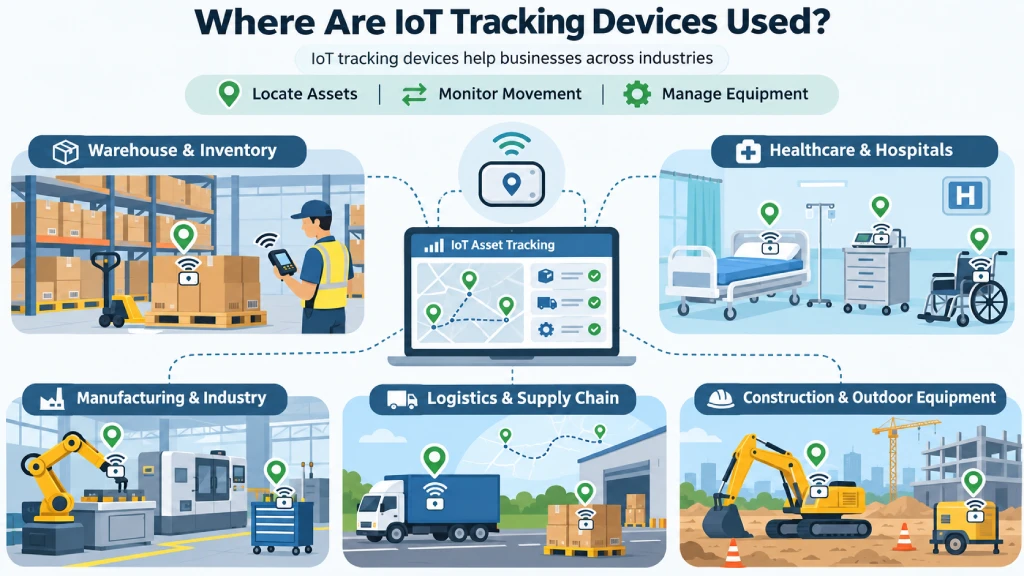
Indoor and outdoor environments create different challenges for wireless communication and positioning, so using the same tracking setup everywhere may produce inconsistent results.
Indoor Asset Tracking
Ambientes internos geralmente contêm paredes, prateleiras, maquinaria, and metal structures that affect wireless signals. BLE, RFID, and UWB can support different indoor tracking requirements, from asset identification and zone detection to more precise positioning.
Posicionamento do gateway, cobertura do leitor, and the required positioning accuracy should be evaluated before deployment.
Outdoor Asset Tracking
Outdoor tracking focuses more on geographical coverage, asset mobility, network availability, and weather resistance. GPS is suitable for assets that move across large areas, while cellular or LoRaWAN connectivity can support data transmission depending on network availability.
For assets moving between indoor and outdoor locations, a combination of tracking technologies may provide more consistent visibility.
Who Benefits Most From IoT Tracking Devices?
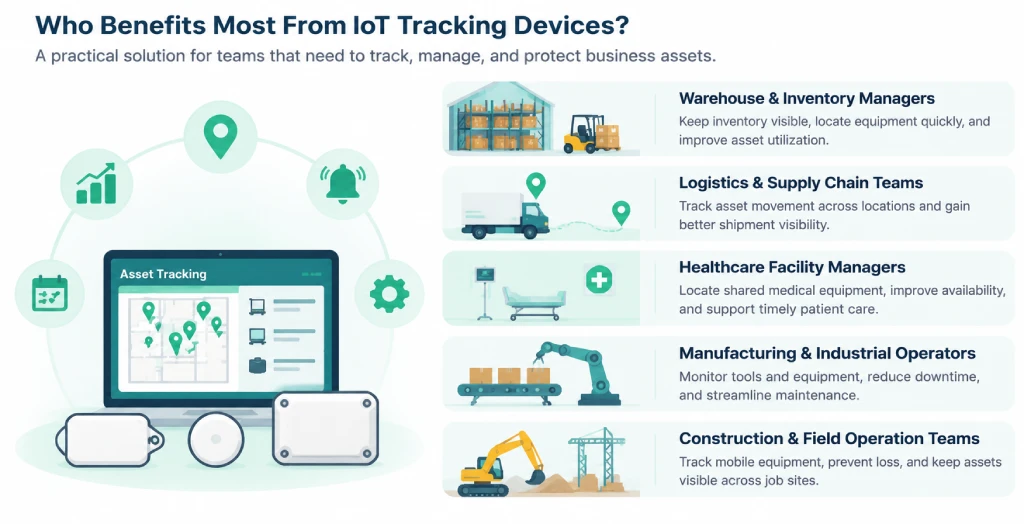
Businesses managing distributed, mobile, or high-value assets can benefit from connected tracking systems, particularly when manual tracking creates operational delays.
● Warehouse Managers: Improve inventory visibility, locate equipment, and reduce manual asset checks.
● Logistics Teams: Monitor asset movement and maintain better visibility throughout transportation processes.
● Healthcare Facilities: Locate shared medical equipment and improve equipment utilization.
● Manufacturing Operators: Monitor tools, maquinaria, and production assets across complex facilities.
● Construction Companies: Track mobile equipment and reduce the time spent locating assets across job sites.
The most suitable solution depends on how assets move, where they operate, and what information the business needs to collect.
Conclusão
IoT tracking devices help businesses improve asset visibility, streamline operations, and monitor equipment conditions across different environments. Choosing the right solution requires more than comparing tracking technologies. Businesses should consider asset types, indoor or outdoor conditions, precisão do posicionamento, data update frequency, duração da bateria, e requisitos de infraestrutura. Whether using GPS, BLE, RFID, UWB, ou LoRaWAN, the most effective tracking solution is one that meets operational needs while balancing performance, escalabilidade, and long-term maintenance costs.