


Choosing a wireless connection shapes more of an IoT project than how devices send data. It affects battery requirements, the infrastructure needed at each site, and the cost of keeping devices connected throughout their service life.
The available wireless technologies for IoT address different needs, so comparing them on speed or range alone tells only part of the story. A useful comparison starts with the application: where devices operate, how much data they exchange, how quickly it must arrive, and who will maintain the network.
This guide compares the main options, explains their tradeoffs, and highlights what to verify before committing to a deployment.
What Are Wireless Technologies for IoT?
Wireless technologies for IoT let Dispositivos IoT exchange data without a physical communication cable. They may connect a sensor to a nearby gateway, link devices within a building, or carry data through a cellular network.
The complete path matters. Sensor Bluetooth might send readings to a gateway, which forwards them through Ethernet or cellular connectivity. A cellular tracker can communicate through an operator network without a local gateway.
These are different architectures, even when the final destination is the same application. Selecting the device radio alone leaves questions about backhaul, network ownership, and failure recovery unresolved.
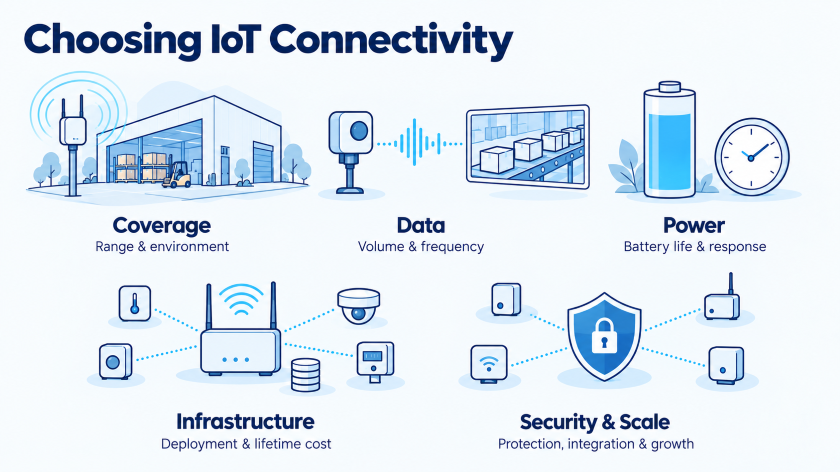
Key Factors to Consider When Choosing Wireless IoT Technology
Coverage and Operating Environment
Devices may operate within a room, across a facility, or between regions. Paredes, metal structures, and antenna placement affect coverage. Local deployments need suitable gateway or access point placement, while mobile devices require network availability along their routes.
Data Volume and Reporting Frequency
Periodic sensor readings, location updates, and video streams have different bandwidth needs. Consider payload size, frequência de relatórios, and occasional transfers such as firmware updates to select sufficient capacity without unnecessary power use or cost.
Power Consumption and Response Time
Battery life depends on how often devices transmit, receive, and sleep. Frequent updates provide more current information but use more energy. Match reporting intervals and response times to the application’s needs and maintenance schedule.
Network Infrastructure and Deployment Cost
Wi-fi can use existing networks, gateways can collect data from many nearby devices, and cellular connections can serve dispersed assets. Comparar hardware, instalação, subscriptions, and maintenance across the expected device count and service life.
Segurança, Integration, and Scalability
Check authentication, data protection, Atualizações de firmware, and regional approvals. Documented payloads and APIs help connect devices to existing applications. As deployments grow, provisioning tools, capacidade de rede, and remote management become increasingly important.
Short-Range Wireless Technologies for IoT
Wi-fi
Wi-Fi suits devices that need substantial data transfer, including cameras, connected equipment, and IoT gateways. Access to an existing network can simplify deployment, provided coverage and enterprise security requirements are addressed.
Power consumption depends on the hardware and workload. Battery-powered applications require particular attention to transmission frequency, connection time, and power-saving settings.
Aplicações típicas: Video monitoring, connected appliances, Equipamento industrial, and gateway backhaul.
Bluetooth and Bluetooth Low Energy
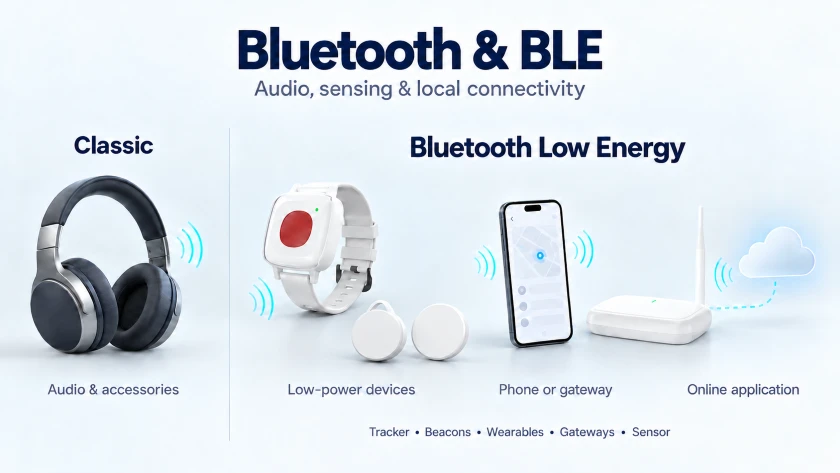
Bluetooth Classic is widely used for audio and connected accessories. Bluetooth de baixa energia, or BLE, supports low-power data exchange through direct connections, broadcasts, e redes mesh. Its phone compatibility also makes device setup and local access practical.
BLE is a common choice for battery-powered sensors, vestuário, and asset tags. A phone or gateway typically forwards device data to an online application. Cobertura, update frequency, and positioning requirements determine receiver placement.
Aplicações típicas: Acompanhamento de bens, faróis, vestuário, fechaduras inteligentes, e monitoramento de condições.
Zigbee and Thread
Zigbee and Thread support low-power mesh networks for sensors and building controls. Routing devices pass messages between nodes, extending coverage beyond a single radio link. Battery-powered end devices can sleep to conserve energy rather than relay traffic.
Zigbee typically uses a gateway for external connectivity. Thread uses IP networking and a border router to connect with other IP networks. Both require suitable routing coverage and compatible application functions.
Aplicações típicas: Iluminação, occupancy sensing, fechaduras de portas, Automação de construção, e gerenciamento de energia.
RFID
RFID identifies tagged items through readers. Passive tags draw energy from the reader’s signal and need no onboard battery, making them practical for large item populations.
RFID provides visibility where reads occur, such as receiving areas, storage locations, or dispatch points. Reader placement and tag selection determine which events the system captures. Continuous visibility between checkpoints requires additional infrastructure or another tracking method.
Aplicações típicas: Inventory, shipment verification, controle de acesso, and asset identification.
Long-Range Wireless Technologies for IoT
LoRaWAN connects low-power devices over extended areas through gateways and a network server. Private deployments give organizations control over local infrastructure, while available public networks offer another connection option.
It suits small sensor messages rather than video or frequent large transfers. Reporting intervals, downlink requirements, regional airtime rules, and gateway capacity shape the deployment. Mobile assets can also use LoRaWAN where route coverage is available.
Aplicações típicas: Monitoramento ambiental, agricultura, leak detection, tank monitoring, and campus asset tracking.
NB-IoT
NB-IoT uses licensed cellular spectrum for small, relatively infrequent data transfers. It is commonly considered for fixed devices that need wide-area connectivity without a local gateway.
Coverage enhancement and power-saving capabilities support installations such as meters and remote sensors. Actual performance depends on operator availability, signal conditions, and device configuration. Check response times and firmware transfer requirements alongside routine reporting needs.
Aplicações típicas: Medição de serviços públicos, Sensores de estacionamento, and fixed environmental monitoring.
LTE-M
LTE-M combines low-power cellular connectivity with higher throughput and stronger mobility support than NB-IoT. It is a useful candidate for devices that travel between sites or need larger data transfers.
Battery life depends on coverage, reporting behavior, and network settings. LTE-M does not necessarily consume more energy than NB-IoT for the same task, so compare devices under the intended workload. Regional availability and roaming support also need verification.
Aplicações típicas: Logistics trackers, mobile wearables, fleet telemetry, and remote monitoring.
4G LTE and 5G
Conventional 4G LTE broadband connections support applications such as video, remote equipment access, and gateway backhaul. They suit workloads that exceed the practical capacity of low-power sensor networks.
5G offers additional capabilities for industrial communication, including support for private networks and demanding latency requirements. These depend on the network architecture and implemented features. For control applications, verify end-to-end delay, disponibilidade, and fallback behavior rather than relying on the network generation alone.
Aplicações típicas: Video surveillance, connected vehicles, industrial gateways, and private industrial networks.
Wireless IoT Technologies Comparison by Key Performance Factors
These categories provide an initial shortlist. Actual range, duração da bateria, and throughput depend on device design, configuração, e condições de operação.
| Tecnologia | Typical Range | Taxa de dados | Consumo de energia | Gateway Required? | Mobilidade | Aplicações Típicas |
| Wi-fi | Short range | Alto | Alto | Router or access point | Limitado | Casas inteligentes, video devices |
| Bluetooth/BLE | Short range | Low to moderate | Baixo | Phone or gateway often required | Limitado | Wearables, faróis |
| Zigbee/Thread | Short-range mesh | Baixo | Baixo | Hub or border router | Limitado | Smart lighting, Automação de construção |
| LoRaWAN | Regional or wide area | Baixo | Muito baixo | Usually required | Usually limited | Agricultura, monitoramento ambiental |
| NB-IoT | Área ampla | Muito baixo | Muito baixo | No local gateway required | Limitado | Medição inteligente, fixed sensors |
| LTE-M | Área ampla | Low to moderate | Baixo | No local gateway required | Good | Acompanhamento de bens, gestão de frota |
| 4G/5g | Área ampla | Alto | Moderate to high | No local gateway required | Good | Vídeo, controle industrial |
| RFID | Short to medium range | Identification data | Passive tags may require no battery | Reader required | Not applicable | Inventory and supply chain |
Common Wireless IoT Technology Selection Mistakes
Comparing Peak Specifications Alone
Maximum range and data rate do not establish application performance. Evaluate message delivery, latência, and energy use with the intended mounting position, payload, and reporting interval.
Selecting the Radio Without Planning the Data Path
A working wireless link is one part of the system. Include gateways, retorno, network services, and application interfaces in the design. MQTT and HTTP describe application communication, enquanto BLE, Wi-fi, and cellular provide connectivity.
Overlooking Maintenance Requirements
Allow for battery replacement, Atualizações de firmware, configuration changes, and connectivity fees. Remote management and documented integration interfaces can reduce service effort as the deployment grows.
Scaling Without Testing Network Load
A successful connection between two devices does not establish capacity for hundreds. Test expected device density, simultaneous reporting, interferência, and recovery after an outage.
Minew Wireless IoT Solutions for Different Connectivity Requirements
Minas offers Bluetooth, LoRaWAN, and cellular devices, alongside gateways with Wi-Fi, Ethernet, or cellular backhaul, dependendo do modelo. The portfolio includes asset tags, personnel devices, sensores, and gateways for different deployment requirements.
This allows solution providers to match endpoint connectivity and backhaul to each project. Dispositivos Bluetooth can report through nearby gateways, LoRaWAN can connect distributed sensors, and cellular options can serve assets beyond local infrastructure. Product selection should account for regional coverage, necessidades de relatórios, fonte de energia, and platform integration.
Conclusão: Selecting the Right Wireless Technology for IoT
The best wireless technology for IoT depends on the information the application needs and the conditions in which devices operate.
Wi-Fi and cellular broadband suit substantial data transfers. BLE, Zigbee, and Thread serve local low-power communication. LoRaWAN, NB-IoT, and LTE-M address wider-area sensing and tracking, with infrastructure and mobility requirements guiding the choice. RFID supports identification at defined reading points.
Build the shortlist around coverage, volume de dados, tempo de resposta, and maintenance cost. Then validate it with representative devices and installation conditions before expanding the deployment.
 Conversar Agora