


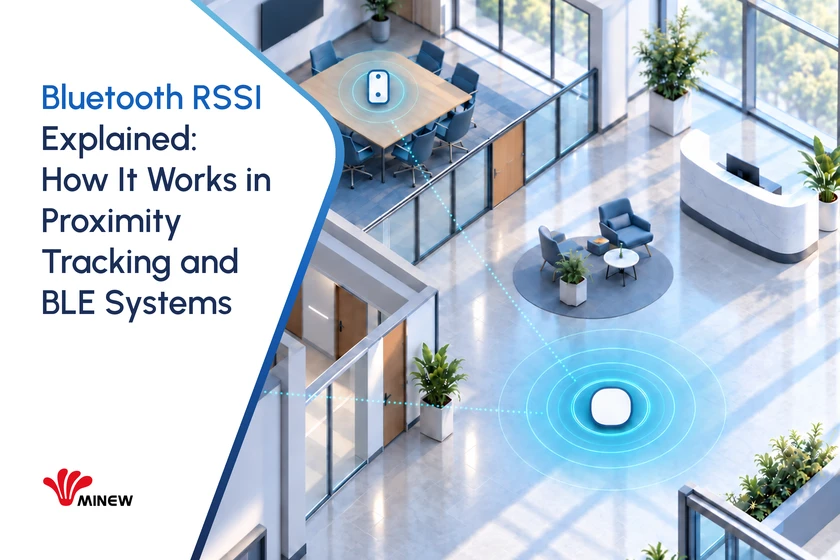
An asset tracking system can detect hundreds of Etiquetas Bluetooth and still fail to answer a basic question: Which room or work area is the asset in?
The system receives a signal, but that signal must be interpreted before it becomes useful location data.
Bluetooth RSSI is one of the most common ways to make this first location estimate. It shows how strongly a gateway, telefone, or other receiver detects a Bluetooth signal. That information can help determine whether an asset is nearby, which zone it is likely to be in, or whether it may have moved.
No entanto, RSSI does not work like a tape measure. Paredes, prateleiras metálicas, pessoas, antenas, and device settings can all change the signal. A useful deployment must account for these conditions before turning RSSI readings into location events.
O que é RSSI Bluetooth?
Bluetooth RSSI stands for Bluetooth Received Signal Strength Indicator. It measures the strength of a Bluetooth signal when that signal reaches a receiving device.
A simple way to understand RSSI is to imagine a person speaking across a room. A nearby listener hears the voice clearly. A person farther away hears it more quietly. Paredes, mobília, and other people may also make the voice harder to hear.
Bluetooth signals behave in a similar way. A strong signal may mean that the transmitter is close to the receiver. A weak signal may mean that it is farther away. Obstacles and antenna position can also affect what the receiver detects.
RSSI is commonly reported in decibel milliwatts, or dBm. Most Bluetooth RSSI values are negative because the received signal power is much lower than one milliwatt.
A value closer to zero represents a stronger signal. Por exemplo, −45 dBm is stronger than −80 dBm.
This does not mean that −45 dBm always represents a specific distance. RSSI measures received signal power, not distance itself.
The Bluetooth SIG identifies RSSI as one of the distance related capabilities available in Bluetooth Low Energy systems. Bluetooth also supports other positioning features, Incluindo Orientação interna e Sondagem de canal.
How Does Bluetooth RSSI Work?
In a typical tracking system, a Bluetooth tag broadcasts short radio messages. These messages contain an identifier that allows the system to recognize the tag.
A nearby gateway, Smartphone, or other Bluetooth receiver detects the message and records its RSSI.
The process usually follows five steps:
• A Bluetooth tag broadcasts its identifier.
• One or more gateways receive the signal.
• Each gateway records the time and RSSI.
• Software filters or compares the readings.
• The system assigns a proximity state, zona, or estimated location
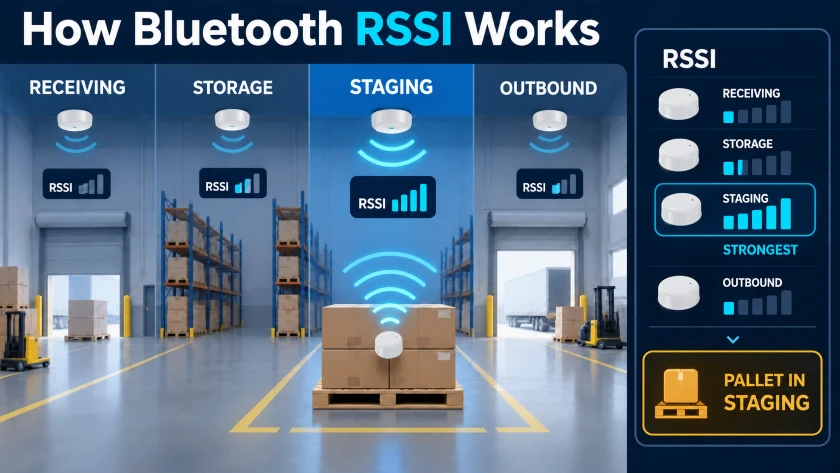
Consider a warehouse with gateways in receiving, armazenar, staging, and outbound areas. If the staging gateway repeatedly receives the strongest signal from a pallet tag, the software may classify that pallet as being in the staging zone.
The useful result is not the raw RSSI value. It is the ability to see that the pallet has remained in staging longer than expected and may delay an outbound shipment.
RSSI is measured by the receiving device
An RSSI reading belongs to the receiver that recorded it.
Two gateways may report different RSSI values from the same tag at the same time. One gateway may be closer, but distance is not the only possible reason for the difference.
Gateway position, antenna direction, nearby materials, sensibilidade do receptor, and device calibration can all affect the result.
This is why RSSI values from different gateways or device models should not be assumed to be directly comparable. Testing and calibration may be needed before the readings can support reliable location rules.
Advantages and Limitations of Bluetooth RSSI
Bluetooth RSSI is often used for indoor tracking because many Bluetooth devices already support it. A separate distance measuring radio may not be required.
Main advantages
• Bluetooth LE tags can operate with relatively low power consumption.
• Many Bluetooth chips, entradas, and mobile devices support RSSI.
• Tags and gateways are available in many sizes and price ranges.
• The technology can support large numbers of tagged assets.
• RSSI is suitable for many proximity and zone-level applications.
• Existing Bluetooth infrastructure may support some data collection needs.
These advantages make RSSI useful when the objective is to improve general asset visibility without installing high precision location infrastructure throughout an entire site.
Main limitations
• Readings can change as the environment changes.
• The same distance can produce different RSSI values.
• RSSI does not directly show exact distance.
• Device models may report different values under similar conditions.
• Walls, metal, equipamento, and people can weaken or reflect signals.
• Precise positioning can be difficult in complex indoor environments.
These limitations define where RSSI fits.
If a process only needs to know whether an asset is near a gateway or inside a room, RSSI may provide enough information. If the process depends on locating the asset within a small area, another positioning method may be more appropriate.
How Should Bluetooth RSSI Values Be Interpreted?
The following ranges provide a general reference. They are not fixed distance bands because hardware and site conditions vary.
| RSSI range | General meaning | Possible interpretation |
| Approximately −30 to −50 dBm | Strong signal | The devices may be close, or the signal path may be clear |
| Approximately −50 to −70 dBm | Moderate signal | The device may be within a useful communication or proximity range |
| Approximately −70 to −85 dBm | Weak signal | The device may be farther away, or obstacles may be reducing the signal |
| Below approximately −85 dBm | Very weak signal | Packet reception may become less consistent |
These ranges are more useful for comparing changes within one system than for comparing unrelated devices.
Por exemplo, a tag may normally appear at about −55 dBm when it is near a loading dock gateway. If the reading later falls to −75 dBm, the radio path has become weaker.
The tag may have moved. It may also have been placed behind a loaded metal container. The RSSI change shows that something has changed, but it does not identify the cause on its own.
Main Factors That Affect Bluetooth RSSI
Distance between the devices
Signal strength generally decreases as the distance between a transmitter and receiver increases. This relationship allows RSSI to support proximity detection.
No entanto, indoor signal loss is rarely smooth. Reflections and obstacles can cause a small movement to create a large change in RSSI. A larger movement may sometimes create very little change.
Walls and physical obstacles
Paredes, portas, racks, maquinaria, containers, and stored materials can weaken or redirect a Bluetooth signal.
The effect depends on the material. A lightweight partition and a loaded metal rack will not affect the signal in the same way.
The operating environment may also change throughout the day. A warehouse aisle that is open during testing may later contain pallets, veículos, and workers.
Antenna direction and tag placement
Bluetooth antennas do not always transmit equally in every direction. Rotating a tag or placing it against another material can change its signal.
A tag that performs well when held in open air may behave differently when attached to a metal tool, installed inside a machine, or placed under a pallet.
Testing should use the final installation position whenever possible.
Radio interference
Bluetooth LE operates in the 2.4 GHZ Band. Other wireless systems also use this band.
Interference may affect packet reception, but one missed packet does not prove that a tag has left an area. Location software should look for a consistent pattern before changing the reported asset state.
Transmit power and hardware differences
Higher transmit power can increase signal strength and range, but it can also increase power consumption.
Antenna design, sensibilidade do receptor, material do invólucro, and radio calibration also affect RSSI. Replacing a tag or gateway model may therefore require new site testing and threshold adjustment.
The Bluetooth SIG identifies transmit power, sensibilidade do receptor, ganho de antena, obstáculos, and path loss as important factors in Bluetooth range.
How Can Bluetooth RSSI Be Used to Estimate Distance?
The Basic Relationship Between RSSI and Distance
In ideal free space, received power decreases as distance increases. Engineers commonly use a log-distance path-loss model to estimate distance:
RSSI(d) = RSSI(d0) – 10n log10(d / d0)
Onde:
• RSSI(d) is the measured RSSI at distance d.
• RSSI(d0) is the RSSI measured at reference distance d0.
• n is the path-loss exponent.
• d0 is commonly set to 1 metro.
The path-loss exponent is approximately 2 in ideal free space. It may be higher in practical environments such as offices, armazéns, hospitais, and residential buildings.
Why One RSSI Reading Is Usually Not Enough
A basic system may use a rule such as this:
“If the RSSI is stronger than a set value, classify the tag as nearby.”
This may work in a controlled space. In a changing environment, the reading may move above and below the threshold even when the asset remains still.
The system may then report that the asset repeatedly enters and leaves the zone. Too many false events can reduce trust in the entire tracking system.
More stable location decisions may require:
• Several readings collected over time
• Different thresholds for entering and leaving a zone
• A minimum dwell time before confirming a location change
• Readings from more than one gateway
• Site specific calibration
• A confidence level for uncertain results
These controls do not make RSSI perfectly accurate. They help the system avoid reacting to every short signal change.
Common IoT Applications of RSSI
Bluetooth asset tracking
RSSI can help determine whether tagged assets are in a room, work area, or operational zone.
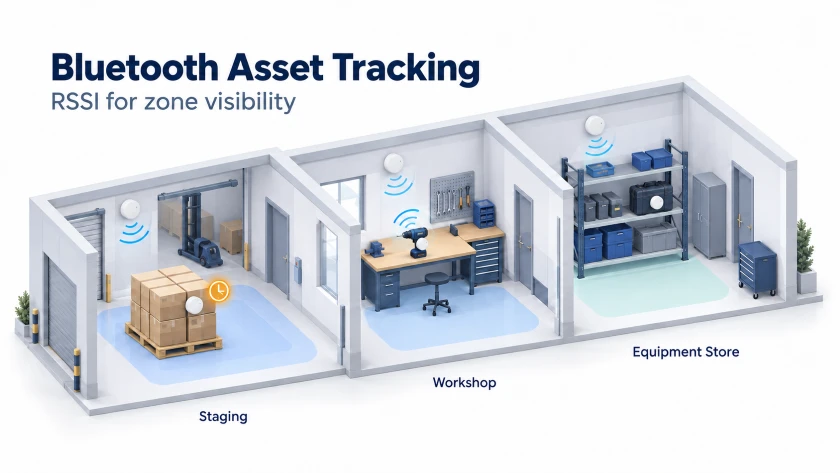
A warehouse can identify pallets that remain in staging too long. A maintenance team can see whether a shared tool is in the workshop, production area, or equipment store.
This narrows the search area and helps teams respond before a misplaced or idle asset affects work.
Indoor personnel location
RSSI can support room or zone-level presence detection in suitable environments.
No entanto, the human body can weaken 2.4 Sinais de GHz, and badge orientation changes as a person moves. Applications involving safety or automatic access decisions may require greater confidence than RSSI alone provides.
Privacidade, consent, and access to location data must also be considered.
Proximity detection
A system can detect when a tag approaches a gateway or enters a monitored area.
This can support arrival notifications, restricted area alerts, tool collection processes, or automatic status updates.
The system should confirm that the condition is stable before triggering an important action.
Device monitoring
RSSI trends can help identify changing radio conditions.
A signal that becomes consistently weaker may indicate that a device has moved, an obstruction has appeared, or an installation has changed. This information can support an inspection of the device or gateway placement.
RSSI Vs AoA: A Clear Comparison
Bluetooth RSSI and Ângulo de chegada do Bluetooth, or AoA, support different location requirements.
| Comparison | RSSI positioning | Posicionamento AoA |
| Primary measurement | Sinal de força | Signal arrival angle |
| Hardware complexity | Relativamente baixo | Usually higher |
| Deployment cost | Relativamente baixo | Relativamente alto |
| Environmental sensitivity | Alto | Also affected by multipath |
| Typical accuracy | Zone-level or several meters | Generally higher positioning accuracy |
| Typical use cases | Proximity detection and zone-level asset tracking | More precise indoor positioning |
Bluetooth AoA uses several antennas in a receiving locator to estimate the direction from which a Bluetooth signal arrives. Multiple locators can combine these direction measurements to calculate a position.
The Bluetooth SIG states that Direction Finding can support high accuracy indoor location services. Actual performance still depends on locator placement, calibração, Programas, and the radio environment.
RSSI may be sufficient when the system only needs to identify whether a pallet is in storage or outbound staging.
AoA may be more appropriate when a worker needs to find a specific tool within a large production area.
Questions to Ask Before Choosing Bluetooth RSSI
What Does a Useful RSSI Deployment Require?
Bluetooth tags and gateways provide the signal data, but they do not create an operational result on their own.
A complete system also needs software that can:
• Process several RSSI readings
• Compare data from multiple gateways
• Apply stable zone rules
• Handle uncertain or missing data
• Monitor tag and gateway health
• Send location events to other operational systems
Por exemplo, detecting that a pallet is probably in staging has limited value if the result remains on a separate dashboard.
The information becomes useful when the warehouse system can identify the pallet, show how long it has remained there, and notify the person responsible for moving it.
The quality of the final workflow depends on the full path from tag detection to operational action.
Is a Higher Bluetooth RSSI Always Better?
A higher RSSI means that the receiver detected a stronger signal. Em muitos casos, this gives the connection more room to tolerate additional signal loss.
It does not automatically mean that the positioning result is more accurate.
A strong signal may come from a nearby tag, a clear radio path, higher transmit power, or favorable antenna direction. Positioning software still needs context before it can decide what the reading means.
Can Bluetooth RSSI Work Through Walls?
Bluetooth signals can pass through many walls and other materials, but the signal becomes weaker.
The amount of signal loss depends on the material, grossura, surrounding objects, and antenna position. Concrete, metal, and dense structures usually have a greater effect than lightweight partitions.
A gateway may detect a tag through a wall, but signal detection alone may not show which side of the wall the tag is on. Gateway placement and zone design are important when rooms are close together.
How Many Gateways Are Needed for RSSI Tracking?
There is no fixed number that works for every site.
A single gateway may be enough for a simple proximity event, such as detecting whether a tagged item has approached a service point.
Zone-level tracking usually requires gateways in several areas so the software can compare observations. Large spaces, paredes, prateleiras metálicas, and overlapping rooms may require additional coverage.
A site survey or pilot should test gateway positions with the final tags, métodos de montagem, and operating conditions.
Other Questions You May Know
A project should begin with the decision the system needs to support.
Useful questions include:
• Does the application only require proximity, room-level, or zone-level location?
• Can the operation accept meter-level location error?
• Can the system be calibrated at the actual site with the final tags, entradas, and mounting methods?
• Will tag position and antenna direction remain reasonably consistent?
• Can multiple BLE gateways be installed in suitable locations?
• Does the environment contain metal racks, paredes, maquinaria, stored goods, or frequent human obstruction?
• How quickly must the system confirm that an asset has moved or entered another zone?
• How will the software handle fluctuating readings, missing packets, and uncertain location results?
• Does the application need to combine RSSI with motion sensors, AoA, UWB, Sondagem de canal, or another positioning technology?
• Can location events connect to existing warehouse, manutenção, facility, or asset management workflows?
• How will tag batteries, gateway connectivity, and device health be monitored?
A successful pilot should test whether the system supports the required action. Producing a location dot on a map is not enough if the result is too unstable to guide daily work.
Conclusão
Bluetooth RSSI can provide a practical foundation for proximity detection and zone-level indoor positioning. It uses signal strength information available from many Bluetooth devices, which can reduce the need for specialized ranging hardware.
Its main limitation is that signal strength is not the same as distance. Paredes, metal, pessoas, antenas, transmitir potência, and device differences can all change the reading.
If the goal is to determine whether an asset is near a gateway, inside a room, or delayed in an operational zone, Bluetooth RSSI may provide enough information. If the workflow depends on a precise and repeatable position, Bluetooth AoA, Sondagem de canal, UWB, or another positioning method may be a better fit.
The most useful system is not the one that produces the most detailed location data. It is the one that provides enough reliable information for the next operational action. No single positioning method fits every deployment because accuracy, cobertura, uso de energia, infraestrutura, and operating conditions vary.
Minas addresses this range of requirements with RSSI, Bluetooth AoA, UWB, Wi-fi, GPS, and hybrid positioning options that can be selected or combined according to the application.
 Conversar Agora