


A meeting room can be booked and still sit empty. At a busy entrance, two people may pass through together while a simple beam registers only one crossing. Both situations call for better information, but they do not call for the same measurement. One team needs to know whether a space is occupied. Another needs a reliable count of people entering and leaving.
That distinction matters when choosing a sensor. Time of Flight senor (ToF 센서), 카메라, 그리고 밀리미터파 레이더 센서 can all contribute to indoor occupancy projects. Each captures a different kind of information, and the results depend on the device, its placement, and the counting method behind it.
How Each Technology Senses People
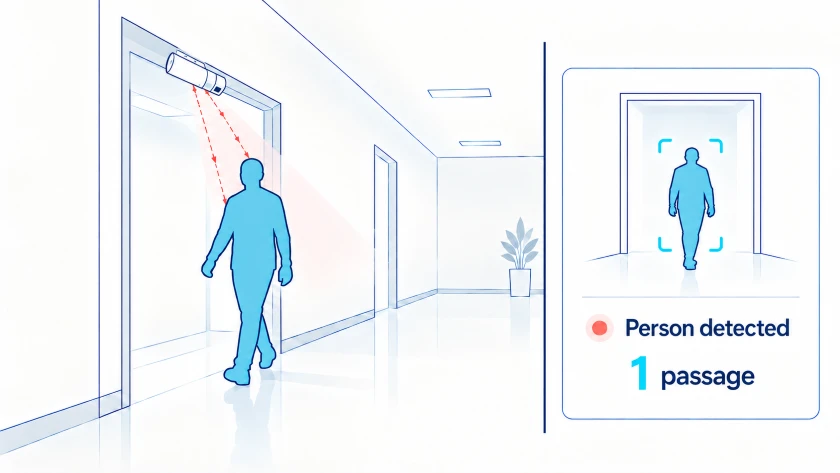
ToF measures distance with infrared light
A ToF sensor sends infrared light into a space and measures its return to estimate distance. Direct ToF measures travel time; indirect ToF uses the phase shift of modulated light. A single-point sensor reports a distance within one sensing area. In a multi-zone sensor, each pixel or zone reports its own distance, creating a depth map of the objects in view. That map supplies position and shape without capturing a conventional color image or reconstructing depth from one—offering far more precise spatial context than traditional passive infrared detectors (learn more about ToF vs PIR differences).
Because ToF provides its own infrared light, it can measure in dark corridors and entrances without additional visible lighting. That can simplify installation in indoor areas where extra lighting is impractical. Strong ambient infrared, including direct sunlight, can still reduce the usable range of some devices, so placement matters.
Cameras turn images into counts with software
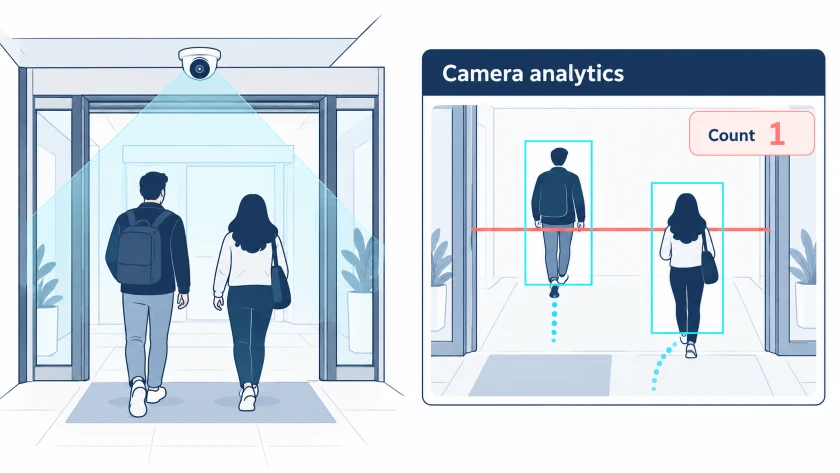
A conventional camera captures two dimensional images, which software must turn into a count. An object detector such as YOLO finds people in each frame. A tracker such as Deep SORT links those detections over time, allowing the system to count crossings of a defined line or estimate how many people remain in an area.
That visual detail is valuable when teams need footage or analysis of movement, crowding, or falls. If the job is simply to report a count or occupied status, it also brings more to consider: 조명, visual overlap, image access, and retention. Edge AI can reduce the video sent or stored, but the camera still captures images and runs processing on the device. Its value is strongest where the additional visual information will actually be used.
mmWave radar reads reflected radio waves
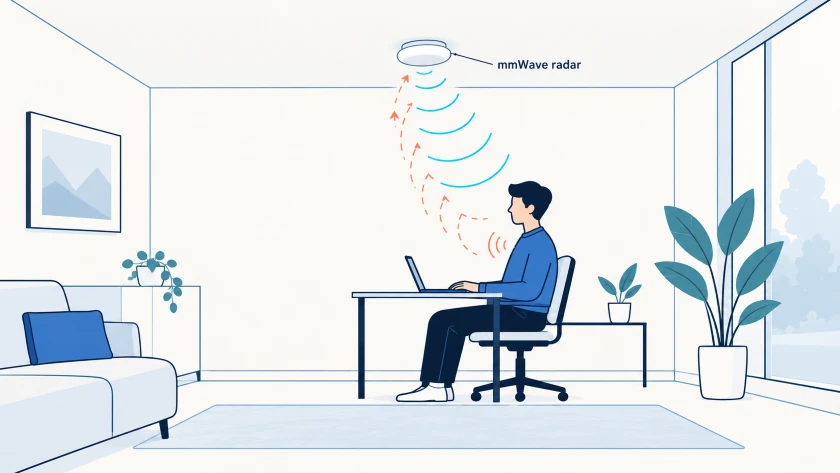
밀리미터파 레이더 operates in the 30 에게 300 GHz range. It analyzes reflected signals to estimate where people are and how they move: timing helps establish distance, Doppler changes reveal radial speed, and antenna processing adds angle information. The resulting point cloud or detected targets provide spatial and motion data without recording a conventional image.
Radar works without visible light and, with suitable processing, can detect small movements such as breathing when a seated person appears still to a basic motion sensor. Specialized systems can detect chest movement associated with a heartbeat, while other systems monitor falls in care settings. Some radar devices also work behind suitable nonmetallic materials, including certain plastics, 목재, 유리, or drywall.
Privacy in Indoor Occupancy Monitoring
Where a team only needs to know whether a room or stall is occupied, ToF and radar can provide that signal without recording recognizable faces, 의류, or video. That narrower output is particularly useful in offices, changing areas, and restrooms. A camera is still valuable when the task requires footage or visual analysis, but it introduces image handling into an otherwise simple occupancy workflow.
The difference continues after installation. Local processing and quick deletion can reduce stored footage, yet a camera still captures images and needs clear rules for access and retention. With ToF or radar, teams can keep the output close to the operational question, such as occupied or available, and limit how long those records are stored. That approach supports GDPR principles on data minimization and storage.
How ToF, 카메라, and Radar Handle Busy Entrances
At a busy doorway, people may pass side by side or closely follow one another. A multi-zone ToF system gives counting software depth and height cues that can help separate people whose outlines overlap in a flat image. With suitable resolution, those cues may also help distinguish a person from a cart or avoid missing a child. Mounting height and coverage still need to give the sensor a clear view of the passage.
A camera can also count well with a stable view and suitable lighting. At a strongly backlit entrance or in tightly packed traffic, people can become harder to detect consistently across frames. Those scenes may call for a different camera angle, additional lighting, or software tuning.
Radar continues to sense when visible light changes and can work in some smoky or dusty settings where an optical view is difficult. For a busy entrance, a radar system built for counting can combine range and angular resolution to distinguish people crossing at the same time.
Comparing ToF, 카메라, and mmWave Radar
| 고려 사항 | ToF 센서 | Conventional camera | 멍청아 |
| 작동 원리 | Infrared light returns from surfaces to measure distance. | Images are analyzed to detect people and count crossings. | Reflected radio waves provide range, 속도, 그리고 각도. |
| Data output | A distance reading from a single-point sensor, or a depth map from a multi-zone sensor. | 2D images or video. | 범위, 속도, 그리고 각도; processed data may include a point cloud. |
| 은둔 | Reports distance or depth without recording recognizable video. | Captures images that may identify people and need careful handling. | Reports motion and position without recording recognizable video. |
| People counting | Multi-zone depth can help separate nearby people when resolution and placement suit the doorway. | Can count accurately with a clear view and suitable software; lighting and occlusion matter. | Dedicated systems can count multiple people; separation of close targets needs testing. |
| Lighting | Works without visible light; strong ambient infrared may reduce range. | A standard camera needs suitable light or additional low-light equipment. | Works independently of visible light. |
| Site interference | Shadows have little effect, but sunlight and blocked views can interfere. | Glare, 그림자, and blocked views can affect detection. | Can operate in some dusty or smoky settings; clutter and mounting materials still matter. |
| Spatial detail | Multi-zone models provide sampled depth; single-point models do not map a scene. | A standard camera is 2D; stereo or depth cameras can provide depth. | Some systems produce 3D point clouds if they also measure elevation. |
| 처리 | Counts still require software to distinguish people and determine crossing direction. | Image detection, crossing analysis, and video handling need processing. | Signal processing and counting multiple people require computing resources. |
| 설치 | Ceiling mounting can cover a defined area when range and field of view fit. | Needs an unobstructed view and suitable lighting. | Can sit behind a tested nonmetallic cover if coverage remains adequate. |
| Typical uses | Desk or stall occupancy; entrance counts with a suitable multi-zone system. | Security footage, visual analysis, and entrance counts. | Presence sensing, discreet installations, and dedicated people counting or fall monitoring. |
Match the Tech to the Use Case
부엌. ToF can report whether a desk, seat, or defined meeting area is occupied without capturing video. That simple signal helps facilities teams identify unused reservations and plan space use. When connected to suitable building controls, it can also inform lighting and heating or cooling schedules.
소매. At an entrance, a multi-zone ToF system built for counting can use depth to help distinguish visitors passing close together without recording their images. Foot traffic trends can inform staffing, while area occupancy trends can guide display and product placement decisions if sensors cover the relevant area. A fitting room may need only a private occupied or available signal.
Public spaces. 도서관, 역, and exhibition venues can use entrance counts and area occupancy to identify demand and crowded periods. Multi-zone ToF or radar systems designed for counting can provide these measurements without a continuous video feed or visible lighting.
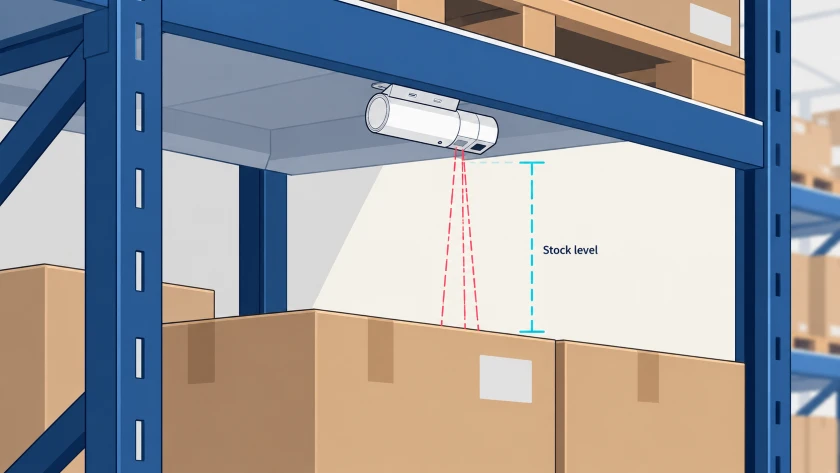
Industry and warehouses. ToF distance sensing can monitor shelf and stock levels, 근접성, or activity in a defined zone. Radar can help where airborne dust or a discreet mounting position makes an optical view impractical. Forklift collision warnings and production line safety functions need purpose-built systems and validation.
Cameras are the better fit when security footage, visual behavior analysis, or customer insights from images are needed. Purpose-built mmWave radar systems suit presence sensing, fall monitoring in care settings, and discreet mounting. For indoor entrances that need reliable counts without recognizable images, a well-positioned multi-zone ToF system is a strong first option, balancing depth detail, 은둔, and operation without visible light. The best choice still depends on the required output and a test at the actual site.
How to Choose an Indoor People Counting System
Choose the output first: occupied status, entrance counts, a live headcount, movement data, or footage. Then weigh privacy, 현장 조건, counting errors, 그리고 총 비용.
1. Start with privacy
In restrooms, changing areas, and similar spaces, ToF or mmWave can report occupancy without recognizable footage. Choose a camera where images are necessary for security or visual analysis and appropriate to capture. For every system, define who can access the data and when it is deleted.
2. Check lighting and installation
ToF and radar need no visible light, making them useful at dim or backlit entrances. Multi-zone ToF suits a defined passage if its range, 시야, and placement cover people walking close together; strong ambient infrared and blocked views still need checking. Radar can work behind suitable nonmetallic covers or where dust hinders an optical view, but placement matters. Cameras also need a suitable view and illumination, although specialized systems can handle challenging scenes. If doorway counts determine occupancy in a large space, cover every entrance and exit.
3. Define the accuracy you need
Distance accuracy is not people-counting accuracy. Multi-zone ToF depth helps counting software distinguish close walkers, while dedicated radar and camera systems can also count several people. Radar is useful when small movements matter more than a count. Set acceptable missed and false count rates, then test with close followers, 어린이들, carts, and stationary occupants where relevant.
4. Compare total cost
Compare hardware, 설치, 힘, 소프트웨어, 처리, 저장, 유지, and integration with a building or retail system. ToF depth data can avoid video storage when the job needs only a count or occupancy signal. Overall cost still depends on coverage and the software needed, so compare systems against the same output and accuracy targets.
For an indoor entrance that needs reliable counts without identifiable images, a purpose-built multi-zone ToF system is a strong starting point. Compare its results with checked manual counts during peak traffic before a wider rollout.
 지금 채팅
지금 채팅